Key Points
- By combining direct imaging and radial velocity observations from ground-based telescopes with precise astrometric acceleration data from a space telescope, the team discovered a companion orbiting a nearby red dwarf (about 55 light-years from Earth) and determined its mass (about 60 times that of Jupiter) and orbital semi-major axis (about 4.3 astronomical units) with high precision.
- This achievement was made possible by integrating radial velocity monitoring from the Subaru Telescope’s Infrared Doppler instrument (IRD) as part of the IRD Strategic Program (IRD-SSP), high-contrast imaging with the Keck Telescope, and astrometric data from the Gaia telescope.
- The newly detected companion is inferred to be a late-T-type brown dwarf and exhibits about 30% variability in near-infrared brightness, making it a promising “benchmark object” for future studies of atmospheric clouds and circulation.
- While previous methods combining Hipparcos and Gaia astrometric acceleration with direct imaging have been used to detect and constrain the masses of companions, this study represents the first successful application of Gaia-only acceleration data to a faint nearby red dwarf system, beyond Hipparcos’ detection limits, resulting in the precise characterization of a brown dwarf companion.
Results:
M dwarfs, or red dwarfs, are the most common type of star in our galaxy, accounting for more than half of all stars in the Milky Way. These small, cool stars are key targets for understanding the processes of stellar and planetary formation and evolution. However, because M dwarfs are intrinsically faint, detailed observations have historically been limited, and early surveys suggested that more than 70% of them were single stars. Recent advances in observational techniques, however, have revealed that this picture was incomplete: the frequency of low-mass stellar and substellar companions, such as brown dwarfs, may have been significantly underestimated. Understanding how often such companions occur—and their mass distribution—is essential for distinguishing the similarities and differences between planet formation and star formation.

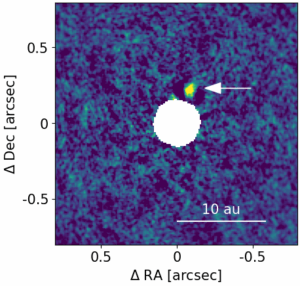
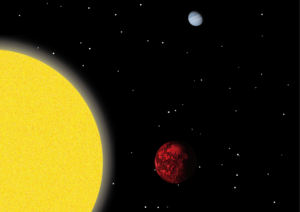
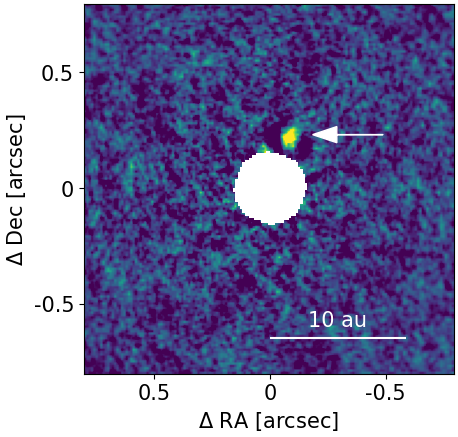
An international research team led by the Astrobiology Center, California State University Northridge, and Johns Hopkins University has now discovered a brown dwarf companion, J1446B, orbiting the nearby M dwarf LSPM J1446+4633 (hereafter J1446), located about 55 light-years from Earth (Figure 1). J1446B has a mass of about 60 times that of Jupiter and orbits its host star at a distance roughly 4.3 times the Earth–Sun separation, completing one orbit in about 20 years. Remarkably, near-infrared observations revealed brightness variations of about 30%, suggesting dynamic atmospheric phenomena such as clouds or storms.
The key to this discovery was the combination of three complementary observational techniques: (1) radial velocity measurements from long-term infrared spectroscopic monitoring with Subaru’s IRD instrument, (2) high-resolution near-infrared imaging with the W. M. Keck Observatory using advanced adaptive optics with a pyramid wavefront sensor, and (3) precise astrometric acceleration measurements from the Gaia mission. By integrating these datasets and applying Kepler’s laws, the team was able to determine the dynamical mass and orbital parameters of J1446B with unprecedented accuracy (Figure 2). Radial velocity data alone cannot break the degeneracy between mass and orbital inclination, but adding direct imaging and Gaia astrometry resolves this ambiguity. The Subaru IRD-SSP program provided essential RV data, while Keck’s state-of-the-art adaptive optics enabled the direct detection of the companion at a very small separation from its host star.
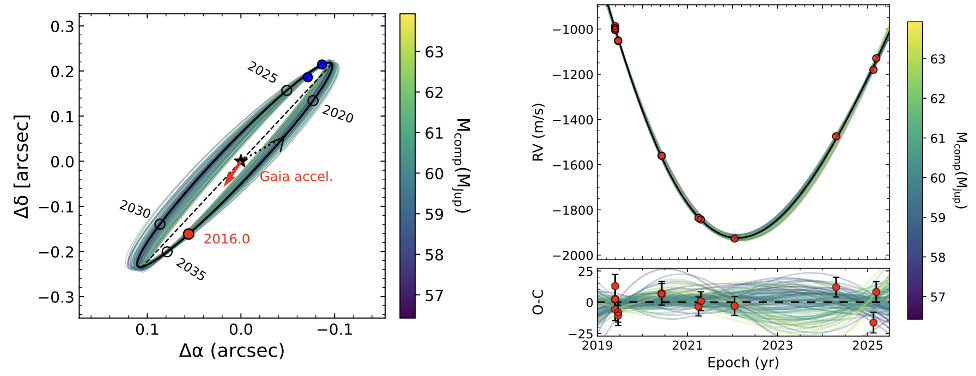
Previous studies have demonstrated the power of combining Hipparcos and Gaia astrometric acceleration with direct imaging to detect and characterize companions. However, Hipparcos was unable to measure the positions of faint red dwarfs like J1446. This study is the first to apply Gaia-only acceleration data to such a system, successfully constraining the orbit and dynamical mass of a brown dwarf companion.
This discovery provides a critical benchmark for testing brown dwarf formation scenarios and atmospheric models. Future spectroscopic observations may even allow researchers to map the weather patterns of this intriguing object. The result highlights the power of combining ground-based and space-based observatories to uncover hidden worlds beyond our solar system.
“Direct Imaging Explorations for Companions from the Subaru/IRD Strategic Program II; Discovery of a Brown-dwarf Companion around a Nearby Mid-M-dwarf LSPM J1446+4633” by Uyama et al. (DOI: 10.3847/1538-3881/ae08b6).
Research Funding:
This research was supported by JSPS KAKENHI (Grant Numbers: 24K07108, 24K07086).[1] The development and operation of IRD were supported by JSPS KAKENHI (Grant Numbers: 18H05442, 15H02063, and 22000005).
Notes:
*1: Brown dwarfs typically have masses between about 13 and 80 times that of Jupiter and cannot sustain hydrogen fusion like stars. They are sometimes referred to as “failed stars” in popular science, but their formation processes remain poorly understood. Like gas giants such as Jupiter, they cool over time, making them important targets for studies of planet formation.
*2: This refers to an observational technique that uses the Doppler effect: the motion of a star causes shifts in its spectral lines, which can be measured to detect companions.
*3: The Subaru Telescope and the Keck Telescope are large-aperture (8 – 10 m class) observatories located at the summit of Maunakea on the island of Hawai‘i.
*4: The Gaia spacecraft, launched in 2013, is an astrometric mission designed to create a detailed 3D map of stars in the Milky Way. Its extremely precise positional measurements enable the detection of companions and planets through the astrometric method, which relies on subtle stellar motions. Hipparcos, launched in 1989, was Gaia’s predecessor and provided the first space-based astrometric catalog.
Publication Information:
Journal: The Astronomical Journal
Title: Direct Imaging Explorations for Companions from the Subaru/IRD Strategic Program II; Discovery of a Brown-dwarf Companion around a Nearby Mid-M-dwarf LSPM J1446+4633
Authors: Uyama, T.; Kuzuhara, M.; Beichman, C.; Hirano, T.; Kotani, T.; An, Q.; Brandt, T. D. et al.
DOI: 10.3847/1538-3881/ae08b6
Related links:
Subaru telescope, NAOJ, October 20, 2025 Press release
W. M. Keck Observatory, October 20, 2025 Press release