Key Points:
- Using the 8-meter telescope (VLT) at the European Southern Observatory, astronomaers have caught the protoplanet AB Aurigae b in the act of gathering material from its surrounding disk.
- The light spectrum from the planet looks similar to that seen in young stars actively accreting material, marking the first direct evidence of mass falling onto a protoplanet.
- This discovery provides strong support that AB Aurigae b is one of the youngest protoplanets ever observed, still embedded within its birth disk.
Abstract:
Small rocky planets like Earth, which can harbor life, and giant gas planets like Jupiter are born around stars like the Sun. Their birthplace is a thin, disk-shaped structure of gas and dust known as a protoplanetary disk. Protoplanetary disks are observed not only around Sun-like stars but also around more massive or lighter young stars. Since the 2010s, their detailed structures have been revealed by 8-meter class telescopes such as the Subaru Telescope (in visible and infrared light) and the ALMA Observatory (in radio wavelengths).

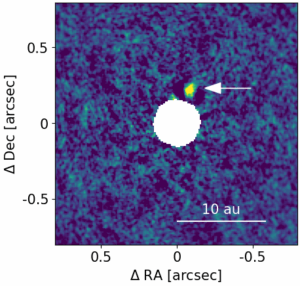
Although many planets have been inferred indirectly from fine structures in these disks—such as gaps or spiral arms—directly capturing newly formed planets (protoplanets) within the disks has so far been achieved only in a few cases, including PDS 70 b and c and AB Aurigae b (AB Aur b). This is thought to be because most protoplanets are embedded within the disk, and become more visible only when they carve gaps in the disk or are observed from directly above. Protoplanets are also considered to be actively gathering material from the surrounding disk as they grow. However, detailed spectroscopic observations of this mass accretion from an embedded disk have, until now, been limited to the PDS 70 system.

In the present study, an international team of researchers led by the Astrobiology Center (Japan) and the University of Texas at San Antonio (USA) succeeded in detecting hydrogen emission lines from AB Aur b using the multi-object spectrograph MUSE mounted on the VLT. These emission lines are interpreted as evidence of mass accretion from the circumplanetary disk onto the protoplanet.
Background:
Since the first discovery of planets beyond the Solar System in 1995, more than 6,000 exoplanets have been identified. Many of these planets have properties that differ significantly from the eight planets in our Solar System. How are such diverse exoplanets formed and evolved, and which of them could potentially become Earth-like planets capable of supporting life? To address these questions, it is essential to observe young planets in the very act of forming in their birthplaces. However, due to observational challenges, direct observations of planets only a few million years old have been extremely limited.
Small, rocky planets like Earth, which can harbor life, and giant gas planets like Jupiter are born around stars similar to the Sun. Their birthplace is a thin, disk-shaped structure of gas and dust known as a protoplanetary disk. Protoplanetary disks are found not only around Sun-like stars but also around both more massive and less massive young stars. Since the 2010s, their detailed structures have been revealed through observations with 8-meter class telescopes such as the Subaru Telescope and with the ALMA Observatory.
While numerous planets have been inferred indirectly from fine structures in these disks—such as gaps or spiral arms—directly capturing newly formed young planets (protoplanets) within the disks has so far been achieved only in a few cases, including the ~4-million-year-old PDS 70 b and c and the ~2-million-year-old AB Aurigae b (AB Aur b). The latter was discovered with the Subaru Telescope in 2022 (Note 1). This limited success is thought to result from the fact that most protoplanets are embedded within the disk, becoming more visible only when they carve gaps in the disk or are observed from directly above.
Protoplanets are also considered to be actively gathering material from the surrounding protoplanetary disk as they grow. However, there have been no detailed spectroscopic observations of mass accretion from the embedded disk onto a protoplanet to date.
Findings:

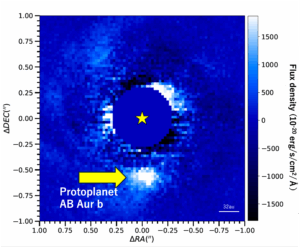
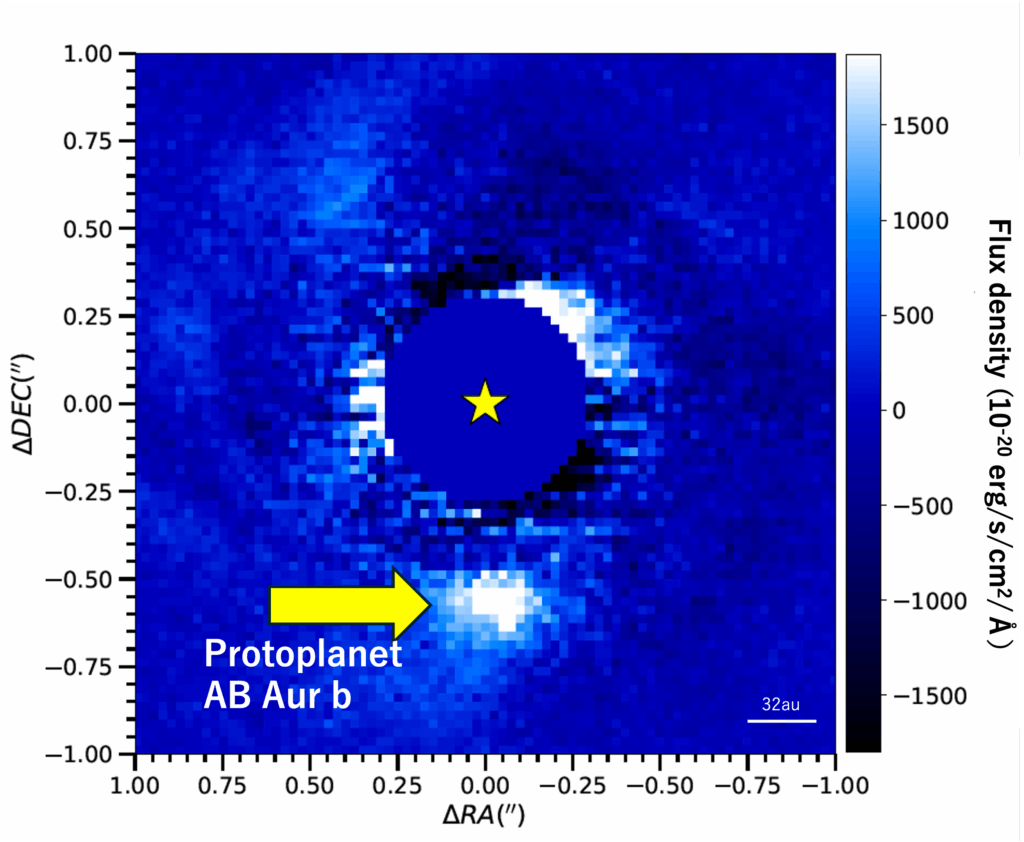
An international team of researchers led by the Astrobiology Center (ABC), the University of Tokyo, National Astronomical Observatory of Japan (NAOJ), Kogakuin University, the University of Texas at San Antonio, and Peking University has successfully detected hydrogen emission (Hα line) from the protoplanet AB Aurigae b (AB Aur b) using the MUSE spectrograph on the VLT. This emission is interpreted as material falling onto the circumplanetary disk around the protoplanet (Figure 1).
Hydrogen emission is commonly observed around young stars and their protoplanetary disks. In the present case, the emission comes from material accreting onto the small disk surrounding the still-embedded protoplanet. Using MUSE, which allows high-resolution spectroscopic imaging of extended structures, the team was able to separate emission from the protoplanet and the protoplanetary disk. The high spatial (0.3 arcseconds) and spectral resolution (λ/Δλ ~ 3000) of MUSE under excellent Chilean seeing conditions made this possible.
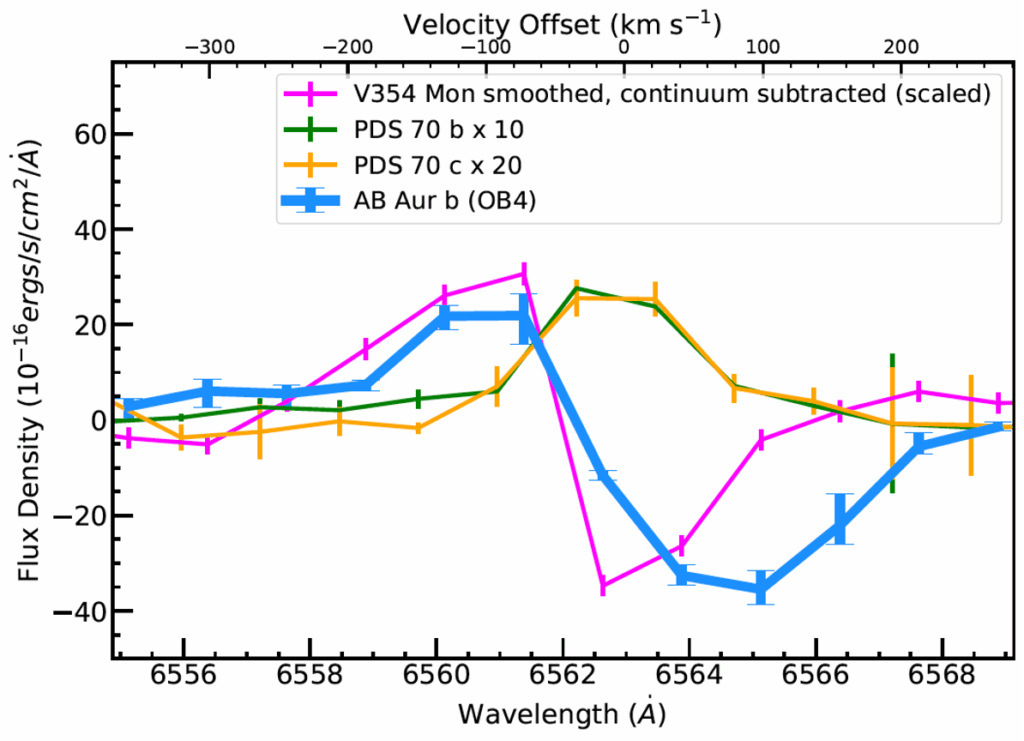
The detected Hα emission at the position of AB Aur b shows an inverse P Cygni profile (Note 2), similar to that seen in young stars (T Tauri stars; Note 3, see figure 2) undergoing mass accretion. To date, AB Aur b is the only protoplanet with this type of emission. Its young age (~2 million years) and the large amount of surrounding material strongly support that AB Aur b is a protoplanet still in formation. Previously, only PDS 70 b and c showed Hα emission, but those planets are located in disk gaps; AB Aur b is still embedded in the disk, making this the first such observation with the infalling signature.
AB Aur b is about four times the mass of Jupiter (Note 4) and orbits at 93 AU from its star. Such a distant giant planet does not exist in the Solar System. Standard planet formation models cannot fully explain its formation so far from the star, before migration occurs. This discovery supports a scenario where massive planets can form via gravitational instability within the disk, providing insight into a type of giant planet not seen in our Solar System.
The results were published on September 2, 2025, in The Astrophysical Journal Letters (Currie et al., “Images of Embedded Jovian Planet Formation at a Wide Separation around AB Aurigae”).
Notes:
Note 1: For the discovery of the protoplanet around AB Aurigae using the Subaru Telescope, and for detailed observations of its surrounding protoplanetary disk with complex structures, please refer to the press releases from the Astrobiology Center and the Subaru telescope, NAOJ, on April 5, 2022, and from the Subaru telescope, NAOJ, on February 17, 2011.

Note 2: Inverse P Cygni profile: The term "P Cygni profile" refers to a characteristic spectrum seen in the star P Cygni, in which an emission line and an adjacent absorption line appear next to each other, indicating large amounts of gas being ejected from the stellar surface. An inverse P Cygni profile is the opposite pattern, where the order of the emission and absorption lines is reversed. This profile is also observed in T Tauri stars (see Note 3) undergoing gas accretion onto their surfaces.

Note 3: T Tauri stars: Young stars that have formed within a gas cloud and have cleared enough of the surrounding gas to be observed in visible light. Some are still accreting material from the surrounding gas. The name comes from the prototype T Tauri star in Taurus, which was first reported as a new variable star in 1945.

Note 4: Considering observational uncertainties, the mass of AB Aur b is estimated to be roughly 4–9 times that of Jupiter.
Paper Info.:
Journal:The Astrophysical Journal Letters
Title:“VLT/MUSE Detection of the AB Aurigae b Protoplanet with Hα Spectroscopy”
Author :T. Currie et al.
DOI: 10.3847/2041-8213/adf7a0