―The planetary system HD 110067 where all adjacent planets have orbital periods in exact integer ratios―
Key Points of the Announcement:
- Global collaborative observations using space telescopes and ground-based observatories have led to the discovery of six transiting planets around the star HD 110067, located approximately 100 light-years away from the solar system.
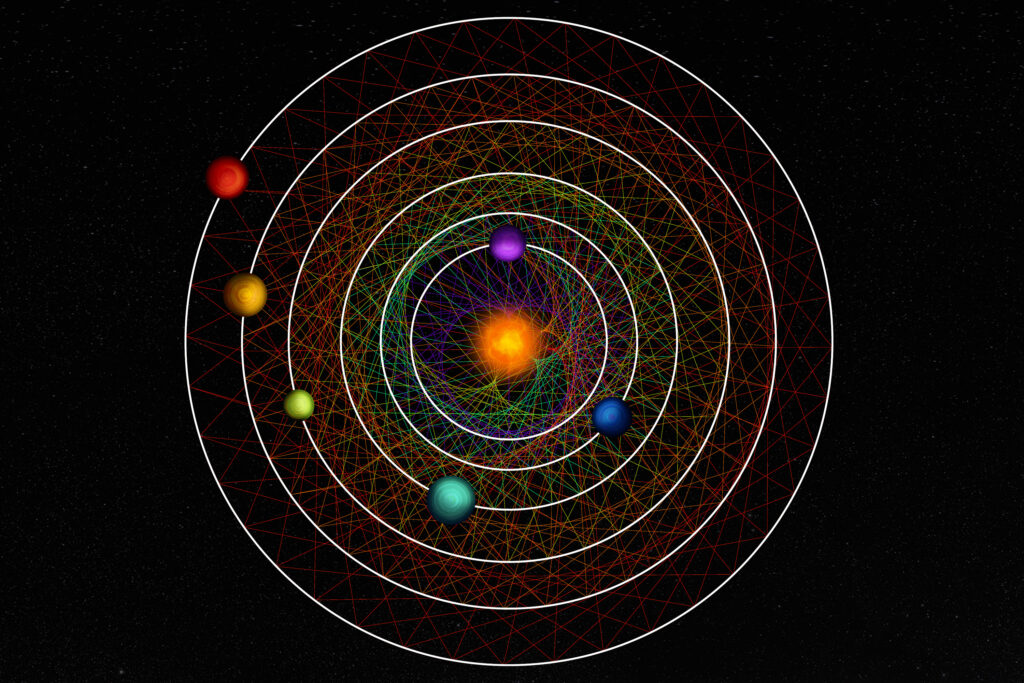
- These six planets exhibit a commensurability where all adjacent planets have orbital periods that are expressed in simple integer ratios.
- This planetary system is unique by providing valuable insights into how planets form and evolve. Observing the atmosphere of each planet will expectedly lead to the understanding of processes of planetary atmospheric acquisition and the influence of stellar radiation on atmospheric dissipation and chemical evolution.
Overview:
An international research team, including Professor Norio Narita (Visiting Professor at the National Institutes of Natural Sciences Astrobiology Center) from the Graduate School of Arts and Sciences at the University of Tokyo, and Project Assistant Professor Akihiko Fukui, along with the MuSCAT team, discovered six transiting planets around the star HD 110067 through collaborative observations using space telescopes and ground-based observatories.
These six planets exhibit a relationship where all adjacent planets have orbital periods that are expressed in simple integer ratios (commensurability). This gives clues to how planets formed and migrated within a protoplanetary disk. Additionally, observing the atmospheres of these planets in the future will expectedly lead to the understanding of processes of planetary atmospheric acquisition and the influence of stellar radiation on atmospheric dissipation and chemical evolution.
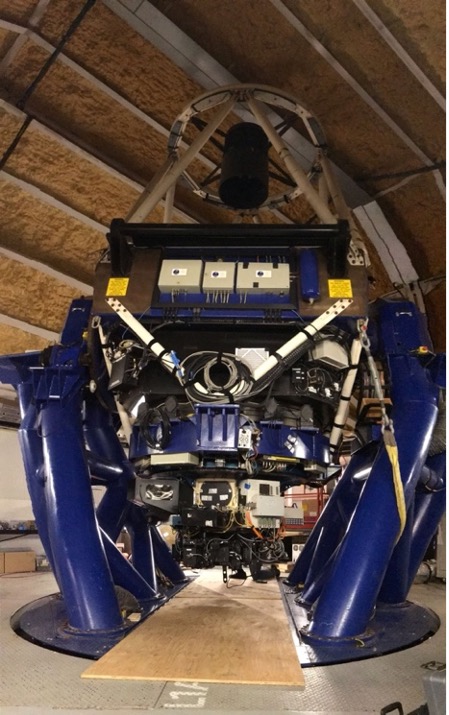
This discovery was realized through collaborative observations using the Transiting Exoplanet Survey Satellite (TESS) by NASA, the CHaracterising ExOPlanets Satellite (CHEOPS) by the European Space Agency (ESA), and multiple ground-based telescopes including the multi-color simultaneous imaging cameras MuSCAT2 and MuSCAT3 developed by the MuSCAT team.
The research findings will be published in the scientific journal “Nature” on November 29, 2023 (British time).
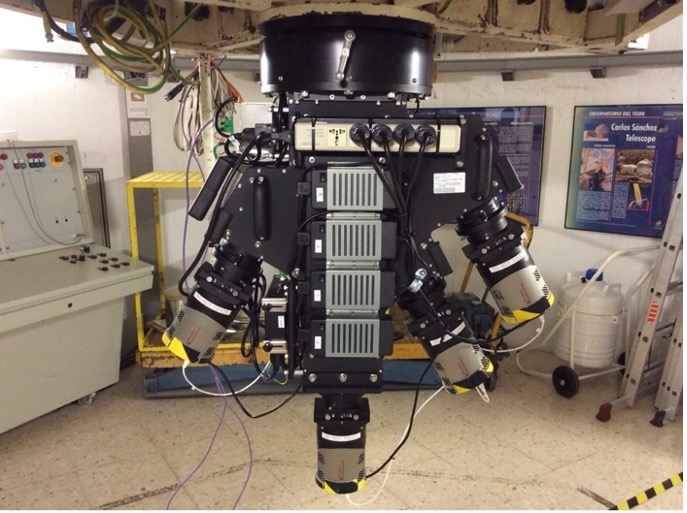
(credit: MuSCAT team)
Announcements
HD 110067, a star with about 80% of the mass and radius of the Sun, is located about 100 light years away in the direction of the constellation Camelopardalis. The star was observed by NASA’s TESS to monitor its brightness change for about 27 days each in March-April 2020 and February-March 2022; the TESS observations revealed that the transit-induced dimming occurred with a period of about 9.11 and 13.67 days, respectively. However, there were many other transit-like dimming events in the TESS data, and it was not known how many transit planets there were around this star or what the period of each planet was. The international research team worked to solve this mystery through hypothesis based on consideration and verification by observation.
The research team first focused on the shape of the transit (depth and duration of dimming). This is because transits by a given planet have the same shape each time. The team found that there were two pairs of transits with the same shape in the TESS data, one observed in 2020 and the other in 2022. However, the period is not necessarily two years, since TESS did not observe the periods between about two years. The time interval between two transits observed about 2 years apart divided by a natural number is a candidate for the true period. Observations made by ESA’s CHEOPS during the times of transits predicted by these candidate cycles confirmed that one of the two transits occurred with a period of about 20.52 days.
If you look closely at the periods of the three confirmed planets (9.11, 13.67, and 20.52 days), you will notice that the period ratios of the neighboring planets are simple integer ratios of 2:3, respectively. Such a simple integer ratio of periodicities of celestial bodies orbiting the same celestial body is called an “exhaustive relationship. For example, Neptune and Pluto have an orbital period ratio of 2:3, and Jupiter’s satellites Io, Europa, and Ganymede have an orbital period ratio of 1:2.
Considering the fact that there are three planets with such an exhaustive relationship from the viewpoint of planet formation, it is thought that at the time of formation of this planetary system, multiple planets were trapped in orbits of mean-motion resonance (Note 3) with an exhaustive relationship with each other and migrated to their current orbits while maintaining this relationship within the protoplanetary disk. Then, it is natural to assume that the remaining transiting planets’ periods also have an exhaustive relationship with each other. Therefore, the research team considered that the true period of the other transit, which was observed about two years apart, has an exhaustive relation to the period of about 20.52 days, i.e., the time interval between the two observed transits divided by a natural number has a simple integer ratio of about 20.52 days. We then found a period of about 30.79 days as the only solution that satisfies such a condition.
Even after the cycles of the four planets were identified, two transits remained in the 2022 TESS data, each with a different shape. Since each of these two had only one transit, the true period was not known. The research team therefore considered 50 different scenarios, assuming that the period of the fifth planet has an exhaustive relationship to the period of the fifth planet, which is approximately 30.79 days, and that the period of the sixth planet has an exhaustive relationship to the period of the fifth planet. Specifically, we considered five scenarios with period ratios of 1:2, 2:3, 3:4, 4:5, and 5:6, and two scenarios with the two observed transits not knowing whether they were the fifth or sixth planet, respectively. From these scenarios, based on the absence of transits in the existing TESS data and on astrodynamic considerations, the research team concluded that the period of the fifth planet is about 41.06 days, which is 3:4 compared to about 30.79 days, and the period of the sixth planet is about 54.77 days, which is 3:4 compared to the period of the fifth planet The sixth planet’s period is about 54.77 days, which is 3:4 relative to the fifth planet’s period.
The MuSCAT team participated in this campaign and accurately captured the beginning of the transit with MuSCAT2 on Tenerife Island, Spain, and the end of the transit with MuSCAT3 on Maui Island, USA (Figure 3). The MuSCAT team participated in this campaign and accurately captured the beginning of the transit at MuSCAT2 in Tenerife, Spain, and the end of the transit at MuSCAT3 in Maui, USA (Figure 3). The transit was a challenging observation with a depth of attenuation of only about 0.1%, a transit duration of more than 5 hours, and a large forecast error. The collaboration between MuSCAT2 and MuSCAT3, which are mounted on time-delayed telescopes, demonstrated its great power. This campaign observation confirmed that the period of the fifth planet is about 41.06 days.
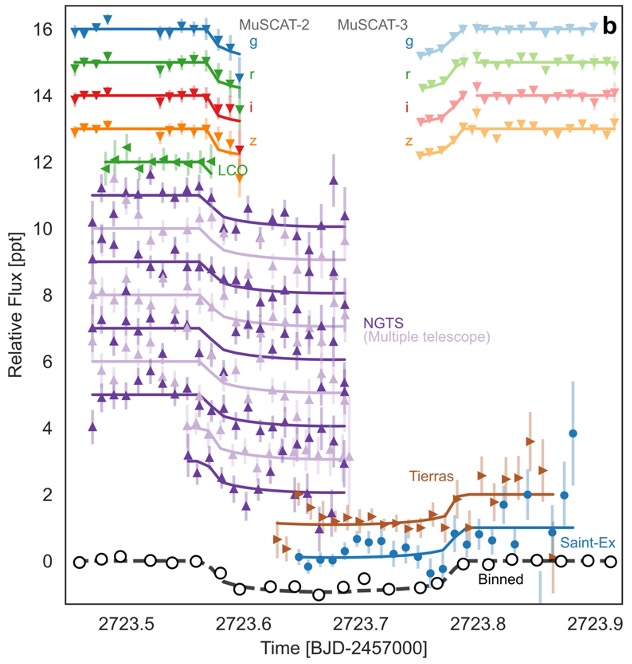
The abscissa is the Julian day minus 2457000 (in days), with noon on January 1, 4713 BC as 0. The vertical axis is the time variation of the relative brightness of HD 110067, in units of 0.001 ppt (0.1%). The data for each telescope are plotted vertically shifting by 1 ppt. The top four are the MuSCAT2 and MuSCAT3 data observed in four colors. For these data, a model that considered that no transit was occurring was compared with a model that considered that a transit was occurring using the WAIC (Watanabe-Akaike Information Criterion).
The other is the analysis of TESS data from 2020, which was not included in the analysis, because scattered light from the Moon and the Earth can be mixed into the observation field of view depending on the observation direction and time of year, and such data is highly noisy. Although such data are acquired, they are not usually analyzed. However, the research team thought that if the above hypothesis was correct, the transits of the fifth and sixth planets should be included in the 2020 TESS data, so they analyzed the data that had been excluded from the analysis. In fact, the team confirmed that the transits were at the times predicted by the hypothesis.
As described above, the research team solved the mystery of the complex transit observed by TESS based on the hypothesis and verification, and revealed that HD 110067 is a sextuplet planetary system in which the orbital periods of all neighboring planets are in an euclidean relationship. The existence of a seventh planet and beyond has not yet been confirmed, but its existence has not been ruled out, and further exploration is expected to continue. The radii of the six planets are 1.9 to 2.9 times that of the Earth, suggesting that they are not rocky planets like the Earth, but rather small Neptune-like planets with hydrogen atmospheres (Neptune’s radius is about four times that of the Earth).
By 2023, more than 5,000 exoplanets have already been discovered, but only a handful of planetary systems like HD 110067, with three or more planets in an ectoparallel relationship, have been discovered. Such planetary systems provide clues for deeper theoretical consideration of how planets formed and migrated within the protoplanetary disk. HD 110067 is also the brightest star of the five or more transit planets discovered around the same primary star. Transit planets orbiting a bright star are suitable for atmospheric observations, and moreover, the presence of multiple transit planets in the same planetary system makes it possible to observe and compare the atmospheres of these planets. Therefore, this sextuplet will be an excellent target for planetary atmospheres in the future, and is expected to allow us to study how the exoplanets acquired their atmospheres in the protoplanetary disk and how light from the star affected the dissipation and chemical evolution of the planetary atmospheres.
○Related information :
Press Release (1): Discovery of an Earth-Size Planet with Possible Volcanic Activity – Exoplanet LP 791-18d Heated by Tidal Forces (2023/05/18)
Press Release (2): Discovery of Super Earths in the Habitable Zone” (2022/09/07)
Press Release (3): Discovery of an Earth-like Exoplanet Suitable for Detailed Atmospheric Studies” (2021/03/05)
https://www.c.u-tokyo.ac.jp/info/news/topics/files/20210305naritanosobun01.pdf
research grant
This research was supported by the Japan Society for the Promotion of Science (JSPS) Grants-in-Aid for Scientific Research (KAKENHI: project number JP18H05439), Japan Science and Technology Agency (JST) CREST (project number JPMJCR1761), and National Institutes of Natural Sciences Astrobiology Center Satellite (project number AB The research was supported by the Japan Science and Technology Agency (JST) CREST (JPMJCR1761) and the National Institutes of Natural Sciences Astrobiology Center Satellite (AB022006).
用語解説
(Note 1)MuSCAT team
Professor Narita and Assistant Professor Fukui have developed the MuSCAT series of multi-color simultaneous imaging cameras that can simultaneously observe transits in three or four wavelength bands for the 188 cm telescope in Okayama Prefecture, Japan; the 1.52 m telescope in Tenerife, Spain; the 2 m telescope in Maui, USA; and the 2 m telescope in New South Wales, Australia. The MuSCAT is a Multicolor Simultaneous Camera for studying MuSCAT stands for Multicolor Simultaneous Camera for studying Atmospheres of Transiting exoplanets, named after the famous Muscat fruit of Okayama Prefecture.
(Note 2)transiting planets
When an exoplanet passes in front of its host star, the apparent brightness of the host star dims slightly. This phenomenon is called transit, and a planet with an orbit that causes a transit is called a transit planet.
(Note 3)Exhaustive number relations and mean kinetic resonance
The period of revolution or rotation of two celestial bodies should be a simple integer ratio. When the orbital periods of two celestial bodies have an exhaustive relationship, they are said to be in a state of mean-motion resonance. When the orbital periods of two objects have an exhaustive relationship, they are said to be in mean motion resonance.
(Note 4)TESS(Transiting Exoplanet Survey Satellite)
TESS is NASA’s satellite program to search for exoplanets by transit, designed by researchers at the Massachusetts Institute of Technology.TESS was launched on April 18, 2018, and has carried out a two-year plan to search for transit planets in nearly the entire sky. A second extension plan is currently underway, which will continue observations until at least 2024. In the five years to date, TESS has discovered more than 6,000 transit planet candidates.
(Note 5)CHEOPS(CHaracterising ExOPlanets Satellite)
CHEOPS is a space telescope dedicated to the observation of transit planets, conceived by Swiss researchers and launched by ESA on December 18, 2019. The main objective is to observe transits of known transit planets with high precision and to determine with high accuracy the time at which the transit occurred and the radius of the planet. Originally planned for 3.5 years, the first extension plan has been approved and observations will continue until at least 2026.
論文情報
Journal:Nature
Title:A resonant sextuplet of sub-Neptunes transiting the bright star HD 110067
Authors:Rafael Luque*, Hugh P. Osborn, Adrien Leleu, et al. including Norio Narita and John H. Livingston
DOI:10.1038/s41586-023-06692-3
URL:https://www.nature.com/articles/s41586-023-06692-3