(Credit: Astrobiology Center)
Abstract:
Recently, red dwarfs (M-type stars), which are low-temperature stars with less than half the mass of the Sun, have been attracting attention as targets for the search for habitable planets that can harbor life like the Earth. Many of the stars close to the Sun are red dwarfs, and it is hoped to observe signs of life (biomarkers) on such planets in the near future.
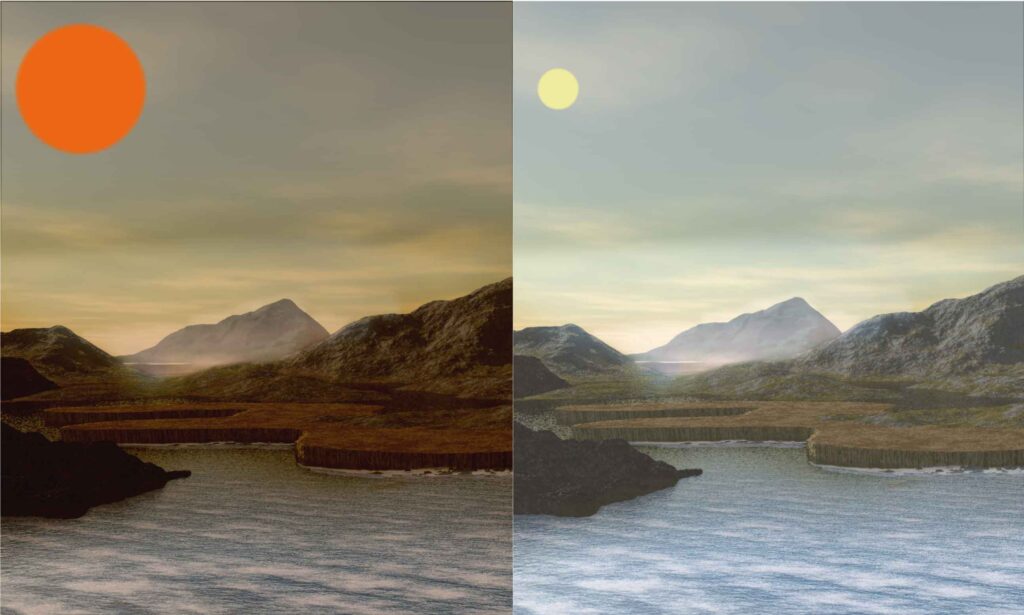
One promising biomarker for exoplanets is the reflectance spectrum called the red edge, which is produced by vegetation on land. However, since the position of the red edge (wavelength of about 0.7 μm) is determined by the wavelength of light used by vegetation for photosynthesis, it has been thought to depend on the wavelength of light emitted by the star. For example, since near-infrared light, which has a longer wavelength than visible light, is dominant on planets around red dwarfs, it was expected that the red edge would also move to the near-infrared wavelength side.
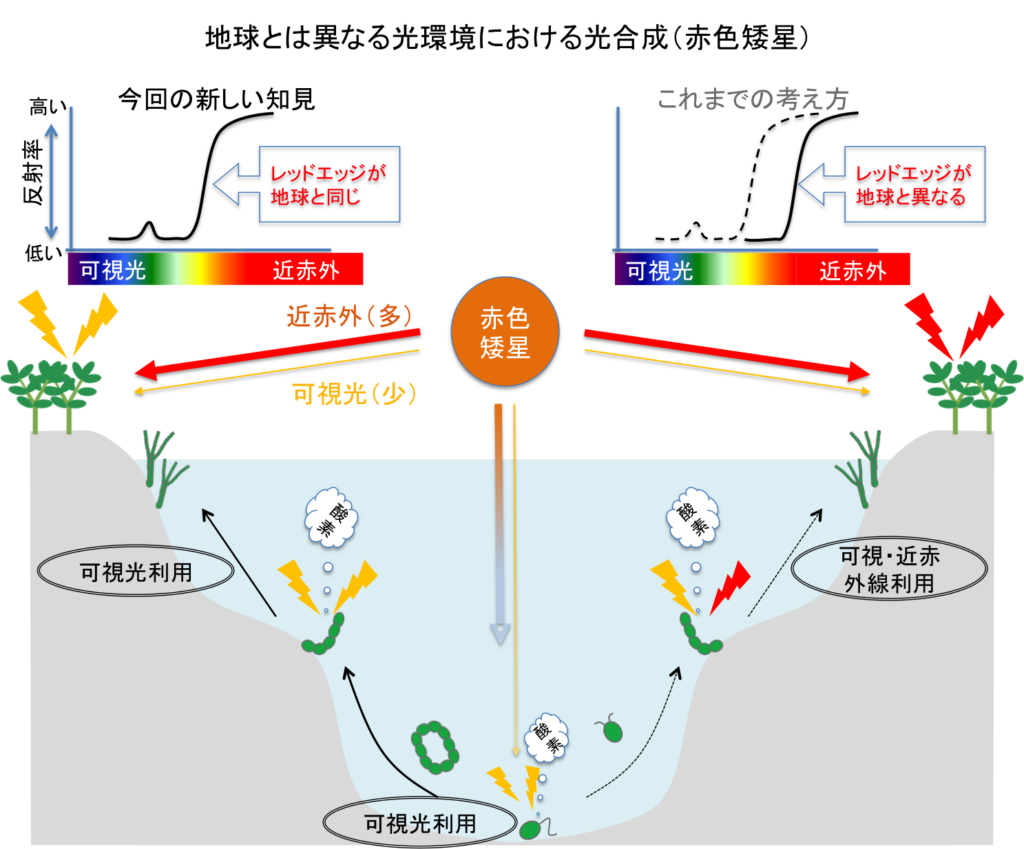
A joint research team consisting of Kenji Takizawa, Project Associate Professor and Nobuhiko Kusakabe, Project Specialist at the National Astrobiology Center of the National Institutes of Natural Sciences, Jun Minagawa, Professor at the National Institute for Basic Biology, and Kenpo Narita and Motohide Tamura, Assistant Professor at the University of Tokyo, has been studying the wavelengths at which red edges appear in the assumed light environment of a life-supporting planet around a red dwarf star. The team theoretically investigated the wavelengths at which the red edge appears in the light environment of a life-supporting planet around a red dwarf from the perspective of photosynthesis. As a result, the team proposed for the first time that photosynthetic organisms that first land on the surface of a red dwarf star, even if they originate and evolve in water, use visible light for photosynthesis just like on Earth because infrared radiation is absorbed by water, and that, contrary to previous expectations, red edges are likely to appear in the same locations as vegetation on Earth. This study may provide important guidance for key biomarkers and wavelengths for future observations of life on exoplanets.
The results of this study will be published in the British online scientific journal Scientific Reports on August 8, 2017 at 10:00 a.m. UK time (6:00 p.m. EDT).
Background:
Observations by NASA’s Kepler spacecraft have revealed that extrasolar planets are ubiquitous in our galaxy, and with the successive discoveries of terrestrial planets in the habitable zone for life, the discovery of a second Earth that harbors life around a star near the Sun is expected to be a feasible goal. If observations of exoplanets confirm the presence of oxygen in planetary atmospheres, it would be a sign (biomarker) of the existence of life, but this alone is not conclusive evidence, since non-living oxygen evolution is also a possibility. In addition, many of the stars close to the Sun are red dwarfs, which are the most important targets for future observations, so there is an urgent need to advance research on biomarkers on terrestrial planets around red dwarfs.
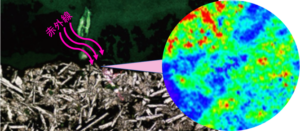
Plants on Earth absorb visible light from blue to red, which they use for photosynthesis, and reflect near-infrared light, which they do not use, and thus show a characteristic reflectance spectrum called “red edge. If this red edge can be observed on exoplanets, it will be a biomarker that can more reliably support the existence of life, along with the presence of oxygen. However, the wavelength of the red edge may not be the same on an exoplanet with a different light environment than on Earth. Red dwarfs, which are important targets for future observations, emit more near-infrared light than visible light, and it has been thought that the wavelength used for photosynthesis shifts from visible light to near-infrared light, which in turn shifts the position of the red edge to the longer wavelength side. In this study, based on the latest photosynthesis research, we examined whether the shift of the red edge in accordance with the light environment is reasonable or not.
Research Findings:
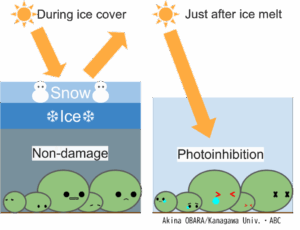
We estimated the light environment on land and in water for an Earth-like planet in the life-supporting region of the red dwarf star Leo AD in the vicinity of the solar system and predicted the optimal photosynthetic utilization wavelength for that environment. If the terrestrial planet evolved to increase photosynthetic productivity due to the abundance of near-infrared light, it would use light up to 900 nm or 1,100 nm for photosynthesis, and the red edge would appear on the longer wavelength side of that wavelength. On the other hand, because near-infrared light is attenuated by water molecules in water, the existence of photosynthetic organisms that depend solely on visible light is predicted even around red dwarfs, as it is on Earth. As a possible evolutionary pathway of the photosynthetic mechanism from visible light-utilizing organisms in water to near-infrared-utilizing organisms on land, we can assume a transient photosynthetic mechanism in which one of the two reaction centers utilizes visible light and the other utilizes near-infrared light. However, if the two reaction centers with different absorption wavelengths cannot be excited in a balanced manner, the acquired energy will generate dangerous reactive oxygen species, which is rather detrimental to survival. We tested whether this transient photosynthetic mechanism can adapt to the light environment in the boundary region between underwater and terrestrial environments by comparing it with examples of terrestrialization that have actually occurred on Earth. The results show that for oxygen-evolving photosynthetic organisms to rapidly evolve from water to land:
- The emission spectrum of the main star is close to the light transmission spectrum of water molecules
- Excitation wavelengths of multiple reaction centers are close
- A mechanism to maintain the excitation balance of the reaction centers is in place.
The following three conditions are necessary. While the light environment and photosynthetic mechanism on Earth satisfy these three conditions, the radiation peak of the main star of a planet around a red dwarf is shifted to the long wavelength side, making it difficult to maintain the excitation balance of the reaction centers if their excitation wavelengths differ greatly, making landing difficult.
On the other hand, if only visible light is used, the reaction center excitation wavelengths are close and thus it is possible to maintain the excitation balance even under the irradiation of the red dwarf, and the photosynthetic organisms that land first are likely to have a photosynthetic mechanism similar to that of the Earth, and the position of the red edge is likely to be similar to that of the Earth. This suggests that even on planets around red dwarfs, the first plants to land on
Prospects:
By examining not only the adaptation of organisms to the environment on a red dwarf planet, but also the processes that lead to such adaptation, it was shown for the first time that visible light utilization is maintained during the process from the birth of oxygen-evolving photosynthetic organisms to the transition to terrestrial life. It is important to further examine whether the evolution to the near-infrared utilization type, which is inhibited in water, progresses quickly on land, from the viewpoints of both photosynthetic function and evolutionary process. Future exoplanet observation instruments such as the 30-meter telescope (TMT) and space telescopes should cover a wide range of wavelengths from visible light to near-infrared, and should also capture the shift of the red-edge position on red dwarfs toward longer wavelengths in accordance with the evolution of terrestrial vegetation.
Translated with DeepL.com (free version)
Terminology:
Kepler spacecraft:NASA’s exoplanet probe launched in 2009, which discovered more than 2,000 exoplanets, showing that there are as many planets as there are stars.
Habitable zone:A region at a certain distance from a star where radiated energy keeps water in a liquid state on the planet’s surface. Also called habitable zone.
Photosynthetic reaction center:A pigment-protein complex that converts light energy into chemical energy. In oxygen-evolving photosynthesis, a pair drives a series of electron-transfer reactions.
Light-harvesting antenna:A pigment-protein complex located around the reaction center that collects light and transfers energy to the reaction center.
Research Support:
This research was supported by Grant-in-Aid for Scientific Research from the Ministry of Education, Culture, Sports, Science and Technology of Japan.
Publication:
Title:Red-edge position of habitable exoplanets around M-dwarfs
Journal:Scientific Reports
Authors:Kenji Takizawa, Jun Minagawa, Motohide Tamura, Nobuhiko Kusakabe, Norio Narita
Related Links:
National Astronomical Observatory Press Release
Institute for Basic Biology Press Release