Abstract:
A research team composed of the Astrobiology Center, the University of Tokyo, Japan Science and Technology Agency, National Astronomical Observatory of Japan, and Institute of Astrophysics of the Canary Islands developed a new multi-color simultaneous imaging camera MuSCAT2. This instrument was installed on the 1.52-meter telescope (Carlos Sánchez Telescope) at the Teide Observatory in Tenerife, Spain, renowned as one of the best astronomical observation sites in the world.
MuSCAT2 is an observational instrument primarily aiming to confirm whether exoplanet candidates reported by NASA’s Transit (Note 1) Exoplanet Survey Satellite (TESS; Note 2) launched in April 2018, are actually real planets or not. To evaluate the camera’s performance, the research team observed known exoplanet transits and employed cutting-edge statistical analysis techniques. Consequently they demonstrated that MuSCAT2 can achieve world-leading photometric precision (the precision to investigate a variability in brightness) at four simultaneous color channels. This level of precision enables the confirmation of second Earths (potentially habitable planets) orbiting nearby red dwarfs (Note 3) discovered by TESS.
Furthermore, through an agreement between the Astrobiology Center andInstitute of Astrophysics of the Canary Islands, a substantial amount of observation time for MuSCAT2, totaling over 162 nights annually until 2022, has been secured. With Tenerife Observatory’s clear-sky rate of approximately 70%, this is equivalent to the confirmation observations of over 100 planets annually. Expectations are high for MuSCAT2 to discover numerous scientifically intriguing planets from the beginning era of TESS.
Key Points of the Announcement:
- Completion of MuSCAT2, a multicolor simultaneous imaging camera capable of observing variations in brightness at four wavelength bands (four colors) simultaneously.
- We achieved world-leading photometric precision across four colors as a result of the engineering runs.
- Collaboration with NASA’s Transit Exoplnaet Survey Satellite TESS enables the discovery of second Earth planets orbiting nearby red dwarfs.
Background:
By 2018, some 4,000 exoplanets have been discovered in stars other than our Sun. In particular, NASA’s transit planet-hunting satellite Kepler, launched in 2009, has discovered about 3,000 exoplanets by the end of its operations in November 2018, using a phenomenon called transit, in which a planet passes in front of its host star.
Kepler’s work has revealed an abundance of Earth-like planets in the universe, some of which are in habitable zones where the distance from the main star is just right to retain liquid water on the surface. However, Kepler mainly discovered planetary systems more than several hundred light years away from the solar system, making it difficult to study the properties of individual planets in detail, even if the existence of the planets and their statistical properties as a whole were known.
In order to discover planetary systems closer to our solar system, a new transit planet search satellite, TESS, was launched in April 2018, equipped with four cameras with an extremely wide field of view of 24° × 24°, which will observe more than 80% of the entire sky over the next two years and will be able to detect thousands of planetary systems that are close to our solar system. It is expected to observe more than 80% of the entire sky over the next two years and discover thousands of planetary systems that are close to our solar system. These are expected to include several hundred planets that are thought to be terrestrial planets, and dozens of planets in habitable zones. However, the planet candidates discovered by the transit method include not only real planets but also fake ones called eclipsing binary stars, in which a star passes in front of another star. Therefore, as thousands of planet candidates are discovered by TESS, it has been a research challenge to efficiently distinguish between real planets and fake eclipsing binary stars (called “discovery confirmation observation”).
Research Description:
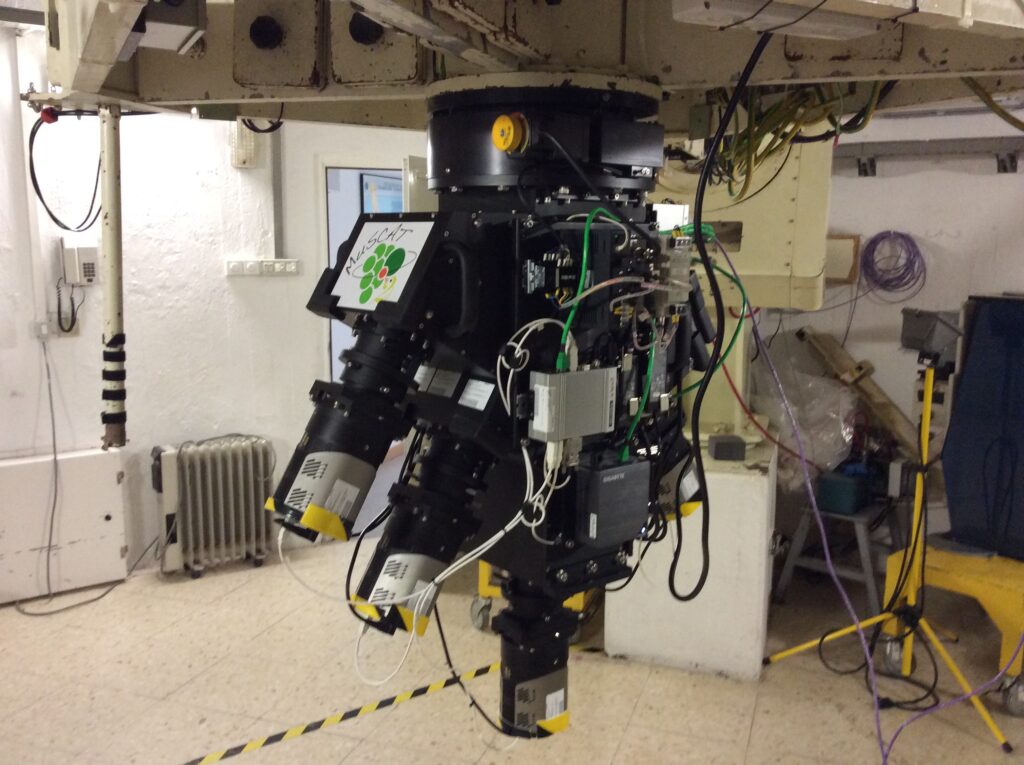
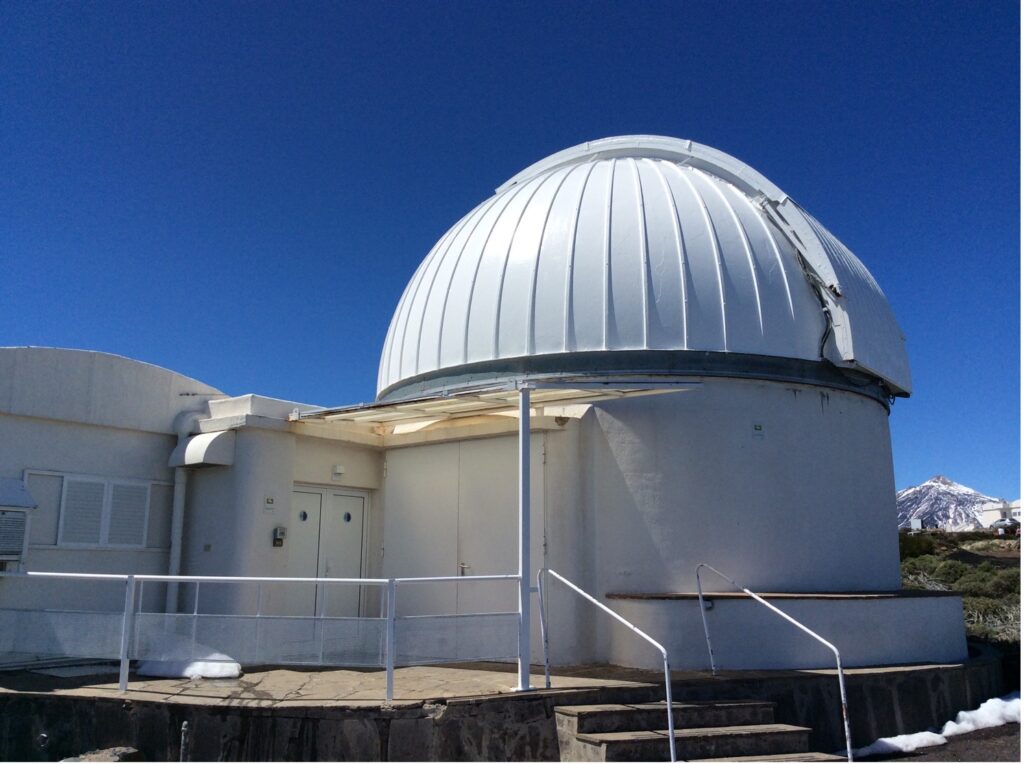
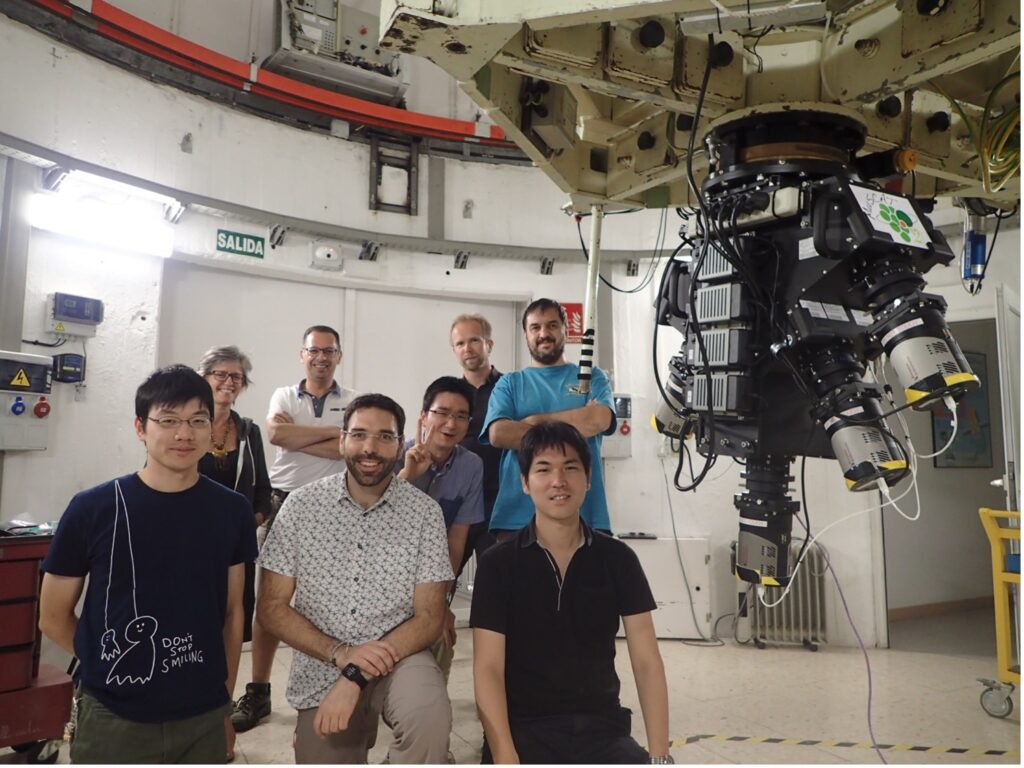
A research team led by the Astrobiology Center of the National Institutes of Natural Sciences, the University of Tokyo, the Japan Science and Technology Agency, the National Astronomical Observatory of Japan, and the Canarian Institute of Astrophysics has developed the MuSCAT2 multicolor imaging camera that can simultaneously observe changes in the brightness of celestial objects in four colors ranging from visible light to near-infrared light. The camera was installed on the 1.52-m telescope (Carlos Sanchez Telescope) at the Teide Observatory in Tenerife, Spain, which is known as one of the best astronomical observation sites in the world (Figure 1 and Figure 2).
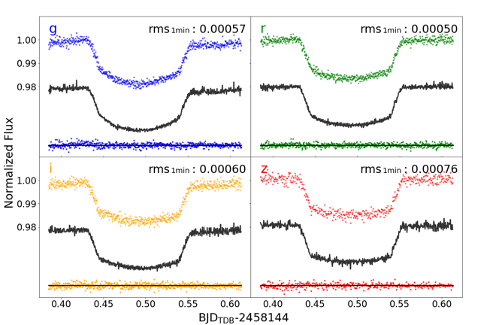
MuSCAT2 ist ein Instrument, dessen Hauptzweck darin besteht, zu bestätigen, ob es sich bei den Planetenkandidaten, die von dem im April 2018 gestarteten NASA-Satelliten TESS für die Suche nach Transitplaneten entdeckt wurden, um echte Planeten handelt (Entdeckungsbestätigung). Um die Leistung dieses Instruments zu bewerten, beobachtete das Forscherteam tatsächlich bekannte Planetentransite und analysierte sie unter Anwendung der neuesten statistischen Methoden. Damit konnten sie zeigen, dass MuSCAT2 die weltweit höchste photometrische Genauigkeit (d.h. die Genauigkeit der Messung von Helligkeitsänderungen) in allen vier Farben gleichzeitig erreichen kann (Abb. 3). Diese photometrische Genauigkeit ist auch in der Lage, die Entdeckung der zweiten Erden (lebensfreundliche Planeten) zu bestätigen, die rote Zwerge in der Nachbarschaft des Sonnensystems umkreisen und die von TESS entdeckt wurden. Darüber hinaus hat eine Vereinbarung zwischen dem Zentrum für Astrobiologie und dem Kanarischen Institut für Astrophysik mehr als 162 Teleskopnächte pro Jahr für MuSCAT2 bis 2022 gesichert. Die Aufklärungsrate am Teide-Observatorium liegt bei etwa 70 %, was der Möglichkeit entspricht, mehr als 100 Beobachtungen zur Bestätigung von Planetenentdeckungen pro Jahr durchzuführen. Dies lässt uns hoffen, dass MuSCAT2 in der kommenden Ära von TESS viele wissenschaftlich interessante Planeten entdecken wird, darunter auch eine zweite Erde.
Significance of this research:
TESS is currently conducting observations of the southern sky as of 2018, and will begin observations of the northern sky in the summer of 2019.With the completion of MuSCAT2, this research team can now lead the world in discovery confirmation observations of planetary candidates discovered by TESS’s observations of the northern sky.
The research team has previously developed the MuSCAT three-color simultaneous imaging camera for NAOJ’s 1.88-m telescope in Okayama, Japan. There is a 9-hour time difference between Okayama and Tenerife, and by installing the instruments in such time-differential locations, it will be possible to observe transits that occur at times when they cannot be observed by each other in a complementary manner. Also, if a transit cannot be observed at one location for a long period of time, continuous observation at Okayama and Tenerife Island will enable coverage of the transit for a long period of time.
Since no other research team in the world has multiple multicolor imaging cameras like this, the existence of MuSCAT and MuSCAT2 is expected to be a great advantage in the era of TESS, which requires a large number of discovery confirmation observations.
Future Development:
The team is developing MuSCAT3 for the U.S. telescope with the aim of establishing a system that will be able to perform 24-hour multi-color imaging observations by the summer of 2019. TESS will begin in the summer of 2019.
We hope that the MuSCAT series will play a major role in the TESS era.
Terminology Explanation:
Note 1: Transit
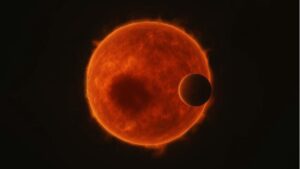
When a planet passes in front of a star, it causes periodic dimming of the star’s brightness. The method of discovering planets by observing these brightness variations over long time is called the transit method, and planets that cause transits are referred to as transiting planets.
Note 2: TESS
NASA’s Transiting Exoplanet Survey Satellite launched on April 18, 2018. Although the aperture size is smaller than the similar satellite Kepler launched in 2009, TESS has a wider field of view and is well-suited for discovering transiting planets closer to the solar system than Kepler. However, due to its larger field of view, TESS is expected to encounter more contamination from false positives such as eclipsing binaries and confirmation observations for discoveries are essential.
Note 3: Red Dwarf
A collective term for stars with absolute temperatures below approximately 3,800K. These stars have lower surface temperatures compared to the Sun, which has a temperature of about 5,800K, making them faint in visible light but brighter in near-infrared.Red dwarf stars account for 70-80% of stars in the universe, including those near the solar system, and they are primary targets for future searches for potentially habitable planets in the solar neighborhood.
Published Paper Information:
Journal Name: Journal of Astronomical Telescopes, Instruments, and Systems
Paper Title: MuSCAT2: 4-color Simultaneous Camera for the 1.52m Telescopio Carlos Sanchez
Authors (* indicates corresponding author):
*Norio Narita, Akihiko Fukui, Nobuhiko Kusakabe, Noriharu Watanabe, Enric Palle, Hannu Parviainen, Pilar Montanes-Rodriguez, Felipe Murgas, Matteo Monelli, Marta Aguiar, Jorge Andres Perez Prieto, Alex Oscoz, Jerome de Leon, Mayuko Mori, Motohide Tamura, Tomoyasu Yamamuro, Victor J. S. Bejar, Nicolas Crouzet, Diego Hidalgo, Peter Klagyivik, Rafael Luque, Taku Nishiumi
Research Group:
the University of Tokyo, Japan Science and Technology Agency, Astrobiology Center, National Astronomical Observatory of Japan, Institute of Astrophysics of the Canary Islands, and others
Research Support:
This research was supported by JSPS KAKENHI Grant-in-aid JP18H01265, JP17H04574, JP16K13791, JP15H02063 and JST CREST JPMJPR1775.
Related Links:
National Astronomical Observatory Press Release
University of Tokyo Press Release
Japan Science and Technology Agency (JST) Press Release