
The new observational instrument installed on Subaru Telescope successfully imaged the protoplanetary disk surrounding the star LkCa 15, which is a planetary system believed to resemble the early solar system, the most vividly to date. This star was thought to harbor three planet candidates, which are more massive than Jupiter, in the process of formation. With the combination of the Subaru Telescope’s extreme adaptive optics system SCExAO and the integral field spectrograph CHARIS, it was revealed that much of the light previously assumed to be planets’ emission likely originated from the protoplanetary disk. Furthermore, it was revealed that potential planets hidden within the disk may be even less massive than previously assumed.
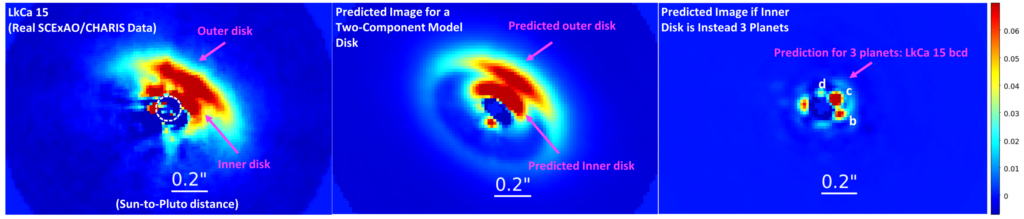
The clear images from SCExAO show that this ‘young solar system’ of LkCa 15 is more like our own solar system than previously thought,” says lead author Thayne Currie of NASA’s Ames Research Center and the National Astronomical Observatory of Japan’s Hawaii NASA Ames Research Center and the National Astronomical Observatory of Hawaii).
LkCa 15, a young solar-type star, has a protoplanetary disk made of planetesimal gas and dust. Previous studies have shown that there are large gaps in this disk. This gap tells us that a “young planet” made of dust is forming in the disk.
However, capturing this planet orbiting LkCa 15 at a distance of more than 500 light years from the Earth directly from the ground on a scale similar to that of the solar system is extremely challenging, even for a large telescope like the Subaru Telescope, which has adaptive optics to compensate for the effects of atmospheric fluctuations of the Earth. Previously, based on observations using a state-of-the-art technique called aperture masking interferometry, three candidate planetesimals were thought to orbit from Saturn to Neptune, which was the first recognized extrasolar planet in the disk. However, this observation method made it particularly difficult to determine how much light was actually coming from the planets compared to the light scattered by the dust disks.
SCExAO on the Subaru Telescope uses a combination of a faster and more sensitive camera than typical adaptive optics instruments and a variable deformable mirror with as many as 2,000 elements. Furthermore, by sending light to a surface spectrograph called CHARIS, it is possible to directly distinguish differences in the “color” of light coming from celestial objects at high resolution, making it possible to study the atmospheric composition of planets and other objects in detail.
SCExAO/CHARIS will allow us to probe planets similar to our own solar system scale more directly than ever before and even reveal their properties,” said Olivier Guyon, SCExAO Instrument Director at NAOJ’s Subaru Telescope in Hawaii.
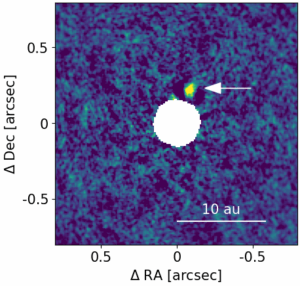
The SCExAO/CHARIS data now show that most of the light coming from around LkCa 15 originates from the disk, which appears to be an extended arc, and has the same brightness as the previously suggested planet candidates. Follow-up observations with the Keck telescope also confirmed that the shape of this disk’s arc has not changed over time. In other words, the light previously thought to be a signal from the orbiting planet is now found to be well consistent with a motionless structure like the disk.
The planetary system of LkCa 15 is quite complex. Based on aperture masking interferometric imaging data acquired prior to this observation, we also thought there would be three Jupiter-like planets. However, the SCExAO/CHARIS data indicate that the previous signals are coming from the disk itself, and that the planets themselves are fainter and likely hidden within the disk. We will continue to challenge ourselves to find that hidden planet,” Currie said.
It will be quite a challenge to clearly distinguish the light from the disk of LkCa 15 and the light from the planet hidden in that disk. However, we are making definite progress technically, and SCExAO will continue to make improvements. In the near future, we may be able to capture a Jupiter-like planet near Saturn’s orbit in the disk of LkCa 15. And further down the road, the planned 30-meter telescope TMT will be equipped with the technology successfully used in SCExAO to image faint planets orbiting near Mars at lower masses.
The results from cutting-edge imaging instruments such as SCExAO provide clues to better understand the origin and evolution of planetary systems, such as whether the history of our solar system is universal or unique,” said paper co-author Motohide Tamura, Director of the National Institutes of Natural Sciences Director and Professor of the Center for Astrobiology, National Institutes of Natural Sciences.
The research outcomes were accepted for publication in the Astrophysical Journal Letters (Currie et al., “NO CLEAR, DIRECT EVIDENCE FOR MULTIPLE PROTOPLANETS ORBITING LKCA 15: LKCA 15 bcd ARE LIKELY INNER DISK SIGNALS“).Additionally, this study is supported from NASA, the Keck Foundation, the Chilean National Fund for Scientific and Technological Development, and the Japan Society for the Promotion of Science Grants JP18H05442 and JP15H02063.