Abstract:
The Antarctic land surface is an extreme environment exposed to low temperatures, freezing, aridity, and strong ultraviolet rays during the summer. Understanding the adaptive strategies of organisms that can thrive in such environments is important for understanding the possibility of life phenomena in various environments, not only on Earth but also in the universe.
Dr. Kosugi and his research team at the Center for Astrobiology have shown for the first time that Antarctic minnows, collected in Antarctica, perform a series of photosynthetic reactions not only in visible light, which is used by most photosynthetic organisms, but also in near-infrared light, depending on the light environment. Since the energy of near-infrared light is lower than that of visible light, it was predicted that photosynthetic efficiency would be greatly reduced. However, measurements of oxygen-evolving activity and redox reactions in the photosystem revealed that the efficiency of utilization of photons absorbed by the algae for photosynthesis is the same as that of visible light.
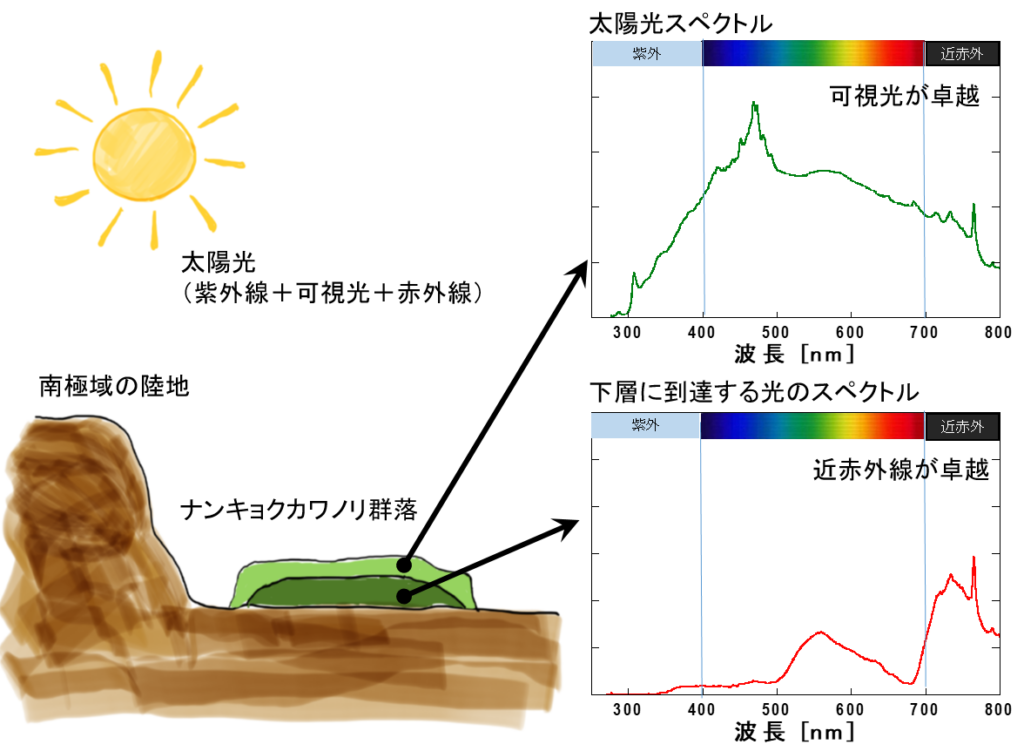
Since the algae grow in multiple layers, visible light is absorbed mainly in the upper layers, and the light reaching the lower layers is dominated by near-infrared rays rather than visible light. The system that enables the use of near-infrared light for photosynthesis is thought to help increase the photosynthetic efficiency of the entire Nankei-Kawanori community.
The existence of photosynthetic organisms that utilize near-infrared light in the extreme environment on Earth provides various hints for the evolution of life on planets around stars (red dwarfs), where the near-infrared light fraction is very high. We believe that further clarification of the evolution and mechanism of near-infrared-utilizing photosynthesis will lead us to the possibility of the existence of oxygen-evolving photosynthetic organisms on such planets.
The results were published in the biological journal Biochimica et Biophysica Acta – Bioenergetics.
Key points of the publication:
- Near-infrared-induced oxygen-evolving photosynthesis was discovered in an algae dominant in the polar regions.
- Highly efficient photosynthetic reactions by uphill-type (Note 1) excitation energy transfer were suggested.
(Remark 1) A phenomenon in which excitation energy is transferred from a molecule with a lower energy state at the time of excitation to a molecule with a higher energy state at the time of excitation. See the right figure in Figure 3.

Research Background:
Photosynthesis, which is carried out by algae and plants on the earth today, is a reaction that uses light energy to break down water and produce organic matter from carbon dioxide using the reduction force obtained. Oxygen is released during the water decomposition process. This oxygen-evolving photosynthesis was initiated by prokaryotic cyanobacteria (cyanobacteria) about 2.7 billion years ago, transforming the anaerobic global environment into an aerobic one, where oxygen was virtually non-existent. The increase in the concentration of oxygen in the atmosphere led to the flourishing of aerobic respiring organisms, which is believed to have had a significant impact on the evolution of life on Earth.
It has been believed that oxygen-evolving photosynthetic reactions require the energy of visible light. This is because at lower light energies, it becomes difficult to obtain the reducing power needed to break down water and fix carbon dioxide. Since the 1990s, however, a number of organisms have been discovered that perform oxygen-evolving photosynthesis using only near-infrared light. It was reported that some cyanobacteria synthesize photosynthetic pigments (chlorophyll d, f) that absorb near-infrared light and use them as reaction centers for charge separation reactions (direct infrared use). On the other hand, efficient energy transfer from near-infrared absorbing chlorophyll to visible light absorbing chlorophyll (indirect infrared utilization) has been suggested in some cyanobacteria and eukaryotic photosynthetic organisms, and an uphill-type (Note 1) energy transfer mechanism that makes this possible has attracted attention The following is a list of the most important examples.
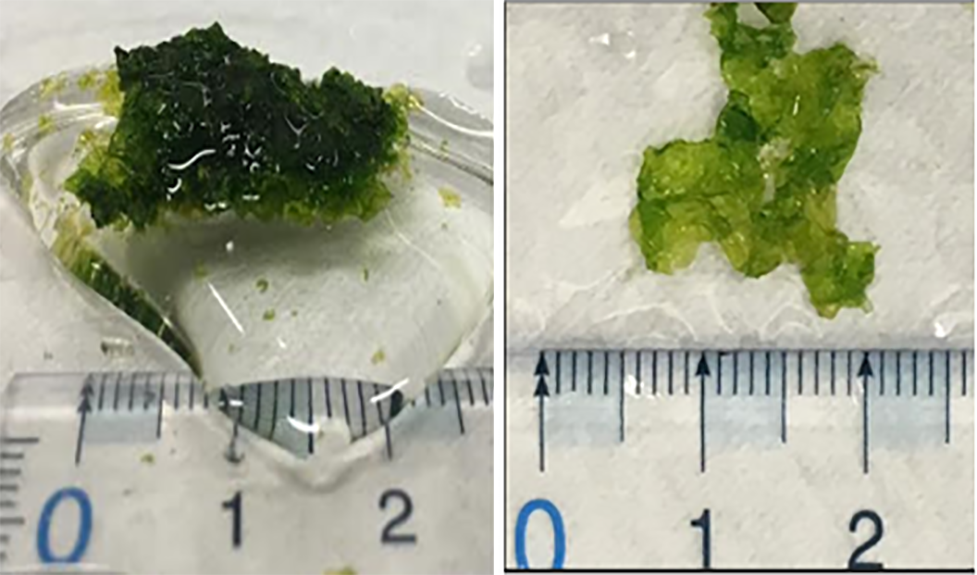
The Nanjing riverine algae (Prasiola crispa) is a terrestrial green alga that is widely distributed in cold regions at high latitudes and is known to form large colonies in polar environments (Figure 1). The research team has been studying the stress tolerance ability and growth environment of Nankiola crispa in detail with the aim of elucidating the adaptive strategies of organisms growing in polar regions. In the process, the team identified a near-infrared absorption band, which is not found in common green algae, and analyzed the role of this band.
Research:
Nankyoku Kawanori collected in Antarctica (Figure 2) has a near-infrared absorption band with a peak absorption around 710 nm as a shoulder to the normal red visible light absorption band (680 nm). The size of the near-infrared absorption band varies greatly among individuals collected in the field and disappears after long-term incubation under fluorescent light, which contains almost no near-infrared light, suggesting that its expression is adjusted according to the light environment. Measurements of the light wavelength dependence of photosynthetic activity revealed that light energy absorbed in the near-infrared absorption band is used for photosynthesis with the same level of efficiency as visible red light. In algae, water decomposition reactions require light energy equivalent to visible light, suggesting that an Uphill-type (Note 1) excitation energy transfer is taking place. It is possible that the Uphill excitation reaction (Note 1), which greatly exceeds the range compensated by thermal fluctuation, is taking place, and further elucidation of the molecular mechanism is expected in the future. Figure 3 is a schematic diagram summarizing the results of this study.

Publication:
Authors:
Makiko Kosugi, Shin-Ichiro Ozawa, Yuichiro Takahashi, Yasuhiro Kamei, Shigeru Itoh, Sakae Kudoh, Yasuhiro Kashino, Hiroyuki Koike,
Title:
Red-shifted chlorophyll a bands allow uphill energy transfer to photosystem II reaction centers in an aerial green alga, Prasiola crispa, harvested in Antarctica,
Journal:
Biochimica et Biophysica Acta – Bioenergetics, 2020年 Vol. 1861 (2), 148139,
DOI:10.1016/j.bbabio.2019.148139