Abstract:
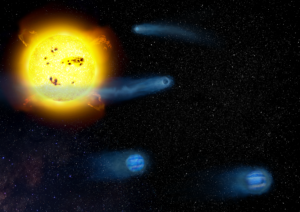

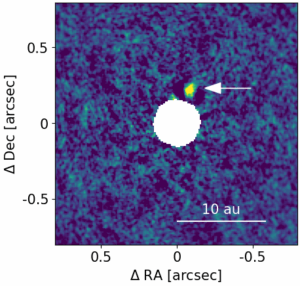
An international research team, including Project Associate Professor Norio Narita from the Astrobiology Center of the National Institutes of Natural Sciences (Graduate School of Arts and Sciences at the University of Tokyo, and JST PRESTO researcher), has discovered a Neptune-sized planet orbiting by 8.5 days the young star AU Microscopii, located approximately 31.9 light-years away from the Solar System. Studying planets around young stars is crucial for understanding how planets form, acquire atmospheres, and are influenced by their host stars, and this discovery expectedly leads to further follow-up observations and theoretical studies. The research findings are published in the British scientific journal Nature on June 25, 2020.
Research:
AU star AU is a young red dwarf (low-temperature star) located about 31.9 light years away from the solar system in the direction of the constellation of Libra (Note 1) in the southern sky. AU has been in existence for only 20 to 30 million years, making it a very young star compared to the Sun, which is about 4.6 billion years old. Although AU star Kenbikyo was known to have a remnant disk (Note 2), which is known as one of the characteristics of young stars, the existence of a planet has not been confirmed until now.
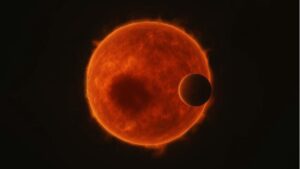
NASA’s Transiting Exoplanet Survey Satellite (TESS), launched in April 2018, measured changes in the brightness of the star AU Librae over approximately 27 days in July and August 2018. Because AU star Cenobibyo is still young and a red dwarf with a fast rotation period of about 4.9 days, its brightness variations were complicated by the presence of large sunspots on the stellar surface and frequent flares, which are explosive events. The team used a statistical method called the Gaussian process to remove the stellar brightness variations and searched for changes in brightness caused by transits, in which a planet passes in front of its star.
As a result, two transits of the same shape were found about 17 days apart during the approximately 27-day TESS observation period. However, right in the middle of these two transits, there was no TESS data. This is because TESS cannot make observations while it is transmitting data to Earth. Without knowing whether the transits occurred during this interrupted observation period, it is impossible to determine whether the orbital period is about 17 days or half a day, about 8.5 days. Therefore, additional transit observations were made in 2019 by the Spitzer Space Telescope (Note 3). From these Spitzer Space Telescope observations, it was determined that the orbital period of the planet is approximately 8.5 days.
Transit observations with TESS and the Spitzer Space Telescope indicate that the newly discovered planet AU b is only 8% larger than Neptune (almost Neptune-sized). Although the planet’s mass has not yet been accurately measured, observations of the main star’s line-of-sight velocity (Note 4) with ground-based telescopes indicate that it is 58 times smaller than that of the Earth. In addition, the TESS data also detected one other transit different from AU star b in Libra, suggesting that there are other planets in this planetary system.
Since AU star AU b is relatively close astronomically, about 31.9 light years from the solar system, and its main star is bright, we expect that various follow-up observations will be made in the future, such as measuring the exact mass of AU star b, measuring the inclination of the planet’s orbit to determine how the planet formed, and observing what kind of atmosphere the planet has. AU star AU is expected to make a variety of follow-up observations. AU star will be the subject of many follow-up observations and theoretical studies, and will be a valuable laboratory in space for understanding the formation and evolution of planetary systems.
Terminology:
Note 1: The Southern Constellation
A constellation in the southern sky, it is new and has no mythology, but it can be seen from Japan. It is located in the autumn sky, below the constellation Capricorn and to the west of the constellation Pisces Minami. It is relatively easy to find, but there are no stars bright enough to be seen with the naked eye, and even the brightest star is not very conspicuous at magnitude 4.7, making it difficult to spot with the naked eye. In addition, the AU star in the constellation of Cepheus this time is at 8th magnitude, so it is not visible to the naked eye.
Note 2: Remnant Disk
A remnant disk is a disk surrounding a star that is composed of solid material (rocky and icy particles) created by the impact of microplanets and asteroids after the loss of hydrogen gas from the protoplanetary disk (mainly composed of hydrogen gas, rocks, and ice) formed around the star at the time of its birth.
Note 3 Spitzer Space Telescope
The Spitzer Space Telescope, launched by NASA in August 2003, is a space telescope dedicated to infrared observations. It has been used for observations not only of exoplanets but also in various fields of astronomy, but was decommissioned on January 30, 2020, and its operation was terminated.
Note 4: Line-of-sight velocity
The speed at which a celestial body approaches or moves away from an observer. When a planet orbits a star, the star is slightly shaken. Due to the Doppler effect of light, the wavelength of absorption lines in the light emitted by the star changes by the amount of the shaken line-of-sight velocity. By observing this change in wavelength through a telescope and measuring the magnitude of the change in line-of-sight velocity, we can determine the mass of the planet.
Publication:
Journal:Nature
Title:A planet within the debris disk around the pre-main-sequence star AU Mic
Authors of the paper (* is the responsible author):
Peter Plavchan*, Thomas Barclay, Jonathan Gagné, Peter Gao, Bryson Cale, William Matzko, Diana Dragomir, Sam Quinn, Dax Feliz, Keivan Stassun, Ian J. M. Crossfield, David A. Berardo, David W. Latham, Ben Tieu, Guillem Anglada-Escudé, George Ricker, Roland Vanderspek, Sara Seager, Joshua N. Winn, Jon M. Jenkins, Stephen Rinehart, Akshata Krishnamurthy, Scott Dynes, John Doty, Fred Adams, Dennis A. Afanasev, Chas Beichman, Mike Bottom, Brendan P. Bowler, Carolyn Brinkworth, Carolyn J. Brown, Andrew Cancino, David R. Ciardi, Mark Clampin, Jake T. Clark, Karen Collins, Cassy Davison, Daniel Foreman-Mackey,Elise Furlan, Eric J. Gaidos, Claire Geneser, Frank Giddens, Emily Gilbert, Ryan Hall, Coel Hellier, Todd Henry, Jonathan Horner, Andrew W. Howard, Chelsea Huang, Joseph Huber, Stephen R. Kane, Matthew Kenworthy, John Kielkopf, David Kipping, Chris Klenke, Ethan Kruse, Natasha Latouf, Patrick Lowrance, Bertrand Mennesson, Matthew Mengel, Sean M. Mills, Tim Morton, Norio Narita, Elisabeth Newton, America Nishimoto, Jack Okumura, Enric Palle, Joshua Pepper, Elisa V. Quintana, Aki Roberge, Veronica Roccatagliata, Joshua E. Schlieder, Angelle Tanner, Johanna Teske, C. G. Tinney, Andrew Vanderburg, Kaspar von Braun, Bernie Walp, Jason Wang, Sharon Xuesong Wang, Denise Weigand, Russel White, Robert A. Wittenmyer, Duncan J. Wright, Allison Youngblood, Hui Zhang, Perri Zilberman
Related Links:
Japan Science and Technology Agency Press Release