Key Points:
- Discovery of LTT 9779 b, an ultra-hot and ultra-short-period Neptune-like planet with only a 19-hour orbital period.
- LTT 9779 b was discovered at an ultra-short-period period, known as the “Neptunian Desert”, where Neptunian planets have never been discovered.
- This planet will be an excellent observational target to study the atmosphere of ultra-hot Neptunian planeets.
Abstract:
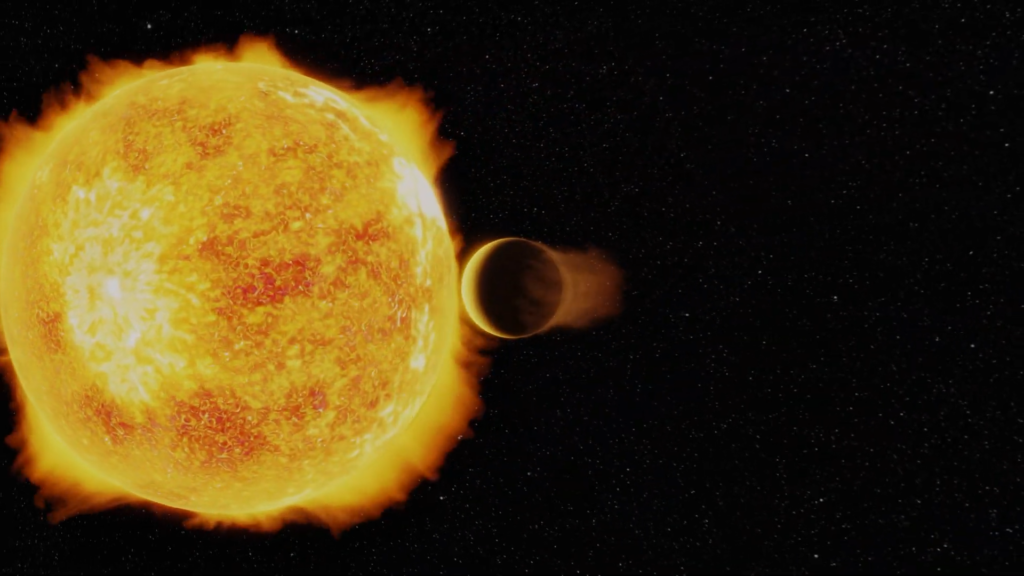
An international team including Professor Norio Narita from the Astrobiology Center and the graduate school of the University of Tokyo and Professor Motohide Tamura from the Astrobiology Center and the graduate school of the University of Tokyo, discovered the ultra-hot and ultra-short-period Neptunian planet LTT 9779 b at only a 19-hour orbital period and at a temperature greater than 1,700 degree Celcius using coordinated observations from NASA’s Transiting Exoplanet Survey Satellite (TESS) and ground-based telescopes.
LTT 9779 b is like an exoplanet, a slightly-magnified version of Neptue, with a radius about 4.7 times that of Earth and a mass about 29 times that of Earth. While over 4,000 exoplanets have been discovered by 2020, no Neptunian exoplanets with orbital periods less than one day had been discovered before, and such ultra-short-period orbits were known as the “Neptunian Desert”. LTT 9779 b, discovered in this study, is the first Neptunian exoplanet found in the Neptunian Desert. LTT 9779 b serves as a promising observational target to study the nature of the atmosphere of ultra-hot Neptunian exoplanets and to understand their formation.
This research was published online in the international scientific journal “Nature Astronomy” on September 21, 2020 (British Summer Time).
Presentation Description:
To date, more than 4,000 exoplanets have been discovered orbiting stars other than the Sun. The orbits of exoplanets have been found to be very diverse, and planets have been discovered in orbits with very short periods of less than one day. However, while Earth- and Jupiter-sized planets have been discovered in such ultra-short orbits, Neptune-sized planets have not been found until now. For this reason, this ultra-short period orbit was also called the “Neptune Desert.
Under such circumstances, NASA launched the Transiting Exoplanet Survey Satellite (TESS) (Note 1) in April 2018 to search for exoplanets in almost the entire sky using the phenomenon of “transit” (Note 2), in which a planet passes in front of its host star. TESS uses four ultra-wide-field cameras to observe a 24° x 96° region (called a sector) at a time; TESS observes each sector for 27.4 days, for a total of 26 sectors over a period of about two years, sequentially observing almost all areas of the sky in all directions to search for transit planets.
LTT 9779 b was discovered as a new transit planet candidate during observations in Sector 2 of TESS. We say transit planet candidate here because the object discovered by TESS may not be a planet, but an eclipsing binary star whose stars periodically eclipse each other. Therefore, it is necessary to verify whether the transit planet candidates discovered by TESS are real planets or not by additional observations with ground-based telescopes. Therefore, this research team conducted additional observations with telescopes around the world, and in particular, the Japanese team conducted these additional observations with the InfraRed Survey Facility (IRSF) 1.4-m telescope (Note 3) in South Africa. As a result, they determined that LTT 9779 b is a real planet, an exoplanet with a radius about 4.7 times that of the Earth and a mass about 29 times that of the Earth, which is a slightly larger version of Neptune. Based on the density of the planet, it is estimated that the planet has a hydrogen-based atmosphere equivalent to about 2~3 times the mass of the Earth.
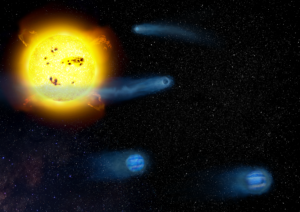
LTT 9779 b orbits the 2 billion year old star LTT 9779 (0.017 AU, or about 1/23 of Mercury’s orbit), which is about 260 light years from the Sun, in just about 19 hours. LTT 9779 b, orbiting close by, is expected to have a surface temperature in excess of 1,700 degrees Celsius. Neptune in our solar system has an orbital period of about 165 years and a surface temperature of less than -200 degrees Celsius, but this is an “extremely hot Neptune,” the exact opposite of the extremely cold world of our solar system.
Among the exoplanets discovered so far, there have been planets smaller than twice the radius of the Earth and giant planets as large as Jupiter (about 11 times the radius of the Earth), even in orbits with orbits of less than one day. LTT 9779 b was discovered in this intermediate region called the “Neptune Desert” (see Figure 1).
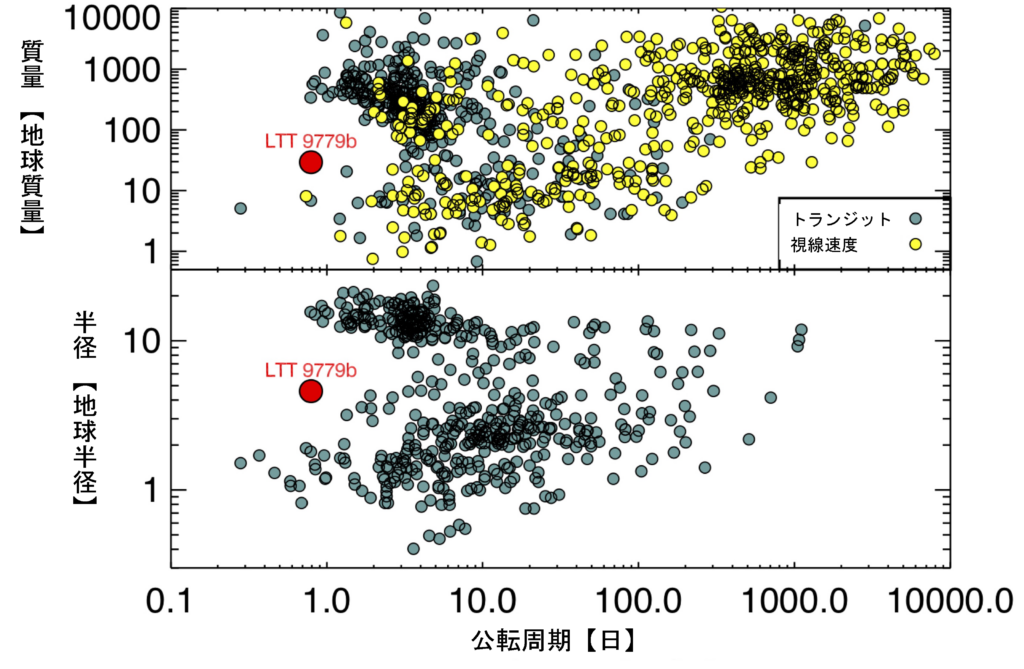
Previous observations have been theoretically explained as follows. That is, in very short period orbits with orbital periods of less than one day, it is predicted that the hydrogen-based planetary atmosphere will escape the gravitational constraints of the planet and flow into the main star, and that the hydrogen atmosphere will be blown away by intense X-rays and ultraviolet rays from the star. Therefore, only a Jupiter-like planet with sufficiently strong gravity to hold a large amount of hydrogen atmosphere or an Earth-like planet that has lost all of its hydrogen atmosphere can exist in such an ultra-short period orbit.
However, the discovery of LTT 9779 b contradicts this conventional theory. One possibility is that LTT 9779 b did not arrive in this orbit immediately after the star’s birth, but was ejected by another planet and moved into this orbit relatively recently, and is in the process of losing its hydrogen atmosphere and evolving into an Earth-like planet.
To test this hypothesis observationally, LTT 9779 b’s orbit and atmosphere must now be studied in detail to determine if there is evidence that the planet has been ejected from its orbit and if its hydrogen atmosphere is dissipating from the planet. LTT 9779 b orbits a bright star near our solar system, making it suitable for further follow-up studies. LTT 9779 b will also provide an excellent test site to determine the nature of the atmosphere of a superheated Neptune-like planet.
Acknowledgements:
This research was supported by
Japan Science and Technology Agency (JST) Strategic Creative Research Promotion Program, PRESTO Research Area, “Development and Application of Intelligent Measurement and Analysis Methods by Integrating Measurement Technology and Advanced Information Processing” (Researcher: Noriyasu Narita, Project Number: JPMJPR 1775)
Grant-in-Aid for Scientific Research on Innovative Areas “Paradigm Shift by New Theory of Star Formation: Elucidating the Pioneering History of Habitable Planetary Systems in the Galaxy”, Planned Research Project “New Opportunities for Observing Young and Habitable Planets in the Infrared” (Research Representative: Motohide Tamura)
Publication:
Journal:Nature Astronomy
Title: “An Ultra Hot Neptune in the Neptune Desert”
Authors(* is the responsible author):
James Jenkins*, Matías Díaz, Nicolas Kurtovic, Nestor Espinoza, Jose Vines, Pablo Peña Rojas, Rafael Brahm, Pascal Torres Miranda, Pia Cortes-Zuleta, Maritza Soto, Eric Lopez, George King, Peter Wheatley, Joshua Winn, David Ciardi, George Ricker, Roland Vanderspek, David Latham, Sara Seager, Jon Jenkins, Charles Beichman, Allyson Bieryla, Christopher Burke, Jessie Christiansen, Christopher Hense, Todd Klaus, Sean McCauliff, Mayuko Mori, Norio Narita, Taku Nishiumi, Motohide Tamura, Jerome de Leon, Samuel Quinn, Jesus Noel Villasenor, Michael Vezie, Jack Lissauer, Karen Collins, Kevin Collins, Giovanni Isopi, Franco Mallia, Andrea Ercolino, Cristobal Petrovich, Andres Jordan, Jack Acton, David Armstrong, Daniel Bayliss, Francois Bouchy, Claudia Belardi, Edward Bryant, Matthew Burleigh, Juan Cabrera, Sarah Casewell, Alexander Chaushev, Benjamin Cooke, Philip Eigmüller, Anders Erikson, Emma Foxell, Boris Gänsicke, Samuel Gill, Edward Gillen, Maximilian Günther, Michael Goad, Matthew Hooton, James Jackman, Tom Louden, James McCormac, Maximiliano Moyano, Louise Nielsen, Don Pollacco, Didier Queloz, Heike Rauer, Liam Raynard, Alexis Smith, Rosanna Tilbrook, Ruth Titz-Weider, Oliver Turner, Stéphane Udry, Simon Walker, Christopher Watson, Richard West, Enric Palle, Carl Ziegler, Nicholas Law, Andrew Mann
DOI:10.1038/s41550-020-1142-z
Abstracts URL:https://www.nature.com/articles/s41550-020-1142-z
Terminology:
Note 1: Transit
A so-called “eclipse” phenomenon in which a planet passes in front of its star. It occurs when an exoplanet’s orbit happens to be such that it passes in front of its main star. A planet in transit is called a “transit planet.
Note 2: Transit planet search satellite TESS
A NASA satellite project led by the Massachusetts Institute of Technology Launched on April 18, 2018, it has carried out a two-year plan to search for transit planets in nearly the entire sky Over the two years of observations, it has discovered more than 2,000 transit planet candidates. Currently, the extension plan has been approved and a third year of observations is underway.
Note 3: IRSF (InfraRed Survey Facility) 1.4m telescope
This 1.4-meter infrared telescope was installed by Nagoya University at the South African Observatory Sutherland Observatory in the Republic of South Africa. It is equipped with a SIRIUS multicolor simultaneous imaging camera that can simultaneously observe in three infrared wavelength bands (colors).
Related Links:
University of Tokyo Press Release :
Discovery of a Neptune-like Planet with Ultra-High Temperature and Ultra-Short Period
Japan Science and Technology Agency press release :
Discovery of Ultra-Hot, Ultra-Short-Period Neptune-like Planet
University of Warwick:
The first Ultra Hot Neptune LTT 9779b is one of nature’s improbable planets