(Image Credit: Astrobiology Center)
Key points of the announcement:
- By analyzing the phenomena of two young planets (AU Mic b and K2-25b) passing in front of the stars at infrared wavelengths with Subaru Telescope and IRD, they revealed that their orbital axes align with the stars’ rotation axes.
- This marks the first orbital information of young planets at about 20 million years old.
- This contrasts with the discovery of numerous planetary systems around stars older than 1 billion years where orbits are misaligned.
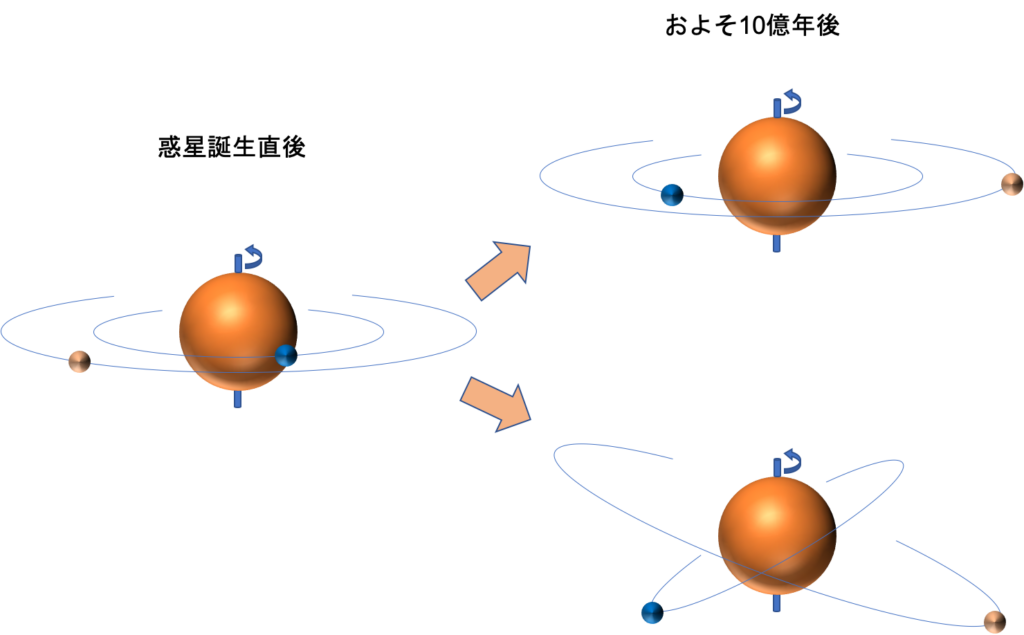
- The observational results suggest that planets do not have tilted orbits immediately after formation but may experience orbital inclination sometime after their birth.
The search for planets orbiting stars other than the Sun (exoplanets) has been limited to mature stars like the Sun. One of the reasons for this is that such stars have less surface activity, making it easier to search for planets. Recently, however, a number of exoplanets have been discovered that orbit around young stars in their early stages of life. Researchers from the Tokyo Institute of Technology, the Astrobiology Center of Japan, and the University of Hawaii have conducted spectroscopic observations of two recently discovered young planetary systems using the Subaru Telescope’s new infrared spectrograph IRD (IRD). The team found that the planetary orbital axes and stellar rotational axes of these young planetary systems are both nearly aligned. One of the two planets observed (AU b in Cenobius) is the youngest planet confirmed to have an unaligned orbital plane. This is the first time in the world that information on the orbits of such young planets has been obtained, and the data is very important for elucidating the evolution of planetary systems.
In general, planets are known to gradually change their appearance (orbits, atmospheres, etc.) over time. In the case of young planets, it is believed that they still retain primitive information related to their formation, such as where they formed and what kind of atmosphere they acquired, making them valuable observation targets in the search for the origin of planetary systems. In particular, it is known that the inclination of a planet’s orbit (the angle between the planet’s orbital axis and the stellar rotation axis) changes with time due to gravitational interactions between planets and tidal interactions with the star. Therefore, it is necessary to investigate the inclination of the orbits of young planetary systems in order to determine the orbits of the planets. More than 100 planetary systems have been studied so far, and some have been found to have planetary orbital axes well aligned with the axes of their stars, while others have been found to have large deviations. However, almost all of these observations have been of mature planetary systems with ages of more than one billion years.
This time, the research team focused on two recently discovered stars with two young transit planets, AU star in Cenobius and K2-25 [Note 1]. These young stars belong to two star clusters called the Beta Giaca motion cluster (age about 23 million years) and the Hyades cluster (age about 600 million years), respectively, and both have Neptune-sized transit planets found around them. Young stars have lower temperatures than mature stars, and the two targets are particularly difficult to observe in visible light because they are low-temperature stars, but they are brighter and easier to observe in the infrared. In addition, the infrared light is expected to have a smaller effect on the activity of young stars. The research team therefore conducted observations using the new infrared spectrograph IRD on the Subaru Telescope, and by using a technique called “Doppler shadow,” which uses the Doppler effect to investigate how a planet’s shadow moves through the spectrum during a transit, they were able to determine that these two The two planets were found to have their orbital axes well aligned with the axes of their stellar revolutions.
(Credit: Astrobiology Center)
The fact that the orbital planes of the planets are not inclined in these young systems has important implications for interpreting the observations to date. Although the orbital planes of the planets are not inclined in the solar system, it is known that a large number (about one-third) of the systems for which the inclination of planetary orbits has been measured have a large inclination (= the orbital axes of the planets and the stellar rotational axes are not aligned). However, when and by what mechanism this is produced has long been a matter of debate. The fact that the orbital planes of young planetary systems were not tilted suggests that the orbits of planets are not tilted immediately after their birth, but that in some systems the orbital planes were tilted some time after their birth. However, these observations of young planetary systems have only just begun, and it is expected that similar observations of more young planetary systems in the future will reveal more about the origin of tilted planets.
These research findings were published in specialized journals: “Limits on the Spin-Orbit Angle and Atmospheric Escape for the 22 Myr Old Planet AU Mic b” by T. Hirano et al. in The Astrophysical Journal Letters (August 7, 2020) and “Zodiacal Exoplanets in Time. XI. The Orbit and Radiation Environment of the Young M Dwarf-Hosted Planet K2-25b” by E. Gaidos et al. in Monthly Notices of the Royal Astronomical Society Letters (August 14, 2020).
[Note 1] Exoplanetary systems in which a planet passes in front of a star and part of the stellar surface is periodically hidden are called “transit planetary systems.
Related Links:
National Institutes of Natural Sciences National Astronomical Observatory of Japan Subaru Telescope Press Release