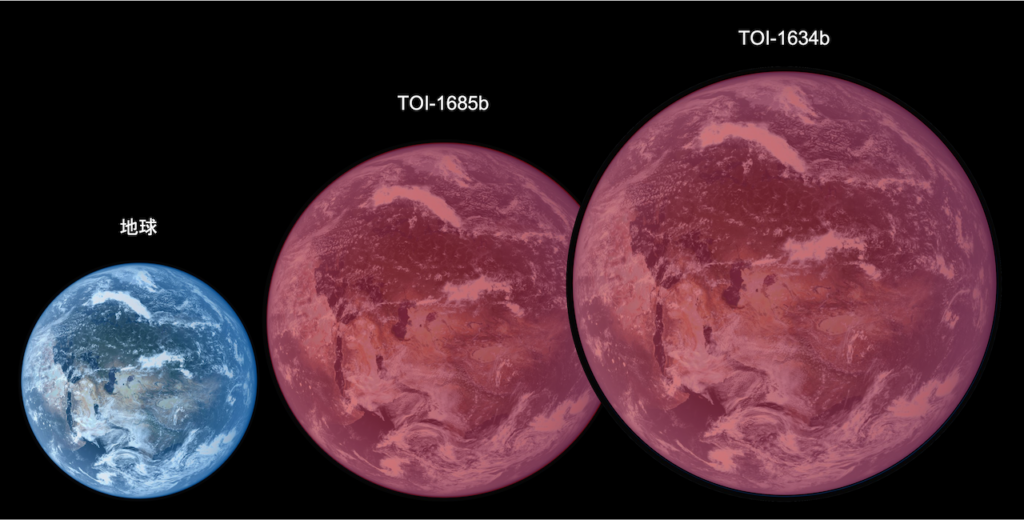
A research team led by researchers from the Astrobiology Center and the University of Tokyo discovered “ultra-short-period planets” with orbital periods of less than a day around cool stars by observations using the Subaru Telescope’s near-infrared spectrograph IRD and other instruments, and revealed that they consist of mainly iron and rock.
The planets discovered around two cool stars, TOI-1634b and TOI-1685b, are super-Earths (Note 1), roughly 1.5-2 times the size of Earth. Particularly, TOI-1634b is one of the terrestrial planets with the largest radius (1.8 Earth radius) and mass (10 Earth mass) among the ultra-short-period planets discovered to date. Located at the boundary between rocky and gas planets, and given the rarity of such discoveries around cool stars, it is said that the most valuable objects were discovered in investigating how planets with “years” shorter than a day on Earth are formed.
Observations have revealed that about 1% of exoplanets (exoplanets) are ultra-short-period planets (planets with orbital periods of less than one day). Ultra-short-period planets are thought to have formed in outer orbits and then moved to inner orbits due to interactions with other planets.
Most of the ultrashort-period planets observed so far are small planets with radii less than 1.5 times that of the Earth, and their internal composition is known to be similar to that of the Earth, consisting mainly of iron and rocks. However, most of these closely examined ultrashort-period planets are known only around sun-like stars (solar-type stars), and only a few have been observed around low-temperature, small-mass stars. Low-temperature stars are known to have a high frequency of multiple small planets, so the frequency of ultrashort-period planets may also be high. Detailed studies of the frequency and characteristics of ultrashort-period planets around low-temperature stars are expected to improve our overall understanding of the origin of ultrashort-period planets.
The research team focused on two low-temperature stars TOI-1634 and TOI-1685, which are transit planet candidates (Note 2) detected by NASA’s Transiting Exoplanet Survey Satellite (TESS). The stars are only about 50% of the mass of the Sun, so we analyzed the TESS data, followed up the transit observations with the MuSCAT series (Note 3), and then conducted spectroscopic observations with the IRD (InfraRed Doppler) spectrograph on the Subaru Telescope. IRD is a spectrograph that precisely measures the line-of-sight velocity of stars, and is uniquely optimized for observing low-temperature stars that appear brighter in the infrared than in visible light.
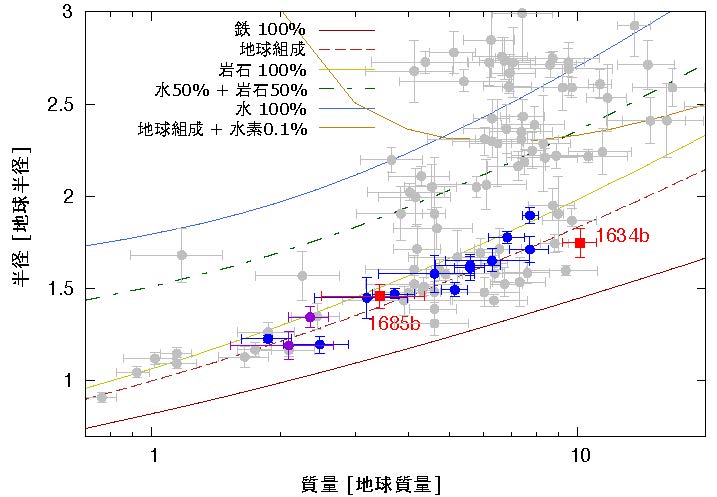
The team analyzed the line-of-sight velocities observed by the IRD in detail and confirmed that the ultra-short-period planets TOI-1634b and TOI-1685b actually revolve around each other with periods of 0.989 days (TOI-1634b) and 0.669 days (TOI-1685b), respectively. Furthermore, the amplitude of the line-of-sight velocity change revealed that TOI-1634b and TOI-1685b have masses about 10 times and 3.4 times that of the Earth, respectively (Note 4). Theoretical estimation of planetary compositions based on these planetary masses and planetary radii determined from transit observations (approximately 1.8 Earth radii for TOI-1634b and 1.5 Earth radii for TOI-1685b) revealed that both planets, like Earth, have internal compositions mainly consisting of iron and rocks (Figure 1). Figure 1). This means that two planetary systems with super Earth-like compositions orbiting close to low-temperature, low-mass stars have been discovered.
TOI-1634b is one of the largest ultra-short-period planets confirmed to have an internal composition similar to that of the Earth in terms of radius and mass, and it is very interesting that such a planet was found around a star much lighter than the Sun. The “mass-radius” relationship (Figure 1) also indicates that both planets lack thick hydrogen atmospheres. In the absence of primordial atmospheres composed of gas from protoplanetary disks, secondary atmospheres composed of gas ejected by the planets may have formed on both planets. This is an interesting observation target for studying how the atmospheres of terrestrial planets orbiting in close proximity to their stars evolve.
(Credit: Astrobiology Center)
Both planetary systems are relatively close to Earth, about 100 light-years away, and are particularly bright among low-temperature stars with ultrashort-period planets, making them strong candidates for the next generation of telescopes. Assistant Professor Teruyuki Hirano (Astrobiology Center, National Institutes of Natural Sciences / National Astronomical Observatory of Japan), the first author of the paper, says, “In the future, we expect that the planetary system discovered in this research will be observed by the James Webb Space Telescope (JWST) and other spacecraft to study the planetary atmosphere and orbit in detail, which will bring us closer to understanding the origin of the still mysterious ultra-short period planets The TESS mission is also expected to help elucidate the origins of the still-enigmatic ultra-short-period planets. The project to intensively follow up the planetary candidates identified by TESS with IRD is still ongoing, and many unique planets should be confirmed by IRD within a year or two,” he said.
This research was published in the Astronomical Journal of the United States on September 23, 2021 (Hirano et al. “Two Bright M Dwarfs Hosting Ultra-Short-Period Super-Earths with Earth-like Compositions”).
(Note 1) “Super-Earths” refer to exoplanets larger than Earth but smaller than Neptune. They typically have masses no larger than about 10 times that of Earth and diameters no larger than about twice that of Earth. There is no planet with such mass and size in the solar system and exoplanet observations first revealed the existence of such planets.
(Note 2) “Transit” is a phenomenon in which a star appears periodically fainter as a planet passes in front of it, and exoplanetary systems in which transits are observed are called transit planetary systems. The transiting planet candidates detected by TESS are confirmed to be real transiting planets only after follow-up observations using other telescopes.
(Note 3) Follow-up observations of transits have been made using the 188cm telescope in Okayama Prefecture, the 1.52m telescope at Teide Observatory in Tenerife, Spain, and the MuSCAT, MuSCAT2, and MuSCAT3 multicolor simultaneous imaging cameras on the 2m telescope at Haleakala Observatory in Maui, USA. The transits were tracked using the MuSCAT, MuSCAT2, and MuSCAT3 cameras mounted on the 2-meter telescope. The parameters such as orbital period and planetary radius, which were tentatively determined by TESS, were determined precisely by these follow-up observations for each of the planets.
(Note 4) When a planet orbits a star, the planet’s gravity causes the star to wobble slightly. This wobble is captured as a periodic change in the line-of-sight velocity of the star by the line-of-sight velocity method, and the larger the mass of the planet, the larger the amplitude of the line-of-sight velocity change. The masses of the two planets were determined by IRD follow-up observations.
About Subaru Telescope:
Subaru Telescope is a large optical-infrared telescope operated by the National Astronomical Observatory of Japan (NAOJ) and supported by the Ministry of Education, Culture, Sports, Science and Technology (MEXT) under the Large-Scale Scientific Frontier Initiative. Mauna Kea, where Subaru Telescope is located, is a precious natural environment and an important place in Hawaiian culture and history, and we are deeply grateful for the opportunity to explore the universe from Mauna Kea.
Publication:
Journal:Astronomical Journal
“Two Bright M Dwarfs Hosting Ultra-Short-Period Super-Earths with Earth-like Compositions“
Authors:Teruyuki Hirano, Noriyasu Narita, et al.
■Related Links
Discovery of an Earth-like Planet with a “Year” Less Than One Day Long Around a Low-Temperature Star(NAOJ Hawaii Observatory, September 27, 2021 Press Release)
Discovery of an Earth-like Planet with an “Annual” Length of Less Than a Day Around a Low-Temperature Star(University of Tokyo, September 27, 2021,Press Release)