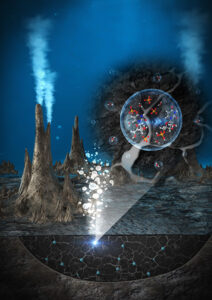
(Credit: T. Currie, NAOJ/NASA-Ames)
The combination of the new exoplanet imaging instrument on Subaru Telescope with innovative ideas for direct explorations of exoplanets has enabled the discovery of new objects orbiting stars more efficiently than ever before. Then they discovered the first ultra-low-mass object HD 33632 Ab by this method. This object is important even when compared to known exoplanets.
The SCExAO and CHARIS on Subaru Telescope represent the state-of-the-art instruments for observing exoplanets and circumstellar disks. SCExAO employs extreme adaptive optics, creating sharp point spread functions as if Subaru Telescope were launched into space free from the atmospheric turbulence of the Earth. CHARIS has a function of integral field spectroscopy enabling the acquisition of spectra from each tiny area of the sky simultaneously. By combining these instruments, it becomes possible to image objects with an unprecedented contrast level while observing their spectra at the same time.

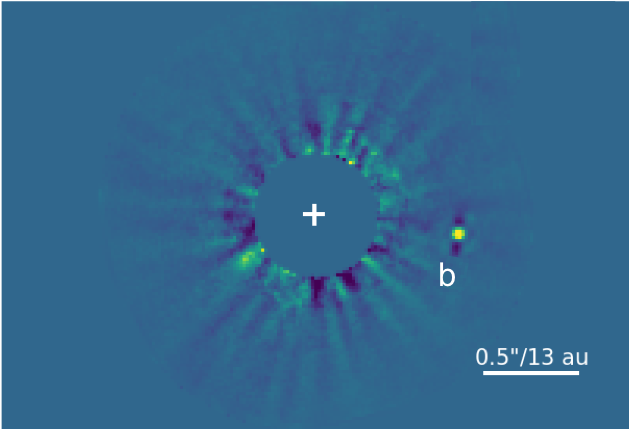
This system has undergone approximately two years of engineering at Subaru Telescope and has already yielded achievements in observations of several objects (Note 1). This time, an international research team including researchers from National Astronomical Observatory of Japan and the Astrobiology Center discovered the ultra-low-mass object (brown dwarf: Note 2) HD 33632 Ab (see Figure 1) with this new system. HD 33632 Ab orbits a star that, except for being slightly younger at 1.5 billion years than the Sun, shares many characteristics with our Sun. It is located in the direction of Auriga, at a distance of 86 light-years from Earth.
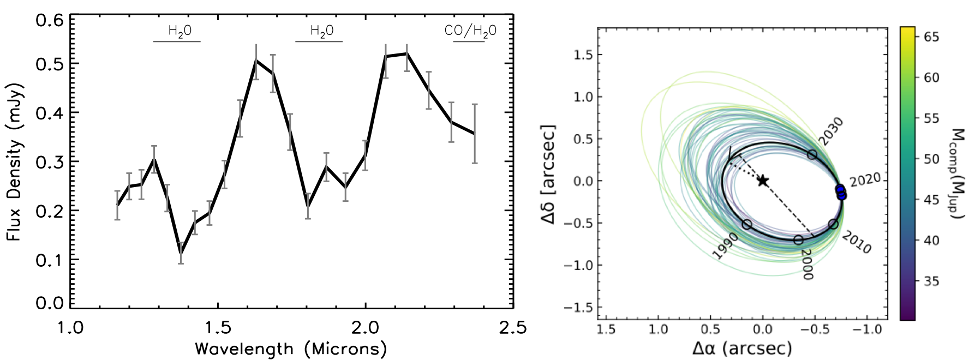
Observations with SCExAO and CHARIS were made in October 2018, followed a month later by observations with the Keck telescope. As a result, HD 33632 Ab was found at a distance of only 20 AU from the star (the central star). Further observations were made on August 31 and September 1, 2020, with more time to follow up on the observations, despite the influence of COVID-19. This proved that HD 33632 Ab is not just a background star, but a new object gravitationally bound to its host star The spectrum of HD 33632 Ab obtained by CHARIS has a shape consisting of several peaks and troughs (Figure 2 left). This is due to the presence of water and carbon monoxide gases in the atmosphere of HD 33632 Ab.
Thanks to the extremely sharp images obtained with the new instrument, we have not only found HD 33632 Ab, but we have also obtained its exact position on the celestial sphere and a spectrum that will help us understand the nature of the object’s atmosphere,” said lead author of the study Dr. Thane Curie, who is affiliated with NASA’s Ames Research Center and concurrently holds a post at Subaru Telescope. Dr. Sein Curie, lead author of the study, who works at NASA’s Ames Research Center and also serves at Subaru Telescope.
The discovery of HD 33632 Ab utilized a new approach to overcome the low detection rates that have been a problem for direct exoplanet searches. The positional astronomical satellite Gaia, launched in 2013, has made it possible to measure the motion of central stars as changes in their positions in the celestial plane. The detection of HD 33632 Ab is proof that this approach is effective.
HD 33632 Ab is the first brown dwarf we have discovered by looking for stellar wobbles in the celestial plane. In the past, looking for brown dwarfs has been like trying our luck, but now we have a much better chance of finding one,” said Dr. Timothy Brandt, an assistant professor at the University of California, Santa Barbara, and a co-investigator familiar with Gaia data.
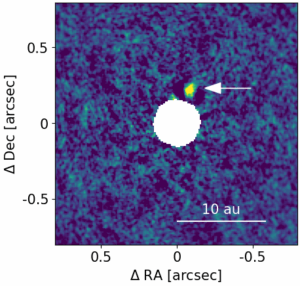
Based on the motion of the central star observed by Gaia and other instruments and the change in position of HD 33632 Ab observed by the Subaru/Keck telescope, the orbit of HD 33632 Ab was analyzed (Figure 2 right), and the mechanical mass of HD 33632 Ab was estimated to be about 46 times that of Jupiter based on Kepler’s Law. In distinguishing between planets and brown dwarfs, we usually refer to a planet if its mass is less than 13-14 times that of Jupiter; HD 33632 Ab’s mass is larger than this boundary value and in the brown dwarf range, but its orbital eccentricity is low and similar to planets discovered by direct imaging so far.
HD 33632 Ab will be an important object for understanding the exoplanet of HR 8799, a planetary system first imaged in 2008-2010 and most closely studied by direct imaging. Compared to HR 8799, which is 40 million years old, HD 33632 is much older. However, because of its large mass and surface gravity, HD 33632 Ab’s surface temperature will be about the same as that of HR 8799’s planet (Note 3). On the other hand, the mass of HD 33632 Ab is well determined by dynamics, and the mass of the planet of HR 8799 is also limited by various techniques. In other words, the planets in HD 33632 Ab and HR 8799 are the best objects for understanding the differences in atmospheres of very low-mass stars (planets and brown dwarfs) with different temperatures due to their different ages and gravities.
The atmospheres of exoplanets like the HR 8799 system are notoriously difficult to model and are thought to have peculiar properties like thick clouds. This new object is important for understanding the atmospheres of these complex exoplanets,” said Curie.
Detection rates of planets and brown dwarfs in previous direct imaging surveys have been very low, around a few percent (Note 4). The research team is using a new method of exploration and observation that utilizes data from positional astronomical satellites. Although this search has just begun, the team has already found several new promising candidates and expects to find planets and brown dwarfs more frequently than in the past.
With the combination of SCExAO and CHARIS, Subaru Telescope will remain at the forefront of direct observations of exoplanets and brown dwarfs,” said co-investigators Professor Motohide Tamura (Center for Astrobiology, University of Tokyo) and Assistant Professor Masayuki Kuzuhara (Center for Astrobiology, University of Tokyo) expressed their expectations for SCExAO/CHARIS.
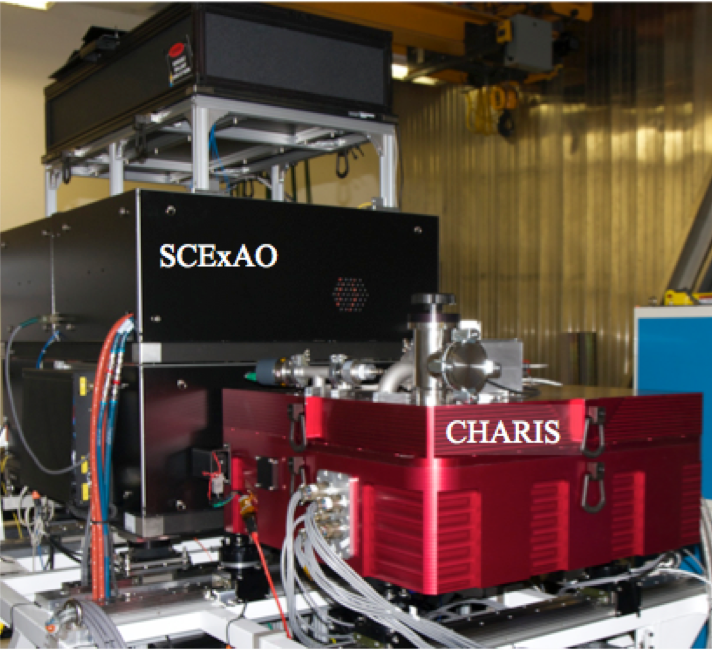
(Credit: CARIS team, Princeton University; National Astronomical Observatory of Japan)
This research achievement was published in the Astrophysical Journal Letters (November 30, 2020)(Currie et al., “SCExAO/CHARIS Direct Imaging Discovery of a 20 au Separation, Low-Mass Ratio Brown Dwarf Companion to an Accelerating Sun-like Star“).
Note 1: The research achievements using SCExAO and CHARIS include observations of protoplanetary disks “Subaru Telescope Images Hidden Young Planetary Systems” and other studies.
Note 2: A brown dwarf is a type of celestial object that fell short in becoming a main-sequence star due to its insufficient mass.
(Note 3) In the case of giant planets like Jupiter, we generally expect younger planets to have higher temperatures, and brown dwarfs that are more massive than planets are expected to have higher temperatures. Since HR 8799 is a young planet, its temperature is expected to be similar to that of HD 33632Ab, a more massive brown dwarf.
(Note 4) Previous direct imaging surveys include the SEEDS project with the Subaru Telescope and the GPI (GPI) and SPHERE (SPHERE) surveys with the VLT (VLT) telescope at the Gemini Telescope in Chile, both of which have detected only a few percent of the planet and its brown dwarf companion. The detection rate of planets and brown dwarf companions by these surveys was only a few percent.
Related Links
Subaru Telescope Press Release