Key Points:
- A new extra-solar planet (exoplanet) LP 791-18d was discovered through collaborative global observations using space and ground-based telescopes.
- LP 791-18d is speculated to exhibit active volcanic activity similar to Jupiter’s moon Io.
- Located near the inner edge of the habitable zone, LP 791-18d potentially retains an atmosphere, making it an intriguing planet for studies on the origin of life.
Overview:
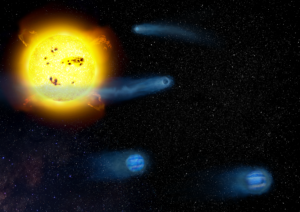
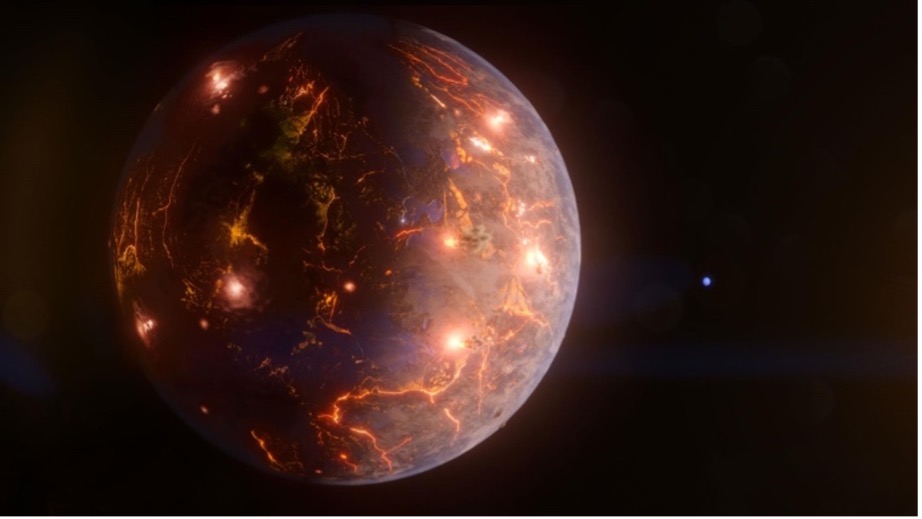
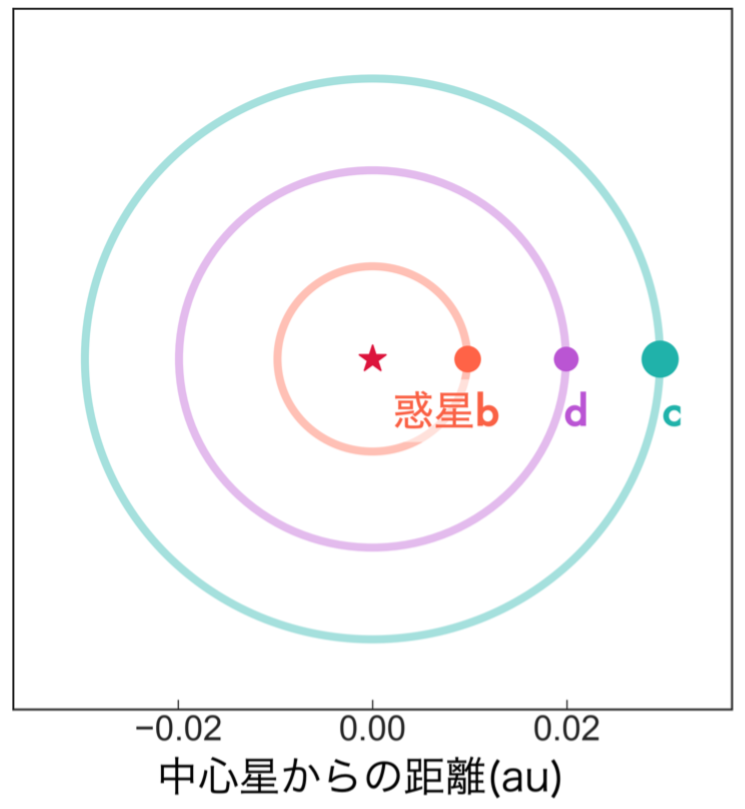
An international research team including Professor Norio Narita (Graduate School of Arts and Sciences, The University of Tokyo; Visiting Professor at Astrobiology Center, National Institutes of Natural Sciences), Project Assistant Professor Akihiko Fukui, and Project Researcher Mayuko Mori, discovered the Earth-sized exoplanet LP 791-18d around a red dwarf star located approximately 90 light-years away through research by a combination of space and ground-based telescope observations (see Figure 1). This planet d has an elliptical orbit influenced by the gravitational pull from a larger, outer adjacent planet c, suggesting that d is covered with volcanoes akin to Jupiter’s moon Io. Future observations of this planet’s atmosphere are anticipated, and the study of how crustal activity affects planetary atmospheres could yield significant findings. This discovery was realized through collaborative observations over NASA’s Transiting Exoplanet Survey Satellite (TESS), NASA’s Spitzer Space Telescope, and multiple ground-based telescopes including the MuSCAT and MuSCAT2 multi-color simultaneous imaging cameras developed by researchers from The University of Tokyo and the Astrobiology Center (see Figures 2 and 3).
This research was published in the journal “Nature” on May 17, 2023 (British Summer Time).
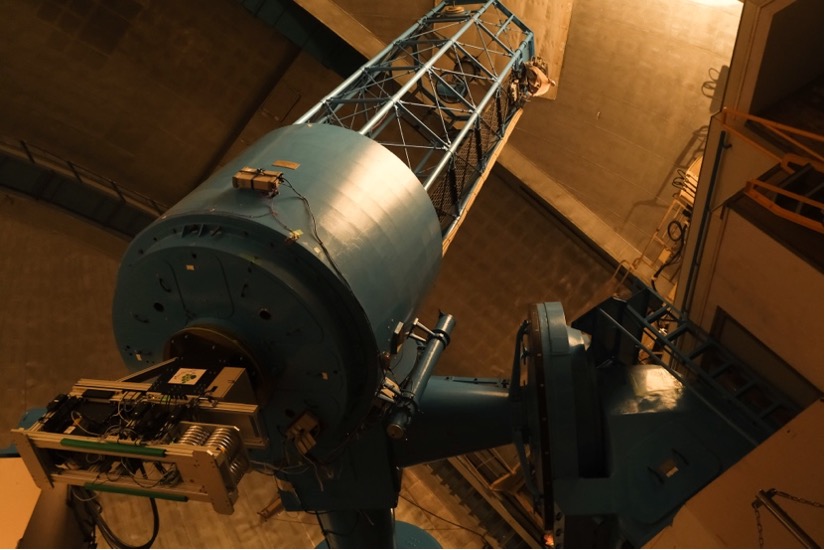
This is the MuSCAT utilized for this observational study enabling optical-light three-color simultaneous imaging observations. The instrument is installed at the Subaru Telescope Okayama Branch of National Astronomical Observatory of Japan (Okayama Prefecture). Credit: MuSCAT Team.
Announcements
〈Research Background〉
The red dwarf star LP 791-18 is located approximately 90 light years away from our solar system in the direction of the constellation Cop. The transit planet search satellite TESS (Transiting Object Survey Satellite) has previously discovered planets b and c around this star. Planet b has a radius about 1.2 times that of the Earth and an orbital period of about 0.94 days, while planet c has a radius about 2.5 times that of the Earth and an orbital period of about 4.99 days.
〈Research〉
Research DescriptionThe transit of a new planet, LP 791-18d, was discovered by a series of 127-hour observations with the Spitzer Space Telescope. The planet d is located in an orbit between planets b and c (Figure 1), orbiting its star with an orbital period of 2.75 days. Its radius is estimated to be approximately 1.03 Earth radii, very similar to that of the Earth.
To find out what kind of planet this planet is, a number of teams participating in the TESS Follow-up Observing Program (TFOP), the official follow-up observation program of TESS, including the MuSCAT team from Japan (Note 4), conducted transit observations of planets c and d using ground-based telescopes. Observations of the transits of planets c and d were made using ground-based telescopes.
Each orbit around LP 791-18 brings planets d and c closer to each other. At this time, their mutual gravitational influence causes the transit time to deviate from the fixed orbital period. The MuSCAT team and other ground-based telescopes have measured the transit time of each planet and found that the mass of planet d is about the same as that of the Earth and the mass of planet c is about 9 times that of the Earth. The results of the observations are as follows
The gravitational force exerted by planet c slightly deforms the orbit of planet d into an elliptical shape. While orbiting in this elliptical orbit, the planet d is slightly deformed by the tidal forces (Note 5) exerted on it from its star. This deformation creates friction inside the planet, possibly heating the planet and causing active volcanism on the planet’s surface. This is the same heating mechanism used by Jupiter’s moon Io, which exhibits the most active volcanic activity in the solar system.
〈今後の展望〉
LP 791-18d is a planet located near the inner boundary of the habitable zone, where tidal forces from the star cause its rotation period to coincide with its orbital period, and it is thought to always face the same side toward the star. The “day side” of the planet receiving light from the star is likely too hot for liquid water to exist, but if volcanic activity is occurring, the planet may have an atmosphere and liquid water may exist on the “night side” of the planet due to water vapor condensation in the atmosphere.
Planet c is scheduled to have its atmosphere observed by the James Webb Space Telescope (Note 6), the newest space telescope that began observations last year. In addition, the research team believes that the newly discovered planet d could also be an important target for planetary atmosphere observations.
Active volcanism on a planet may be responsible for pumping materials into the atmosphere that would normally be trapped inside the planet’s crust. Such materials include carbon, which is important for life. Detection of the atmospheric composition of a planet would allow us to study in depth the effects of planetary crustal activity on planetary atmospheres. This could lead to the study of the origin of life, which is important from an “astrobiology” perspective.
Research Grants
This work was supported by Grants-in-Aid for Scientific Research (KAKENHI: Grant-in-Aid for Scientific Research, JP17H04574, JP18H05439), Grant-in-Aid for Young Scientists (JP20J21872), Japan Science and Technology Agency (JST) Strategic Creative Research Promotion Program PRESTO (JPMJPR1775), CREST (JPMJCR1761), and National Institutes of Natural Sciences Astrobiology Project (AB031010). JPMJCR1761), and National Institutes of Natural Sciences, Center for Astrobiology Project (Project No. AB031010).
Annotation
(Note 1) Red dwarf
A star with a surface temperature below about 3,500 degrees Celsius is called a red dwarf. About 80% of the stars in the universe are red dwarfs, and many of the stars in the vicinity of our solar system are also red dwarfs. Because they are smaller than the Sun and have a lower surface temperature, the habitable zone, which is the region that can hold liquid water on the surface of a planet, has a shorter period than that of the Sun.
(Note 2) Transit planet search satellite TESS
When an exoplanet crosses in front of its star, the brightness of the star dims slightly. TESS is NASA’s satellite project to search for exoplanets by transit. The plan has been to search for transit planets over a two-year period. A second extension plan is currently underway, which will continue observations until at least 2025. Over the past five years, TESS has discovered more than 6,000 transit planet candidates.
(Note 3) Spitzer Space Telescope
This space telescope was launched by NASA in 2003 and retired in 2020. It is capable of high-precision infrared observations and played a major role in the observation of exoplanets.
(Note 4) MuSCAT Team
The MuSCAT series of multi-color simultaneous imaging cameras that can observe transits in three or four wavelength bands simultaneously, developed by Professor Narita and Project Assistant Professor Fukui for the 188 cm telescope in Okayama, the 1.52 m telescope in Tenerife, Spain, and the 2 m telescope in Maui, USA (the instrument names are MuSCAT, MuSCAT2, and MuSCAT3), MuSCAT stands for Multicolor Simultaneous Camera for studying Atmospheres of Transiting exoplanets, after the famous Okayama (Note 4) Tidal force
(Note 5) Tidal force
A force that changes the shape of celestial body A when it is subjected to gravitational force from another celestial body B. On Earth, the moon causes the ebb and flow (shape change) of the oceans. On Jupiter’s moon Io, the friction inside the moon caused by tidal forces heats the interior of the moon, resulting in active volcanic activity.
(Note 6) James Webb Space Telescope A 6.5 m aperture space telescope launched by NASA, launched on December 25, 2021, to begin scientific observations in 2022. The telescope is capable of imaging, spectroscopic, and photometric observations in the visible, near-infrared, and mid-infrared regions with previously unattainable precision.
Publication
〈Journal〉 Nature
〈Title〉 A temperate Earth-sized planet with tidal heating transiting an M6 star
〈Authors〉 Merrin S. Peterson, Björn Benneke, Karen Collins et al.
〈DOI〉 10.1038/s41586-023-05934-8
〈URL〉 https://www.nature.com/articles/s41586-023-05934-8
Related Links
University of Tokyo Press Release
Japan Science and Technology Agency (JST)Press Release