Key Points
- IRD, the world’s unique new exoplanet search instrument for the Subaru Telescope, has begun full-scale operation.
- For the first time in the world, it is now possible to detect stellar motion “in the infrared” at the speed of a human walk.
- For the first time, systematic searches for light planets such as the Earth became possible with the Subaru Telescope.
Abstract
The InfraRed Doppler (IRD, in Japanese), a new exoplanet search instrument for the Subaru Telescope, has been developed and built by a team led by researchers from the National Astrobiology Center of the National Institutes of Natural Sciences, the National Astronomical Observatory of Japan, the University of Tokyo, Tokyo University of Agriculture and Technology, and Tokyo Institute of Technology, In February 2018, the team began astronomical observations at the Subaru Telescope and successfully achieved first light (see note 1) of the instrument, taking advantage of all its capabilities.
The IRD is an instrument designed to search for exoplanets using infrared light rather than visible light, which has been the predominant Doppler method (Note 2). Using the latest infrared and laser technology, IRD is currently the world’s most accurate infrared instrument for detecting changes in stellar velocity.
The IRD is currently the world’s most accurate infrared instrument for detecting changes in stellar velocity. With full-scale observations in the near future, we aim to use the unique features of IRD and the large aperture of the Subaru Telescope to discover Earth-like planets around light, low surface temperature stars (M-type stars: Note 3), which are also numerous near the Sun. Such planets will be excellent targets for the next-generation telescope’s search for life.
Please look forward to the new exoplanet search instrument, IRD, which has finally begun its mission!
Background
Exoplanets, one of the hottest research subjects in astronomy, have now transcended the boundaries of astronomy and become the subject of astrobiology, the study of life in the universe. Advances in exoplanet and astrobiology observation techniques are expected to lead to the detection of water, oxygen, and other substances necessary for the existence
of life on exoplanets in the near future.
Recent exoplanet searches, led by the Kepler space telescope, have discovered more than 5,000 exoplanets and candidates, some of which are habitable planets, or planets with the “potential” to be suitable for life. However, the number of habitable planets discovered so far is too small to study in detail, and the habitable planets found by the Kepler Space Telescope are too far from the Earth to study their characteristics in detail. Therefore, an important future challenge in astrobiology is to discover habitable planets that are close enough to Earth to study their characteristics in detail.
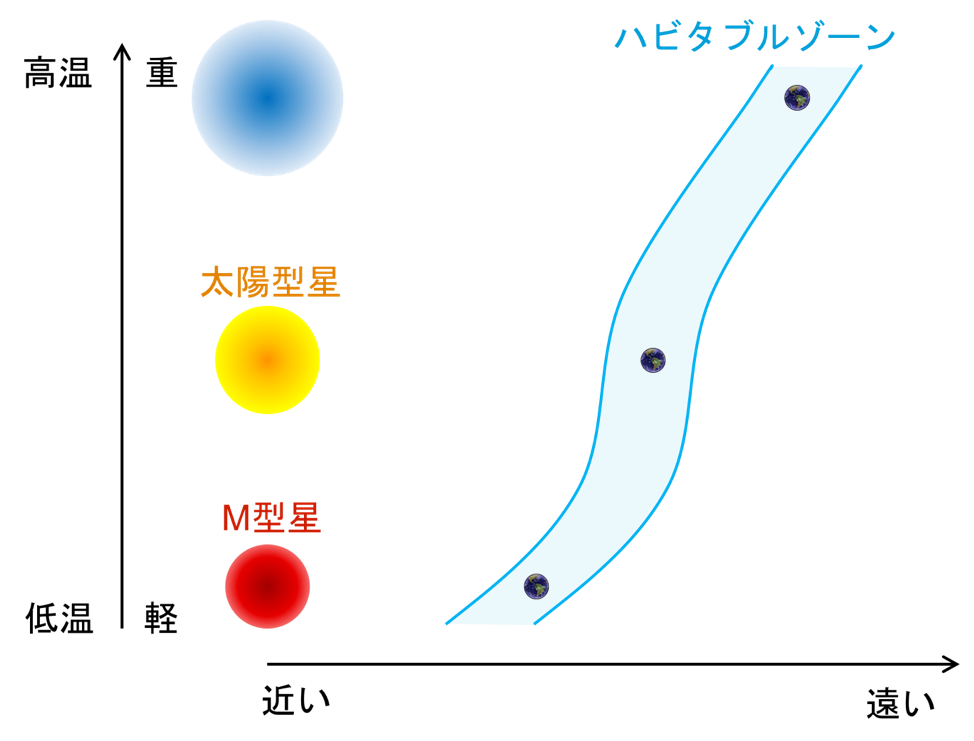
The habitable zone is closer to the parent star for lower temperature stars and farther away for higher temperature stars. (Credit: Astrobiology Center)
Liquid water, considered essential for the existence of life, can only exist in moderate environments. The distance from the parent star defined as “the region where liquid water can exist” is called the habitable zone (Figure 1). We can also imagine that a suitable planet for life would be a light planet like the Earth, mainly made of rock. However, the Doppler method (Note 2) and the transit method (Note 4), which are the main methods to search for exoplanets, detect planets by studying variations in the velocity and brightness of the parent star, but the smaller the planet to be found, the more precise observations are required. The higher the temperature of the parent star, the further away from the parent star the habitable zone becomes, and the farther away from the parent star, the more difficult it is to find a planet using the Doppler and transit methods. For example, it is very difficult to discover a planet about the same size as the Earth that orbits a star with a temperature similar to that of the Sun in one year. Therefore, it is very difficult to discover Earth-like planets in the habitable zone, and only a few such planets have yet been discovered.
M-type stars (Note 3), also known as red dwarfs, have a habitable zone close to the parent star due to their low surface temperature and faintness. In addition, because M-type stars are smaller in mass and size than other stars such as solar-type stars, the variability of the parent star caused by the planet is greater. This makes it easier to detect planets located in the habitable zone for M-type stars. In addition, M-type stars are often located near the Sun, making them very good targets for the discovery of Earth-like habitable planets. If we can discover habitable planets around M-type stars near the Earth, it will be easier to conduct detailed observations in the future.
One of the most interesting objects to observe is a late M-type star (Note 3), which is a low-mass and low-temperature type of M-type star. Late M-type stars have the potential to discover a planet with a mass similar to that of the Earth in the habitable zone using current state-of-the-art technology. Therefore, Late M-type stars are very promising objects for the discovery of potentially life-supporting planets. However, late M-type stars are generally faint, which is a problem for astronomical observations. In order to make high-precision observations, it is necessary to collect enough light emitted by the observed object, which is difficult to do with faint objects. In addition, the search for exoplanets has been conducted mainly in visible light, but late M-type stars are generally faint in visible light, which has also made it difficult to observe late M-type stars. Late M-type stars at low temperatures are brighter in the infrared than in visible light, making observations in the infrared more advantageous.
Development of IRD and the science we aim to achieve
A research team consisting mainly of researchers from the National Astrobiology Center, National Astronomical Observatory of Japan, the University of Tokyo, Tokyo University of Agriculture and Technology, and Tokyo Institute of Technology has been developing a new instrument for exoplanet exploration called the InfraRed Doppler (IRD). The IRD will enable highly accurate Doppler observations in the infrared, which has not been possible in the past, using the most suitable infrared light for late M-type stars. The Doppler method, however, is less susceptible to this problem and is therefore more effective for searching for habitable planets that are close to the Earth. The Doppler method is effective for finding habitable planets near the Earth.
The IRD has a number of innovations for finding small planets, which will be discussed in more detail later. I will describe them in detail later.
(1) A very stable infrared spectrograph with high wavelength resolution and the ability to observe a wide range of wavelengths simultaneously (Note 5)
(2) A laser frequency comb (optical comb) that provides an accurate measure of stellar velocity
(3) mode scramblers that reduce light turbulence that can cause instability
, and more. Subaru Telescope’s large primary mirror can collect enough light even from faint Late M-type stars. Late M-type stars are faint in visible light but bright in infrared light because their surface temperature is only about half that of the Sun. The combination of the IRD, which can search for planets with high precision in the infrared, and the Subaru Telescope, which has a large aperture, is the best combination for finding habitable planets around Late M-type stars by the Doppler method.
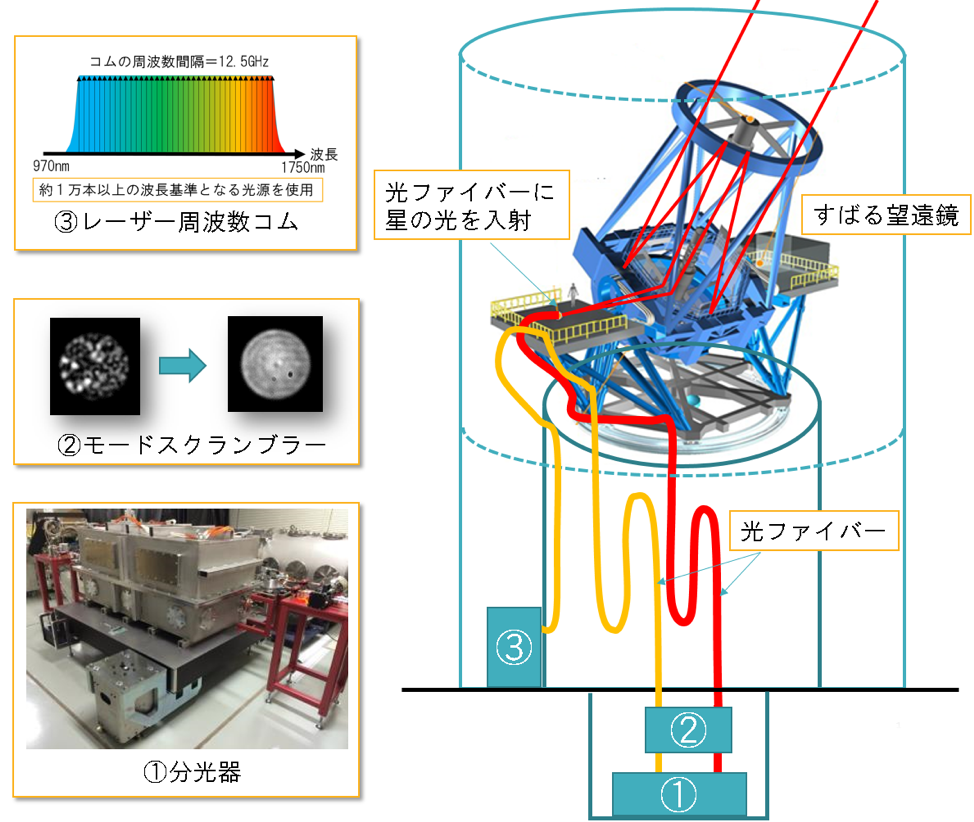
Light from celestial objects collected at the Nasmyth focus of the Subaru Telescope is put into the spectrograph (1), which is placed in a coupled chamber with a small temperature change, using a fiber injection system and optical fibers. Before the light is put into the spectrograph, it is passed through a mode scrambler (2) to reduce turbulence. The light from the laser frequency comb (3) also enters the spectrograph through the same path as the celestial light from the Nasmyth focus.
First light on InfraRed Doppler (IRD) equipment
The IRD has been in planning, development, fabrication, testing, and installation on the Subaru Telescope for almost eight years. As a result, we succeeded in first light with the spectrograph alone in August 2017 (see note 1) and in a complete form combined with the optical com in February 2018.
IRD uses the Doppler method to observe planets, but the Doppler method requires the use of spectroscopy to obtain stellar spectra. Figure 3 shows the data for M-type stars obtained at First Light in February 2018. This figure is used to show why IRD can precisely measure the velocity of a star. On the two-dimensional image in Figure 3, you can see a line with darkened areas in some places, which is the spectrum of the star. In parallel with the spectrum of the star, you can see many small dots lined up in a regular pattern like dotted lines. This is the spectrum of the optical comb observed at the same time as the spectrum of the star as the reference light. This optical comb serves as a “precision scale” that is used as a reference for measuring the velocity of stars in IRD observations. Laser frequency combs are very new to astronomy, having been rarely used in astronomy until now.
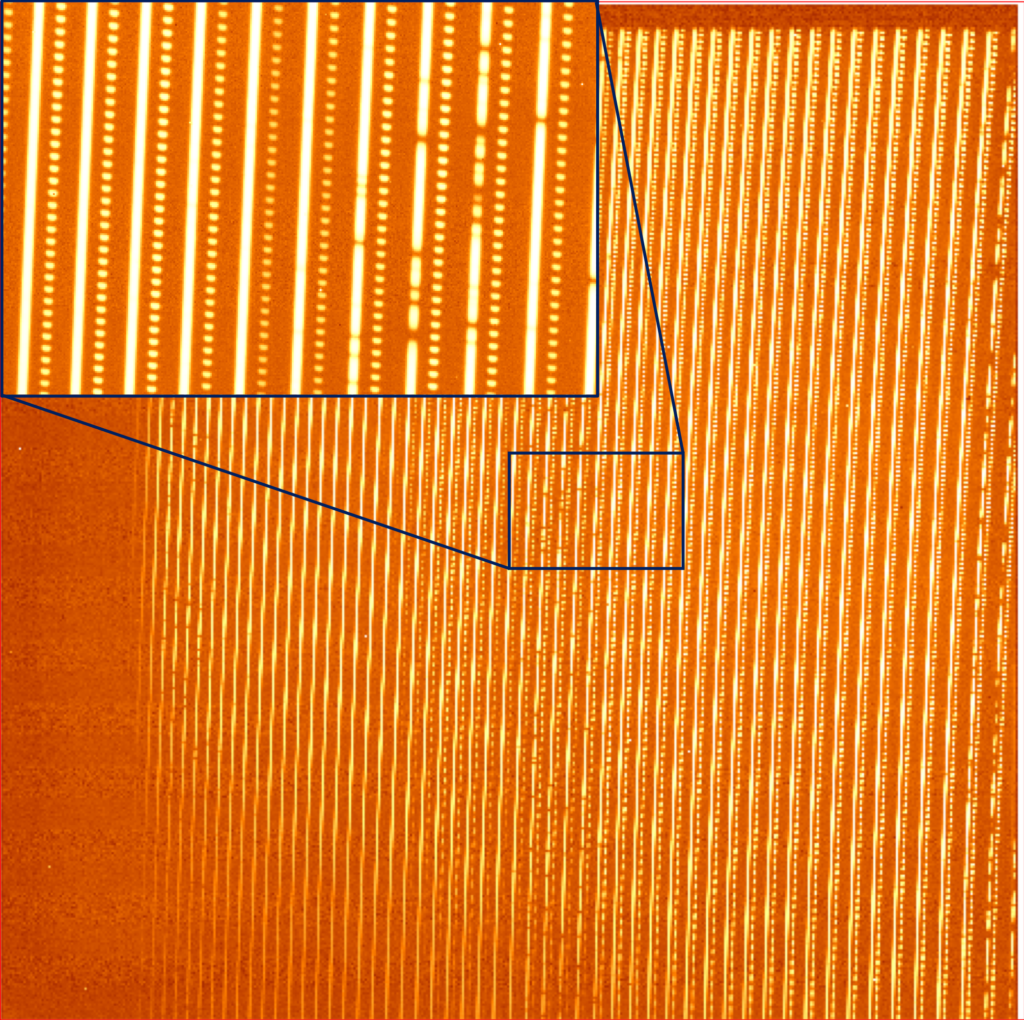
The straight lines that appear as stripes are the spectrum of the star. The dotted line next to the spectrum of the star, which can be seen by zooming in on the central part, is the spectrum of the optical com. What sometimes appears to be a break in the straight lines of the star’s spectrum is due to absorption by the star itself. (Credit: Astrobiology Center)
The spectrum acquired on a two-dimensional image is transformed into a one-dimensional spectrum (light intensity per wavelength) by data processing, as shown in Figure 4. The upper panel of Figure 4 shows an enlarged image of a small portion of the spectrum of the M-type star (GJ436) obtained from observations, in which a large number of absorption lines are visible. These absorption lines are caused by the absorption of light at that wavelength by the gas in the atmosphere of the parent star, but when the star is accompanied by a planet, the wavelength of the absorption lines changes due to the Doppler effect of light as the velocity of the star changes. The presence of a planet can be investigated by examining the wavelength variation in detail with respect to the optical com spectra. The purpose of this first light was to test the performance of the IRD, and this data was also acquired for that purpose. We will continue to test the performance of the IRD using the Subaru Telescope in the future.
The IRD’s unique observational capabilities were also used in this test observation, and only with these instruments will we be able to discover habitable planets in late M-type stars. The following is a detailed description of those capabilities.
IRD Features for Discovering the Second Earth
Feature 1: Infrared spectrometer with high wavelength resolution, wide wavelength range, and high temperature stability
The key to finding planets using the Doppler method is the wavelength resolution of the spectrograph, which indicates “how finely light can be divided. The higher the wavelength resolution, the more absorption lines in the spectrum of a celestial body can be sharply captured. As a result, more absorption lines can be separated, substantially increasing the number of absorption lines whose variability can be studied. This allows the Doppler method to achieve high precision observations. Since absorption lines in the infrared spectra of late M-type stars are crowded, high wavelength resolution is important, and IRD uses infrared spectroscopy with very high wavelength resolution to search for planets. IRD’s infrared spectrograph has a wide wavelength range. The wider wavelength range of the spectrograph increases the number of available absorption lines, which improves the accuracy of the Doppler method. The spectrometer must be stable because the Doppler variation signal due to the planet is very small and difficult to capture. Therefore, IRD controls the temperature of the spectrograph with extremely high precision to minimize the noise that can occur when the instrument is unstable.
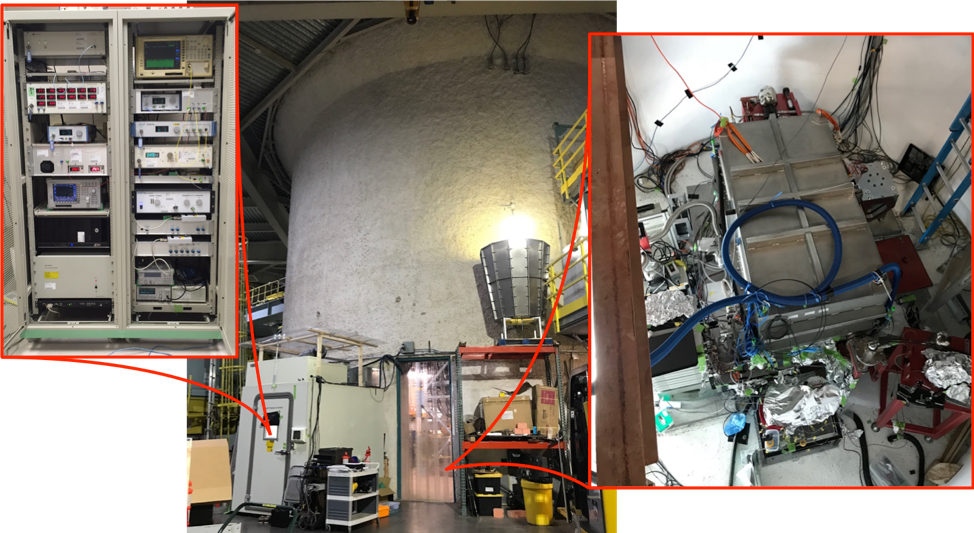
Feature 2: Laser frequency comb for extremely precise wavelength scaling
Das IRD verwendet einen Laserfrequenzkamm (optischer Kamm) als „Wellenlängenskala“. In der Vergangenheit wurde eine bestimmte Wellenlängenskala als Wellenlängenskala verwendet. In der Vergangenheit wurden Lampen und Jodzellen, die die Eigenschaften bestimmter Atome und Moleküle nutzten, als Wellenlängenskala verwendet, aber ihre Leistung war im Infraroten sehr begrenzt, was für die Beobachtung von Sternen des M-Typs von Vorteil ist. Laserfrequenzkämme, die in den letzten Jahren zunehmend in Bereichen wie der Präzisionsspektroskopie eingesetzt werden, senden eine sehr große Anzahl von „Laserstrahlen“ über einen überwältigend großen Wellenlängenbereich im Infraroten aus und dienen als Standards für verschiedene Wellenlängen. Auf diese Weise lassen sich Wellenlängen genauer als je zuvor bestimmen und die gesamte Bandbreite der Absorptionslinien im Sternspektrum nutzen.
Merkmal 3: Mode Scrambler zur Verringerung von Lichtturbulenzen beim Durchgang durch die Faser.
Ein weiteres wichtiges Merkmal von IRD ist eine Funktion namens Mode Scrambler. Bei der Messung sehr kleiner Dopplerverschiebungen mit einem Spektrographen ist bekannt, dass die Instabilität von Instrumenten wie Teleskopen und atmosphärische Turbulenzen das Licht (d. h. das Spektrum) von Himmelsobjekten stören können, was zu großem „Rauschen“ führt, das präzise Messungen behindert. Das IRD ist mit einem so genannten „Mode Scrambler“ ausgestattet, der dieses Rauschen reduziert, indem er das Licht mit Hilfe von Glasfasern usw. absichtlich stark „stört“. Die für astronomische Infrarotbeobachtungen geeigneten Fasern und Scrambler, die für die Zwecke des IRD verwendet werden, sind nicht gut bekannt, so dass das IRD-Team an verschiedenen Geräten arbeitet. Das IRD-Team hat bisher verschiedene Arten von Fasern und Mode-Scramblern getestet, da diese noch nicht gut bekannt sind. Die für diese Beobachtung ausgewählten Fasern und Modescrambler wurden auch verwendet.
Prospects
Der IRD, der erfolgreich zum ersten Mal beleuchtet wurde, steht Forschern auf der ganzen Welt seit August 2018 zur Verfügung. Es wird erwartet, dass die Beobachtungen mit dem Subaru-Teleskop in naher Zukunft ernsthaft beginnen werden. Das IRD-Team plant außerdem, mit einer Reihe japanischer und internationaler Exoplanetenforscher zusammenzuarbeiten, um ein Projekt zur Planetenjagd auf späte Sterne vom Typ M mit dem IRD und dem Subaru-Teleskop voranzutreiben. Das Projekt zielt darauf ab, bewohnbare Planeten um Sterne des späten M-Typs zu entdecken und Planetensysteme um Sterne des späten M-Typs zu charakterisieren. Sterne des späten M-Typs sind in unserer Galaxie reichlich vorhanden. Mehr als 500 von ihnen befinden sich in der Nähe unseres Sonnensystems in einer Entfernung von weniger als 30 Lichtjahren, so dass Exoplaneten in ihrer Umgebung eingehend untersucht werden können, sobald sie gefunden werden. Es wird erwartet, dass die Suche nach Planeten in späten M-Typ-Sternen mit IRD wertvolle Erkenntnisse für die Astronomie und Astrobiologie liefern wird. Auf diese Weise werden in Zukunft Beobachtungen mit dem IRD durchgeführt werden, um seine einzigartigen Eigenschaften optimal zu nutzen. Wir freuen uns auf das neue IRD-Instrument zur Suche nach Exoplaneten, das nun endlich seine Arbeit aufgenommen hat!
Annotation:
Note 1 First light
First time the light collected by a telescope is put into an astronomical instrument.
Note 2 Doppler method (line-of-sight velocity method)
This is a method of finding a planet by detecting the “stellar wobble” caused by the planet’s orbit around the star. In the spectrum of a star, there are many absorption lines due to atoms and molecules in the star’s atmosphere. When a star is slightly shaken by the gravitational pull of a planet, the wavelengths of these absorption lines are slightly shifted due to the Doppler effect of light. This periodic shift of wavelengths caused by planetary orbits can be used to determine the existence of a planet by observing the change in the velocity of the star relative to us over a long period of time. In the Doppler method, the more massive and close the planet is to us, the larger the stellar jolts become and the easier they are to observe. The first exoplanet (51 Pegasus) to be identified around an ordinary star was found by this method.
Note 3 (Late) M-type stars
M-type stars are stars with surface temperatures between 2,200°C and 3,800°C and masses between 0.08 and 0.6 times that of the Sun. Compared to the Sun, which has a surface temperature of about 5500 °C, M-type stars have a lower surface temperature than the Sun. In this section, we further distinguish the objects with surface temperatures below 3000 ºC among M-type stars, which have lower temperatures and lighter masses, as late M-type stars.
Note 4 Transit method
When a planet passes in front of a star, the light of the star periodically dims. This method is used to find a planet by observing this change in brightness over a long period of time. It is unlikely that a planet passes “just in front” of a star, so it is necessary to observe a large number of stars. On the other hand, the larger the planet, the greater the change in brightness. By observing many stars, Kepler was able to find thousands of planets.
Note 5 (Infrared) Spectrograph
A device that records light divided into various wavelengths using optical elements such as prisms and diffraction gratings in order to precisely study the “color (= wavelength)” of celestial light. To investigate the Doppler effect of light, it is necessary to divide the light into very fine wavelengths using a spectroscope. Spectrographs have different wavelengths of light that can be spectrally divided depending on their characteristics, but IRD is equipped with a spectrograph for spectroscopy of infrared light.
Co-presenting Institution
National Institutes of Natural Sciences National Astronomical Observatory of Japan Subaru Telescope
Graduate School of Science, The University of Tokyo
Announcer
Takayuki Kotani (Assistant Professor, Center for Astrobiology/ National Astronomical Observatory of Japan)
Motohide Tamura (Director, Center for Astrobiology/ Professor, Graduate School of Science, University of Tokyo/ Professor, NAOJ)
and others, IRD Development Team