An international research team led by Bordeaux University, the University of Tokyo, and the Astrobiology Center discovered approximately 100 objects, which is the largest number among the homogeneous samples of free-floating planets to date, from images of star-forming regions captured by Subaru Telescope’s Hyper Suprime-Cam or other instruments. Comparisons with theoretical models of star formation revealed that most of these objects did not originate as stars from molecular clouds but were likely born as planets around stars and then ejected from their respective planetary systems. This study sheds light on the identity and origin of enigmatic planetary-mass objects drifting through space.

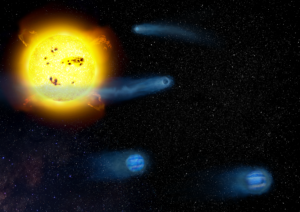
Observations of planets orbiting stars other than the Sun (exoplanets) have made remarkable progress, and more than 4,500 exoplanets have been discovered so far. On the other hand, independent observations by Japan, the U.K., and Spain since around 2000 have revealed the existence of objects that have the mass of a planet but do not orbit a star like an exoplanet, but instead roam around in space. These are called “floating planets” or “solitary planets. Like planets, they are lighter than 13 times the mass of Jupiter, but they are thought to be isolated and floating in space because there are no bright nearby stars.
Like brown dwarfs (Note 1), these floating planets are very faint because they cannot fuse and shine by themselves due to their small mass. Therefore, there have been only a limited number of cases of direct imaging and spectroscopic studies of these floating objects, and discoveries through direct observation have been sporadic (Note 2).
This time, an international research team led by the University of Bordeaux, the University of Tokyo, and the Astrobiology Center focused on a star-forming region (about 171 square degrees) between Scorpius and Hydrae. This star-forming region is one of the closest regions to the Earth where massive stars much heavier than the Sun and less massive stars much lighter than the Sun are born in clusters, and it allows us to study the formation of various stars and their clusters in detail.
The team has compiled about 80,000 visible and infrared images from observatories around the world over the past 20 years to create a catalog (DANCe; Dynamical Analysis of Nearby ClustErs) that includes the positions, brightness, and intrinsic motion (the movement of celestial objects in the celestial plane) of 26 million objects. The DANCe catalog also includes data from Subaru Telescope’s wide-field cameras, Hyper Suprime-Cam and Suprime-Cam, whose sharp images have contributed to the precise determination of the objects’ positions. The sharp images have made an important contribution to the precise determination of the position of celestial objects.
By combining data from two positional astronomical satellites, Gaia and Hipparcos (*3), and further refining the intrinsic motion of stars, the research team succeeded in extracting from the DANCe catalog approximately 100 faint sources of probable planetary mass that are estimated to be in this star-forming region. This is the largest number of homogeneous observations of floating planets with no nearby stars in a single region. Including objects heavier than planets, 3455 objects have been identified in this region.
Since a large number of newborn stars, including floating planets, have been identified, we can now ask “How many stars of what mass are born in this star-forming region? In other words, we can now approach the question, “How many stars of what mass are born in this star-forming region? The question of why so many stars with masses like the Sun are born in the universe, and how many heavier and lighter stars are born relative to it, is essential information for the study of galaxies composed of stars, and is one of the most important questions in astronomy. In particular, the frequency of stars much lighter than the Sun is still unknown.
In this study, for the first time, the mass functions of stars from about 10 times the mass of the Sun to floating planets with masses less than 1/100th of the mass of the Sun have been accurately determined. Comparing this mass function to the standard theory of star formation, i.e., the model in which stars and brown dwarfs are formed by the self-gravitational contraction of molecular clouds, the observed number of floating planets far exceeds the number of planets predicted by extrapolating the theoretical model to planetary masses. This result supports the scenario that the majority of the floating planets were formed by the ejection of planets from the protoplanetary disks of individual young stars due to gravitational scattering between planets (Note 4) or other processes when the stars were born in clusters. In other words, it turns out that the majority of the floating planets in this region were not “born like stars” but rather “born like planets.
Translated with DeepL.com (free version)
This December, the National Aeronautics and Space Administration’s (NASA) JWST large infrared space telescope is scheduled for launch. Professor Motohide Tamura (University of Tokyo/National Institutes of Natural Sciences, Center for Astrobiology), co-author of the paper, says, “For the 6.5-meter JWST, the infrared successor to the Hubble Space Telescope, cold, faint, bright objects such as floating planets are the best targets to observe with the high sensitivity infrared. Unlike exoplanets, the JWST is not a direct observer. Unlike exoplanets, there are no bright stars nearby to interfere with direct observations. The newly discovered floating planet will be an important sample for the study of its atmosphere and for comparative studies with other exoplanets.
Translated with DeepL.com (free version)
The research was published in Nature Astronomy (December 22, 2021)(Núria Miret-Roig et al. ” A rich population of free-floating planets in the Upper Scorpius young stellar association“)。
(Note 1) A star with a mass about 80 to 13 times that of Jupiter (about one-tenth to one-hundredth the mass of the Sun) is called a brown dwarf.
(Note 2) In 2011, observations using gravitational microlensing, one of the indirect methods to detect exoplanets, suggested that there are many floating planets floating in our galaxy, and the number of floating planets is estimated to be comparable to the number of stars. When two stars are aligned, the gravity of the front star acts like a lens to collect the light of the distant star and temporarily brighten it due to the gravitational bending of light (gravitational lensing) based on Einstein’s General Theory of Relativity, which is called gravitational microlensing. This phenomenon can be used to find exoplanets and floating planets, but because it is a temporary phenomenon, it cannot be followed up, and its true nature has remained a mystery.
(Note 3) Hipparcos and GAIA are positional astronomical satellites launched by the European Space Agency (ESA) in 1989 and 2013, respectively, to accurately measure the position and distance of celestial objects. Its successor, GAIA, has achieved much more accurate distance measurements and, by combining data from the old and new positional astronomical satellites, is able to precisely measure the intrinsic motion of celestial objects. (In star-forming regions, such as star-forming regions where stars form in clusters, floating planets have the same spatial motion as stars. (In star-forming regions such as star forming regions where stars form in clusters, floating planets have the same spatial motion as stars.)
(Note 4) The orbits of planets are affected by each other’s gravity, which is called gravitational scattering. It has been thought that if a planet is greatly affected by gravitational scattering, it will leave the planetary system in which it was born and become a floating planet. The present results support this scenario.
Translated with DeepL.com (free version)
About Subaru Telescope
Subaru Telescope is a large optical-infrared telescope operated by the National Astronomical Observatory of Japan (NAOJ) and supported by the Ministry of Education, Culture, Sports, Science and Technology (MEXT) under the Large-Scale Scientific Frontier Initiative. Mauna Kea, where Subaru Telescope is located, is a precious natural environment and an important place in Hawaiian culture and history, and we are deeply grateful for the opportunity to explore the universe from Mauna Kea.
■Related Links