The Subaru Telescope’s powerful exoplanet imaging instrument has discovered the first-ever evidence of a Jupiter-like protoplanet in the process of forming.
This planet, detected around an approximately 2 million-year-old young star AB Aur, marks the first-ever imaging example of ‘protoplanet’ where gas and dust are accreting and provides important suggestions on planet formation theorie

While there are eight planets in our solar system, about 5,000 distant planets beyond our solar system (exoplanets) have been discovered since their first discovery in 1995. How are exoplanets born, how do they evolve, and how can some of them become life-supporting planets like Earth? To solve this mystery, it is essential to capture planets in the act of formation at the very site where they are being born. However, due to observational difficulties, observations of young planets with ages of about 1 million years have been extremely limited.
Since the 1980s, it has been known that planets are born in protoplanetary disks, which are disk-like structures found around young stars (main stars), and observations with the Subaru Telescope in the 2010s and the ALMA Telescope in recent years have revealed many gaps and spiral arms in protoplanetary disks, These structures are considered to be indirect evidence of planet formation in the disk. However, only one example of a newborn planet in a disk has been captured in images so far. The young planet, PDS70, is a young star with an age of about 4 million years. However, the “young planet” PDS70b is located “in the gap” of the protoplanetary disk, which limits the amount of material, if any, falling from around it. In other words, PDS70b is considered an advanced planet in the final stages of formation (Note 1).

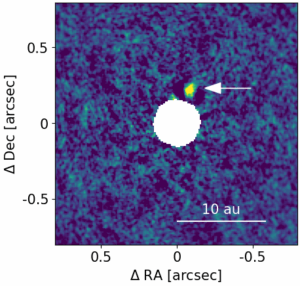
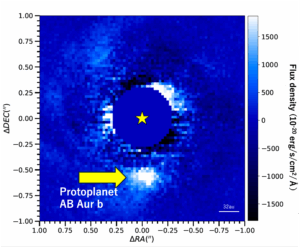
An international research team led by Subaru Telescope, NASA, the University of Tokyo, and the Astrobiology Center of Japan has successfully discovered a protoplanet buried in the protoplanetary disk of AB Aur in the constellation Auriga (Figure 1), using super-compensation optics (Note 2) on the Subaru Telescope. (Figure 1). The existence of this object was also confirmed by follow-up observations using the infrared camera on the Hubble Space Telescope.
The Subaru Telescope’s super-compensating optics allowed us to clearly distinguish between the protoplanet and the disk,” says Dr. Olivier Guyon, the instrument’s principal investigator.
In general, it is difficult to distinguish between a planet embedded in a disk and a small structure in the disk. However, since light from a disk is polarized by reflection, polarimetric observations can distinguish between a disk that reflects light from its host star and a planet that emits light by itself. Polarization observations with the Subaru Telescope’s super-compensating optics confirmed that the discovered object was not a fine structure in the disk. The visible light instrument mounted on the same super-compensating optics also showed that a large amount of hydrogen gas has fallen into this planet.
Because the main star is so young (about 2 million years old) and a large amount of material is still visible around the planet, this planet, AB Aur b, may be the first example of a so-called “protoplanet,” a planet that is just now being born. At the same time, this is the first evidence that the gaps, spiral arms, and other structures in the protoplanetary disk surrounding AB Aur discovered by the Subaru and ALMA telescopes are caused by the effects of a planet on the disk (Note 3).
AB Aur b has about four times the mass of Jupiter (Note 4) and orbits 93 times farther from its host star than the Earth-Sun distance. This provides evidence that AB Aur b is a model for the formation of a planetary system distinct from the Jupiter-like planets in our solar system,” said Dr. Thane Curie, lead author of the study.
The formation of the planets in our solar system can be well explained by the so-called standard planetary system formation model. In this model, microplanets grow in a protoplanetary disk around a young star, which then collects more material and forms giant planets such as Jupiter and Saturn. It has been suggested that after formation, these planets may move closer to or farther away from their host star, or scatter. However, this discovery indicates that giant protoplanets formed far from their host stars during a period shortly before planetary migration occurred. The formation of such distant giant protoplanets cannot be explained by the Standard Model or the planetary migration and scattering model. Rather, it is a clear example of “formation of a planetary system by gravitational instability,” in which a giant planet is formed by self-gravity in a disk.
AB Auriga has a long history with the Subaru Telescope. Subaru discovered the spiral disk surrounding this star in 2004, and in 2011, Subaru also discovered the disk’s structure of gaps and rings. However, no planets were detected in either case. This time, we finally succeeded in discovering a protoplanet buried in the disk, which had long been a dream of ours,” recalls co-researcher Prof. Motohide Tamura (University of Tokyo).
Subaru Telescope is located at the summit of Mauna Kea in Hawaii, which is not only the best place for astronomy, but also an important place for Native Hawaiians.
Mauna Kea is the best place on Earth to see the world beyond our solar system. Mauna Kea is the best place on Earth to see the world beyond our solar system, and we are deeply grateful for the opportunity to study the universe in such a place,” said Dr. Curie.
This research result was published in the British scientific journal “Nature Astronomy” on April 4, 2022 (Currie et al. “Images of embedded Jovian planet formation at a wide separation around AB Aurigae“).
(Note 1) The existence of another planet candidate PDS70c has also been noted in this planetary system, but it is only visible in hydrogen emission lines and no direct light from the planet itself is thought to be visible. There are other young planet candidates in other planetary systems, but it is difficult to distinguish between a planet and a part of a disk, and no one has yet found one that can be considered a planet with certainty.
(Note 2) Ground-based telescopes produce out-of-focus and shaky images of celestial objects, as if looking out from underwater, due to the effects of the Earth’s atmosphere. The super-compensating optics corrects the turbulence caused by the Earth’s atmosphere in real time at the limit, and realizes beautiful images of celestial objects as if the Subaru Telescope were placed in space. The CHARIS imaging spectrograph and the VAMPIRES visible light polarizer were used as detectors.
(Note 3) For detailed observations of the protoplanetary disk with a complex structure surrounding AB Aur by the Subaru Telescope, please see the Subaru Telescope Press Release on February 17, 2011.
(Note 4) Taking into account errors, the mass of AB Aur b is about 4 to 9 times that of Jupiter.
About Subaru Telescope
Subaru Telescope is a large optical-infrared telescope operated by the National Astronomical Observatory of Japan (NAOJ) and supported by the Ministry of Education, Culture, Sports, Science and Technology (MEXT) under the Large-Scale Scientific Frontier Initiative. Mauna Kea, where Subaru Telescope is located, is a precious natural environment and an important place in Hawaiian culture and history, and we are deeply grateful for the opportunity to explore the universe from Mauna Kea.
■関連リンク
- NAOJ April 5, 2022 Press Release
- Subaru Telescope April 5, 2022 Press Release
- The University of Tokyo April 5, 2022 Press Release
- The World’s Most Clear Image of a Planet-Birth Site: A Giant Planet’s Disk Pattern (Subaru Telescope, Hawaii, February 17, 2011)
- Subaru Telescope’s image of the birthplace of a planet in the shape of a spiral (Subaru Telescope observation on April 18, 2004)