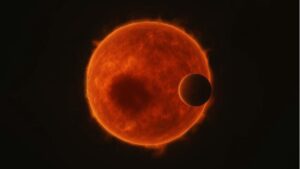
Two super-Earths around the low-temperature star LP 890-9 (also known as TOI-4306 or SPECULOOS-2), located approximately 100 light-years away from the solar system, were discovered. The outer super-Earth, LP 890-9 c, orbits within the habitable zone where liquid water could exist on the planet’s surface. This discovery was achieved through the collaboration of NASA’s Transiting Exoplanet Survey Satellite (TESS), the SPECULOOS project led by researchers from the University of Liège in Belgium, and collaborative observations with the MuSCAT3 multi-color simultaneous imaging camera and Subaru/IRD by researchers from the University of Tokyo and the Astrobiology Center.
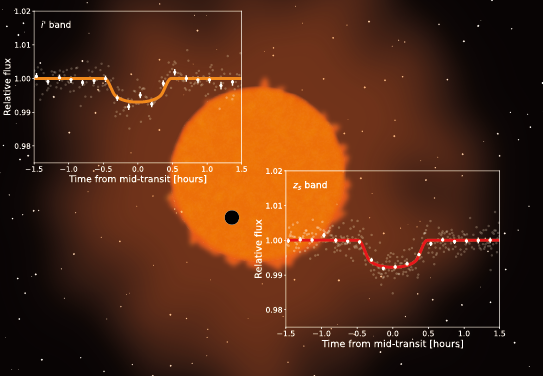
As of 2022, the Transiting Exoplanet Survey Satellite (TESS) (Note 1) is searching for exoplanets using the phenomenon called “transit,” in which a planet passes in front of its star. TESS uses four ultra-wide-field cameras to observe a 24° × 96° region of the sky for 27.4 days at a time, looking for periodic dimming of stars during transits. The low-temperature star (red dwarf; Note 2) LP 890-9, where the planet was discovered this time, was found by TESS to have a period of 2.73 days, and the name of the transit planet candidate “TOI-4306.01” was released to the world on July 21, 2021.
The Japanese MuSCAT team (Note 3) and the Belgian SPECULOOS team (Note 4), which are participating in the TESS Follow-up Observing Program (TFOP), the official follow-up observation program of TESS, will independently carry out follow-up observations after August 2021 to confirm whether this planet candidate The TESS team has been working independently since August 2021 on follow-up observations to confirm whether this planetary candidate is real or not. The periodic dimming found by TESS can also occur when two stars (binary stars) are obscuring each other.
The MuSCAT team confirmed that TOI-4306.01 is a planet (LP 890-9 b) by October 2021, based on multicolor transit observations with the MuSCAT3 four-color simultaneous imaging camera at Haleakala Observatory on Maui and line-of-sight velocity observations with Subaru’s IRD infrared Doppler instrument. The SPECULOOS team has confirmed that TOI-4306.01 is a planet (LP 890-9 b).
On the other hand, the SPECULOOS team has continuously observed LP 890-9 since August 2021, including the non-transit time of TOI-4306.01, and discovered another period of dimming (another transit planet candidate) in October and November 2021. Although the SPECULOOS team’s data could not narrow down the planet’s orbital period to one, the MuSCAT team, in cooperation with the SPECULOOS team, performed follow-up observations with MuSCAT3 and found that this transit planet candidate is a real planet (LP 890-9 c) with an orbital period of about 8.46 days. The MuSCAT team is led by Tokyo University’s Professor Masahiro Nakamura, who is also a member of the MuSCAT team.
The IRD line-of-sight velocity measurements provided strong constraints on the mass of the planet candidate and were decisive in confirming that the two objects orbiting LP 890-9 are real planets,” said Professor Noriyasu Narita of the University of Tokyo, who led the MuSCAT team.
The two discovered exoplanets LP 890-9 b and LP 890-9 c are super-Earths (Note 5) with radii of 1.32 and 1.37 Earth radii, respectively. Planets with these radii are theoretically considered rocky planets slightly larger than Earth. The outer of the two, LP 890-9 c, lies within the so-called habitable zone, a region where the distance from the main star (LP 890-9) meets the conditions for liquid water to be retained on the planet’s surface. The reason a planet with an orbital period of less than 10 days, i.e., in close proximity to its host star, is in the habitable zone is that its host star is a small star with a radius about 15% that of the Sun and a surface temperature of only about 2600 degrees Celsius (the Sun is about 5500 degrees Celsius).


LP 890-9 c has only just been discovered, and at this point we do not know what kind of world it is or whether it is a habitable world. However, since LP 890-9 c is a transit planet, future follow-up observations of the transit will allow us to study its atmospheric composition, cloud cover, and other atmospheric properties in detail. The nature of the atmosphere greatly affects the stability of liquid water on the surface. Even if future observations show that life is unlikely on this planet, it is important to study the atmospheric properties of rocky planets in the habitable zone to determine what kind of existence our planet has in the universe. In this respect, this discovery provides an important research target for further study in the future.
The results of this research were published in the online edition of the European scientific journal Astronomy & Astrophysics on September 7, 2022. (Delrez et al. “Two temperate super-Earths transiting a nearby late-type M dwarf“)
This research was supported by Grant-in-Aid for Scientific Research (KAKENHI: Grant-in-Aid for Scientific Research (KAKENHI: JP15H02063, JP17H04574, JP18H05439, JP18H05442, JP19K14783, JP21H00035, JP21K13975, JP21K20376, JP22000005), Grant-in-Aid for Young Scientists (JP20J21872), Japan Science and Technology Agency (JST) CREST (JPMJCR1761), National Institutes of Natural Sciences (NINS) Astrobiology Center Project (AB031010, AB031014), and social welfare corporation Azusa Tomokai. The project was conducted with support from the Azusa Yuukai social welfare corporation.
For more information, please see the University of Tokyo press release.
(Note 1) Transiting Exoplanet Survey Satellite (TESS) is a NASA satellite program led by the Massachusetts Institute of Technology. The plan has been to explore almost all of the transiting planets in the sky over a two-year period. It is currently in its fifth year of observations, with the second phase of the extension program underway. During the four years of the first extension plan, more than 5,000 transit planet candidates have been discovered.
(Note 2) A star with a surface temperature below about 3,500 degrees Celsius is called a red dwarf. In fact, nearly 80% of all stars in the universe are red dwarfs, and many of the stars in the vicinity of our solar system are also red dwarfs. Because they are smaller than the Sun and have a lower surface temperature, the habitable zone is located closer to the stars than in the case of the solar system.
(Note 3) The MuSCAT series are instruments that can observe transits in three or four wavelength bands simultaneously, and are mounted on the 188 cm telescope in Okayama, the 1.52 m telescope in Tenerife, Spain, and the 2 m telescope in Maui, USA (the instrument names are MuSCAT, MuSCAT MuSCAT stands for Multicolor Simultaneous Camera for studying Atmospheres of Transiting exoplanets and is named after a specialty of Okayama Prefecture.
(Note 4) SPECULOOS is a project led by researchers at the University of Liège in Belgium to search for transit planets orbiting in the habitable zone around red dwarf stars. cOOl Stars, after the name of a traditional Belgian biscuit.
(Note 5) Planets with a radius 1 to 1.5 times that of the Earth and slightly larger than the Earth are called Super Earths. Theoretically, a planet with this radius is very unlikely to be a small gaseous planet (subneptune) with a hydrogen atmosphere (it cannot sustain a hydrogen atmosphere), so it is considered to be a rocky planet.
About Subaru Telescope
Subaru Telescope is a large optical-infrared telescope operated by the National Astronomical Observatory of Japan (NAOJ) and supported by the Ministry of Education, Culture, Sports, Science and Technology of Japan (MEXT) under the Large-Scale Scientific Frontier Initiative. Mauna Kea, where Subaru Telescope is located, is a precious natural environment and an important place in Hawaiian culture and history, and we are deeply grateful for the opportunity to explore the universe from Mauna Kea.
■Related Links