Summary
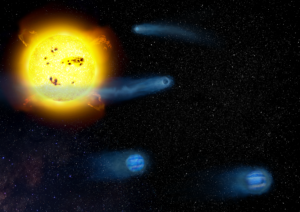
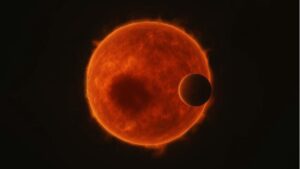
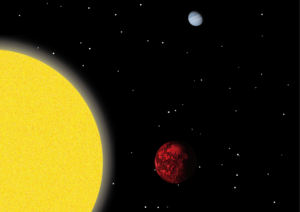
The team led by researchers from the Astrobiology Center discovered an “approximately Earth-sized planet” K2-415b orbiting the red dwarf star K2-415 located 71 light-years away from Earth with a period of about 4 days (see Figure 1) by the “transit method”, which takes advantage of planets passing in front of stars causing a slight eclipse. Using the Subaru Telescope, they placed constraints on its mass and other physical parameters, confirming that its composition is consistent with those of a terrestrial (rocky) planet. Until now, very few transiting planets have been found around stars as light and cool as K2-415, making the K2-415 system a valuable observational target for studying the atmospheres and orbital characteristics around such cool stars. Moreover, K2-415b is currently the closest planet to Earth among the planets (including candidates) discovered by the Kepler satellite operating between 2009 and 2018, making it an excellent observational target for future observations using instruments like the James Webb Space Telescope (JWST). This achievement was published online in The Astronomical Journal on February 27, 2023(Hirano et al, 2023, “An Earth-sized Planet around an M5 Dwarf Star at 22 pc”)
Research Background
More than 5,300 exoplanets have been discovered so far, most of which are found around stars similar to our Sun in mass and surface temperature (solar-type stars). On the other hand, red dwarfs, which are less than half the mass of the Sun, are known to be the most common type of planets in our galaxy, but since red dwarfs are particularly faint and difficult to observe in visible light, the atmospheric and orbital characteristics of the planets around them are not as well understood as those around solar-type stars. The atmospheres and orbits of the planets around them are not as well known as those around solar-type stars. Transit planet systems, in which a planet passes in front of its star, are important targets to study the atmospheres and orbits of planets, but few transit exoplanets have been found, especially around late M-type dwarfs, which have masses less than 0.2 times that of the Sun.
Research Findings
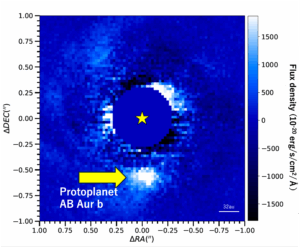
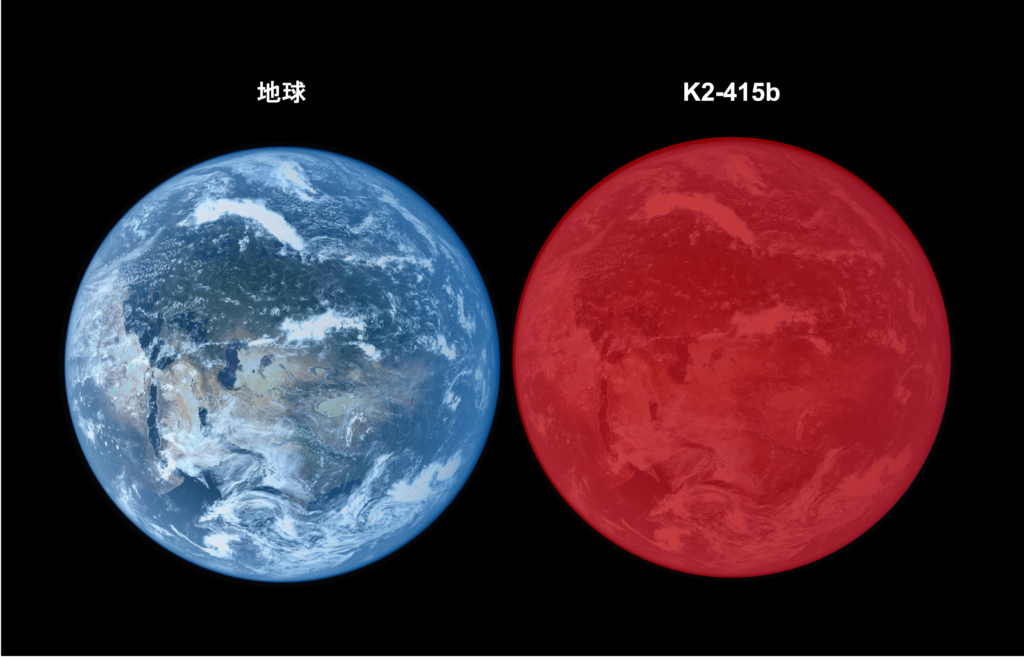
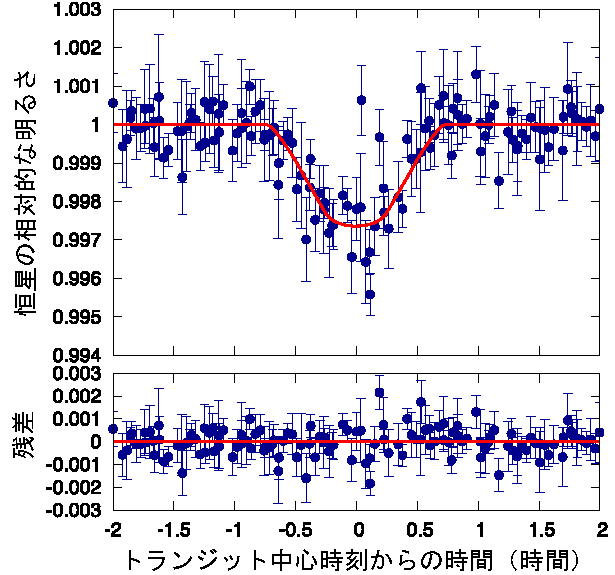
The research team analyzed in detail the data acquired from 2017 to 2018 by the second transit exoplanet mission K2, launched in 2009 by NASA’s Kepler satellite, and discovered a transit planet “candidate” orbiting a red dwarf star K2-415, located 71 light years from Earth, with a period of 4.02 days (Figure 2). The data was analyzed in detail using a proprietary method, and a transit planet “candidate” was discovered orbiting a red dwarf star K2-415 with a period of 4.02 days, located 71 light years away from the Earth (Figure 2). The team conducted follow-up observations of K2-415 using the Subaru Telescope and other telescopes from 2018 to 2021 in order to confirm that the candidate is a real planet. K2-415 is a very cold star with a mass about 0.16 times that of the Sun and an effective surface temperature below 3,000 degrees Celsius, making it faint in visible light and difficult to observe with conventional visible light instruments. The team confirmed that K2-415 is a real planet (named K2-415b) with a radius 1.02 times that of the Earth and a surface temperature of about 100 to 140 degrees Celsius, based on precise changes in line-of-sight velocity.
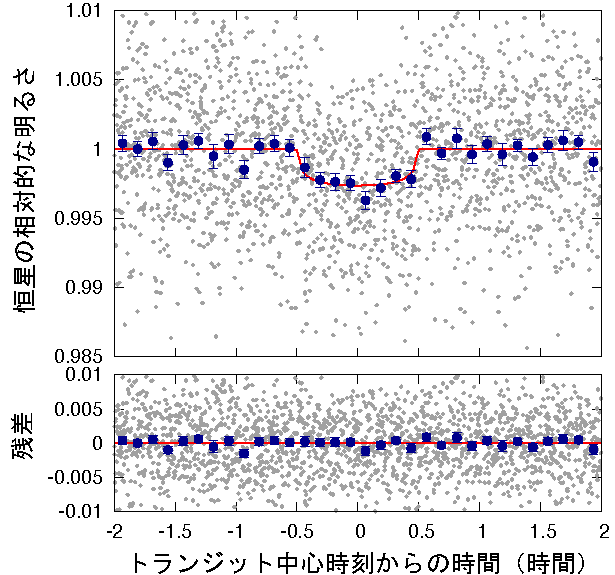
K2-415 was also observed by the Transiting Exoplanet Survey Satellite (TESS), the successor to the Kepler satellite, at the end of 2021, and the transit by K2-415b was independently detected from observations of stellar brightness changes over a period of about 80 days (Figure 3). The team analyzed the combined data from K2 and TESS to precisely determine the planetary radius, period, etc.
K2-415 is one of the lightest and coldest stars with an Earth-size planet, and only four such transit planetary systems (Note 2), including the famous TRAPPIST-1 system, have been discovered so far. K2-415b is a particularly valuable target for studying the characteristics of planets around low-temperature red dwarfs, since detailed spectroscopic observations of transits can provide information on planetary atmospheres, orbits, and so on. K2-415 is about 71 light years from Earth, which is quite close to Earth for a star with a transit planet (i.e., the star is relatively bright), which will be an advantage for future observations. The Kepler satellite has detected thousands of planets and their candidates during its observations from 2009 to 2018, and the newly discovered K2-415b has been confirmed to be the closest planet to Earth among those discovered by the Kepler satellite so far (Note 3).
The atmospheres and orbits of terrestrial planets around low-temperature stars are not well understood due to the paucity of previous observations. Now that a near-Earth sample has been observed, JWST will be able to study the atmospheres of these planets in more detail. The large ground-based telescope will also provide information on the orbits of these planets, and the study of their atmospheres and orbits will help us to understand terrestrial planets around low-temperature stars, which are worlds different from our Earth.
Annotation:
1) Ref: July 2, 2018 ABC release Searching for a second Earth, new instrument IRD is up and running!
2) Only four systems with Earth-like transit planets in stars cooler than K2-415 have been found so far: TRAPPIST-1, LP 791-18, LHS 1140, and Kepler-42.
3) Apart from the discoveries by the Kepler satellite, transit planet systems closer to the Earth than K2-415 have been found in recent years, mainly by TESS observations. However, there are only about 14 cases of systems with Earth-like planets like K2-415.
Publication
Journal:The Astronomical Journal
“An Earth-sized Planet around an M5 Dwarf Star at 22 pc”
Authors:Teruyuki Hirano, et al.