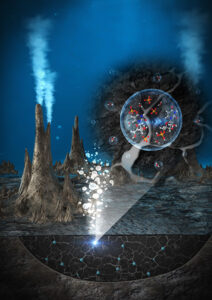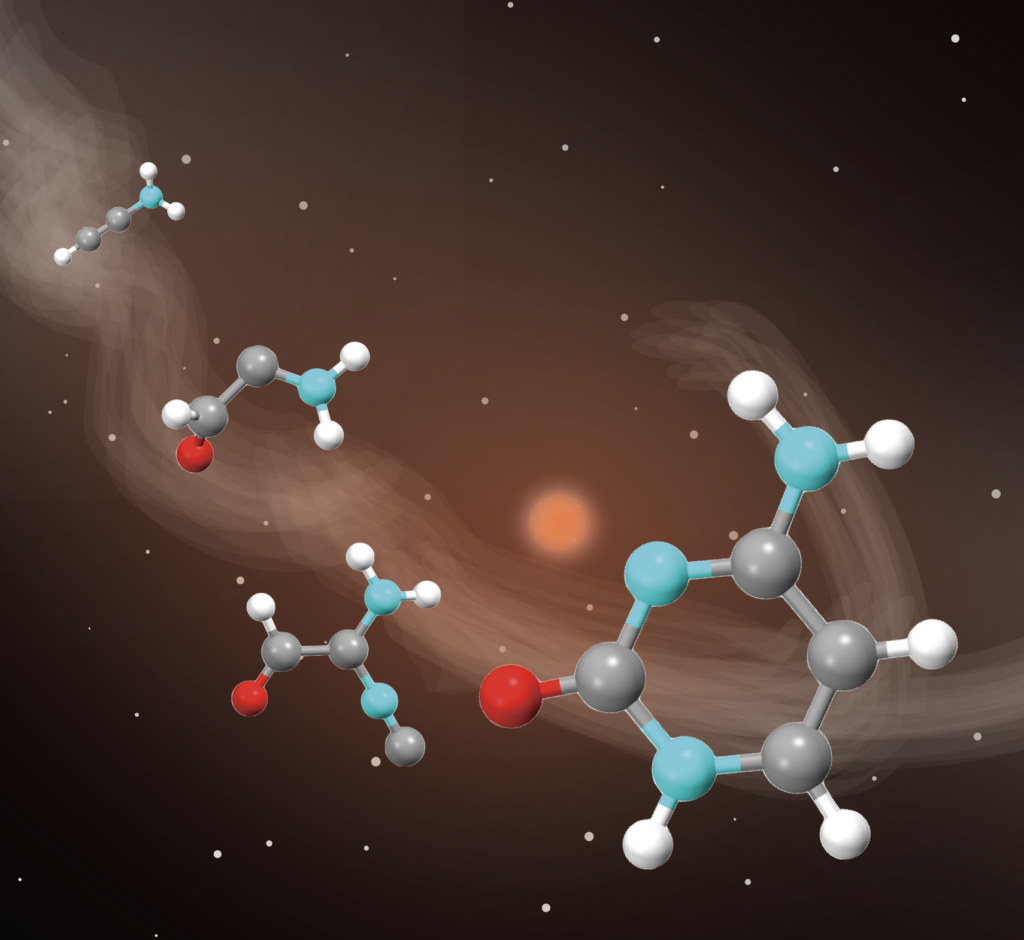
Researchers Yu Komatsu and Daiki Suzuki (currently affiliated with the University of Tokyo) at the Astrobiology Center theoretically predicted the possibility of cytosine molecules, which are nucleobases governing the genetic code in DNA and RNA, being generated from molecules in interstellar space (Figure 1). Through thorough calculations using the automated reaction path exploration method based on quantum chemicals, they discovered a pathway where cytosine could be efficiently produced from interstellar molecules without the conventional intermediate material of pyrimidine molecules. This study was published online in the American scientific journal “ACS Earth and Space Chemistry” on October 11, 2022 (Komatsu and Suzuki, 2022, “Quantum Chemical Study on Interstellar Synthesis of Cytosine by the Automated Reaction Path Search“)
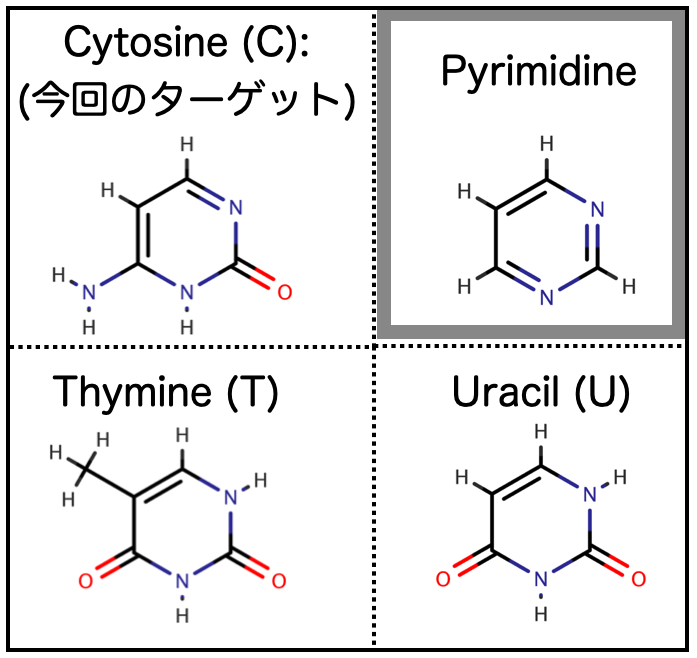
DNA and RNA employ a cyclic molecule called a nucleobase as the genetic code unit, forming pairs between one of the “pyrimidine bases,” cytosine (C), thymine (T), or uracil (U) (Figure 2) and one of the “purine bases,” adenine (A) or guanine (G) ( Note 1). Why and how these molecules were selected in life on Earth is a great mystery. All of these nucleobases have been detected in meteorites, suggesting that life similar to ours may have originated outside of Earth, or that these molecules from extraterrestrial sources may have served as our material.
Previous studies on reaction pathways in interstellar space have suggested the formation of C, T, and U pyrimidine bases via pyrimidines (e.g., Nuevo et al., Astrobiology, 2012). However, recent studies have shown that pyrimidines have not been found in meteorites where nucleobases have been detected (Oba et al., Nat. Commun., 2022), suggesting that a more natural route is one in which pyrimidines are formed from common interstellar molecules.
(Credit: Astrobiology Center)
Therefore, using an automated reaction pathway pathfinding method (e.g., Maeda et al., J. Comput. Chem., 2018) that estimates possible complex chemical reactions on a potential energy surface (Note 2) in the range of quantum mechanics, we investigated the pathways in which cytosine (C) is energetically likely to be produced among nucleobases We investigated.Without the arbitrariness of “predetermining the reaction pathway in advance and then evaluating it,” which is the approach taken in conventional quantum chemistry (Note 3) transition state calculations (Note 4), this research thoroughly explored the pathway to the formation of cytosine, the target molecule.
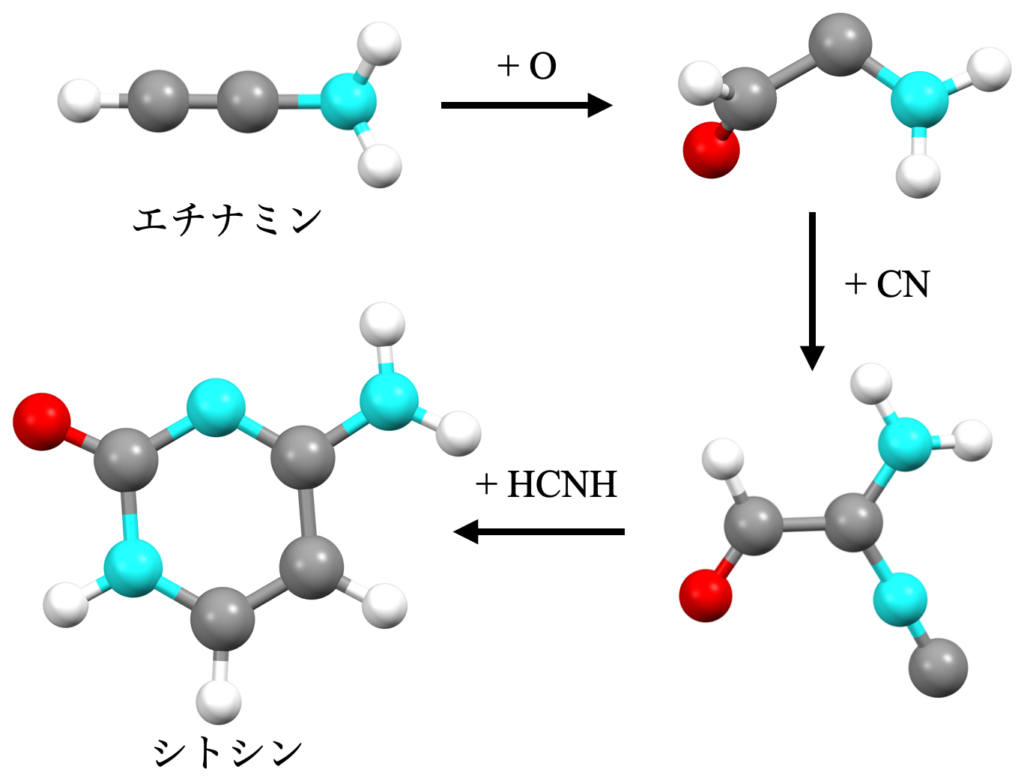
The resulting chemical reaction network revealed the following efficient formation pathway by exothermic reaction with no reaction barriers. First, a multi-step reaction pathway was obtained in which a molecule called ethinamine reacts with oxygen O, and then CN and HCNH react to form cytosine. Thus, for the first time, the formation pathway of a molecule related to life was discovered by an automated search calculation using a molecule that could be found in interstellar space, rather than pyrimidine, which has not been found even in meteorites. Although this discovery was obtained by a relatively large calculation, it is still only a part of the picture of nucleobase formation, suggesting that there may be other possible formation pathways from commonplace interstellar molecules. Further multifaceted verification through laboratory experiments and astronomical observations and modeling is needed to determine what the actual abundances are in celestial bodies.
Publication Information
(注1) DNAにおいてA-TとC-G、 RNAにおいてA-UとC-Gのようにピリミジン塩基とプリン塩基の間で水素結合を形成してペアをつくる。
(注2) さまざまな原子の配置に対して、系が持つエネルギーを示すプロファイルのこと。
(注3) 量子力学を化学の諸問題に応用した分野のことである。 量子化学計算によって系の波動方程式を解くことにより、系の物性や反応性を調べることができる。
(注4) ある反応物と生成物の間に、その中間の構造である遷移状態を同定し、これらのエネルギーを評価することにより反応の進行しやすさを推定できる。
Publication
Journal:ACS Earth and Space Chemistry
“Quantum Chemical Study on Interstellar Synthesis of Cytosine by the Automated Reaction Path Search“
Authors:小松 勇, 鈴木 大輝