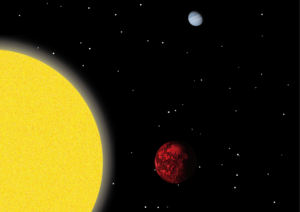
The discovery of the first extrasolar planet (hereafter exoplanet) through systematic observations using the high-precision infrared spectrograph installed on the Subaru Telescope was achieved. This planet, with the potential for liquid water on its surface, will be an important target for obtaining new insights into the potential for life.

Research on exoplanets, which has made great progress in recent years with the discovery of giant planets around stars similar to our Sun, is now focusing on red dwarfs, which are lighter than our Sun. Red dwarfs, which account for three-quarters of the stars in our galaxy and exist in large numbers in the vicinity of our solar system, are excellent targets for the discovery of exoplanets in our neighborhood. The discovery of nearby exoplanets, with detailed observations of their atmospheres and surface layers, will allow us to discuss the presence or absence of life in environments that are very different from those of our solar system.
However, red dwarfs are very faint in visible light due to their low surface temperature of less than 4000 degrees. Conventional planet searches using visible light spectrometers have only discovered a limited number of planets around very nearby red dwarfs, such as Proxima Centauri b. In particular, red dwarfs with surface temperatures below 3,000 degrees (late red dwarfs) have been discovered. In particular, there have been no systematic planet searches for red dwarfs (late red dwarfs) with surface temperatures below 3000 degrees (Note 1).
Red dwarfs are important targets for studying life in the universe, but are difficult to observe because they are too faint in visible light. In order to solve the difficulty of spectroscopic observation of red dwarfs, a planetary survey using a high-precision spectrograph in the infrared, where red dwarfs are relatively bright, has been long awaited (Note 2).
The Astrobiology Center has successfully developed the world’s first high-precision infrared spectrograph for an 8-meter class telescope. This is the Subaru Telescope’s IRD (InfraRed Doppler) instrument. Using the Doppler method, the IRD can detect minute wobbles in the velocity of a star, about the speed of a person walking (Note 3, Note 4).
Using this IRD, a project (IRD-SSP) to strategically observe late red dwarfs and search for planets is starting in 2019. This is the world’s first systematic planetary search around late red dwarfs and is an international project involving about 100 researchers from Japan and abroad. During the first two years, screening observations were conducted to discover “stable” red dwarfs with low noise, where even small planets can be detected (Note 5). Currently, the project is in the phase of intensive observations of about 50 promising late red dwarfs that have been selected through screening.
Translated with DeepL.com (free version)
The first exoplanet was discovered by IRD-SSP around Ross 508(*6), a red dwarf star one-fifth the mass of the Sun, located about 37 light years away from Earth. This is the world’s first exoplanet discovered by a systematic search using an infrared spectrometer (Note 7). This planet, Ross 508b, has a minimum mass of only about four times that of the Earth (Note 8). Its average distance from its central star is 0.05 times the Earth-Sun distance, and it is located at the inner edge of the habitable zone. Interestingly, the planet is likely to have an elliptical orbit, in which case it would cross the habitable zone with an orbital period of about 11 days (Figures 1 and 2).

Planets in the habitable zone retain water on their surfaces and may harbor life. Ross 508b will be an important target for future observations to verify the possibility of life habitability of planets around red dwarfs. Spectroscopic observations of molecules and atoms in planetary atmospheres are also important, although the current telescope lacks the resolution for direct imaging observations due to the close distance between the planet and the star. In the future, they will be the target of life search observations by 30-meter class telescopes.
The IRD-SSP is expected to continue discovering new planets.
The significance of the first planet discovered by SSP-IRD is explained by the paper’s lead author, Dr. Hiroki Harakawa, a researcher at NAOJ’s Subaru Telescope in Hawaii, as follows: “Ross 508b is the first planet discovered by SSP-IRD. Ross 508b is the world’s first successful detection of a super-Earth using only near-infrared spectroscopic data. Prior to this, near-infrared observations alone were not accurate enough for the detection of light planets such as super Earth, and verification by highly accurate line-of-sight velocity measurements in visible light was necessary. This study shows that IRD-SSP alone is capable of detecting planets and clearly demonstrates the advantage of IRD-SSP in that it can search with high precision even for late red dwarfs that are too faint to be observed with visible light.”
Professor Fumie Sato of Tokyo Institute of Technology, who leads the IRD-SSP, said, “It has been 14 years since the IRD project began. We have continued our development and research with the hope of finding a planet exactly like Ross 508b. The IRD-SSP will continue to search for planets around low-temperature red dwarfs, which have not yet been explored, with the aim of making new discoveries,” says Professor Sato of the Tokyo Institute of Technology. We are very enthusiastic about this project.
This research result was published in the “Publications of the Astronomical Society of Japan” on June 30, 2022 (Harakawa et al. “A Super-Earth Orbiting Near the Inner Edge of the Habitable Zone around the M4.5-dwarf Ross 508“).
(Note 1) The transit method, which detects changes in stellar brightness as a planet crosses the front of a star, does not require as many photons as the spectroscopic Doppler method, so the search for planets around red dwarfs using the transit method has been gaining momentum in recent years. TESS satellites can detect terrestrial planets around red dwarfs (early red dwarfs) with relatively high temperatures.
(Note 2) For example, the brightness of the Sun seen from a distance of 30 light years is 5th magnitude in visible light and 3rd magnitude in infrared light. On the other hand, the lightest late red dwarf is very faint in visible light at magnitude 19, but relatively bright in the infrared at magnitude 11.
(Note 3) The transit method can only detect planets whose planetary orbits are along the line of sight, whereas the Doppler method can detect planets without regard to their placement on the celestial plane as such. It is also an important method in that it can determine the “mass” of a planet.
(Note 4) IRD has achieved cutting-edge results in determining the orbits of terrestrial planets and young planets and in detecting planetary atmospheres, in addition to planet detection, by taking advantage of its infrared observation capabilities.
(Note 5) Red dwarfs have high surface activity, such as flares, and this surface activity can cause changes in the stellar line-of-sight velocity even if no planets exist. Therefore, only stable red dwarfs with low surface activity are targets for the search for small planets such as the Earth. (In fact, infrared observations are more advantageous for planet detection for the same accuracy because the effect of surface activity is reduced in infrared compared to visible light. However, it is important to observe red dwarfs with as little activity as possible in both visible and infrared light in order to detect light planets such as the terrestrial planets.)
(Note 6) Ross 508 is the 508th object on the list of stars with large intrinsic motion published by Frank Elmore Ross (1874-1960).
(Note 7) To confirm that the periodic wobble of Ross 508 was indeed caused by a planet, the IRD-SSP team identified several indicators of stellar activity that could be mistaken for a planet (e.g., changes in stellar brightness and some emission line shape indicators) and showed that the periods of these indicators were clearly different from planetary periods. The team showed that the periods of these indicators are distinctly different from the planetary periods. This is a much more difficult task than using the Doppler method to confirm planetary candidates reported earlier by the transit method, but it is an indispensable method for detecting non-transiting planets.
(Note 8) In principle, the Doppler method alone requires a lower limit for the mass of a planet. If a planetary system can be observed in transit, the planetary mass can be accurately determined in combination with the results of the Doppler method.
About Subaru Telescope
Subaru Telescope is a large optical-infrared telescope operated by the National Astronomical Observatory of Japan (NAOJ) and supported by the Ministry of Education, Culture, Sports, Science and Technology (MEXT) under the Large-Scale Scientific Frontier Initiative. Mauna Kea, where Subaru Telescope is located, is a precious natural environment and an important place in Hawaiian culture and history, and we are deeply grateful for the opportunity to explore the universe from Mauna Kea.
■Related Links