
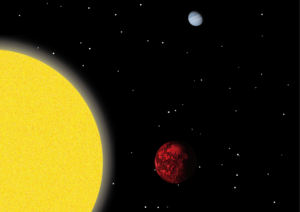
A research team led by researchers from the University of Hawaii and the Astrobiology Center discovered a planet named “2M0437b” bound to a young M-dwarf star at an age of about 200 to 500 million years using observations with the Subaru Telescope and other telescopes. 2M0437b is the youngest exoplanet among those found to date and is like a newborn baby planet compared to Earth’s approximately 4.6 billion-year-old age. The observations estimated that 2M0437b has a 3 to 5 Jupiter mass, making it a valuable target for studying how such “super-Jupiters” form around low-mass stars.
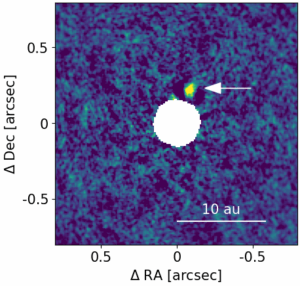
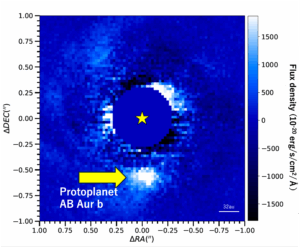
Most extrasolar planets (exoplanets) are found by the indirect method, in which the presence of a planet is detected indirectly from observations of its host star (star). This is because planets are so faint that it is difficult to separate their light from that of the nearby bright main star and observe them directly. The planet’s host star, 2M0437, is a newly born star in the star-forming region of Taurus, about 420 light years away from Earth, and the accompanying planet is considered to be of the same age. Generally, young planets glow brighter in the near-infrared because of the heat from their formation. Using Subaru Telescope’s near-infrared spectroscopic imager IRCS and adaptive optics instrument AO188 in 2018, the research team discovered 2M0437b at 0.9 arcseconds away from 2M0437 by direct imaging (Figure 1).

The follow-up observations to confirm that 2M0437b is indeed a planet orbiting 2M0437 and not a background star were made with the Subaru Telescope and the Keck Telescope, also on Mauna Kea. After three years of observations and precise tracking, the two objects were confirmed to be a planetary system bound by each other’s gravity.
Based on the brightness observed by IRCS and other instruments, the mass of 2M0437b is estimated to be three to five times the mass of Jupiter. This is one of the lightest exoplanets found by direct imaging observations, and is a testament to the power of the Subaru Telescope and adaptive optics. The age of this planetary system is estimated to be 2-5 million years, making this the youngest planet ever discovered among the 10 Jupiter masses or less that can be reliably called a planet (Note 1).
Conventional theories of planet formation suggest that it is difficult for a small-mass star like an M dwarf to form a giant planet like 2M0437b at some distance from its host star (about 100 AU in this case) in a few million years. 2M0437b is an extremely valuable discovery for understanding where and how giant planets are formed. It will be an extremely valuable observation target for elucidating how and where giant planets form, and will provide important insights into the study of planet formation.
Assistant Professor Teruyuki Hirano (Astrobiology Center, National Institutes of Natural Sciences/National Astronomical Observatory of Japan), who is one of the leaders of the research, said, “There have not been many cases where exoplanets have been discovered by directly observing light from planets, and only a few planets with ages younger than 10 million years have been found. The newly discovered planet is one of the youngest, and is a very unique planetary system. In addition to the Subaru Telescope, we hope to study the atmospheres and other properties of newly born planets through further observations with the James Webb Space Telescope (an infrared telescope scheduled for launch at the end of 2021) and other telescopes,” he said.
This research was published in the Monthly Notices of the Royal Astronomical Society on October 26th (Gaidos et al. “Zodiacal Exoplanets in Time (ZEIT) XII: A Directly-Imaged Planetary-Mass Companion to a Young Taurus M Dwarf Star“)。
(Note 1) If we include objects in the boundary region between “planets” and “brown dwarfs” that are larger than 10 Jupiter masses, objects as old as or slightly younger than 2M0437b have been reported.。
About Subaru Telescope:
Subaru Telescope is a large optical-infrared telescope operated by the National Astronomical Observatory of Japan (NAOJ) and supported by the Ministry of Education, Culture, Sports, Science and Technology (MEXT) under the Large-Scale Scientific Frontier Initiative. Mauna Kea, where Subaru Telescope is located, is a precious natural environment and an important place in Hawaiian culture and history, and we are deeply grateful for the opportunity to explore the universe from Mauna Kea.
■Related Links
Subaru Telescope, National Astronomical Observatory of Japan, October 23, 2021 (JST) Press Release
University of Hawaii (English) Oct. 22, 2021 (HST) Press Release