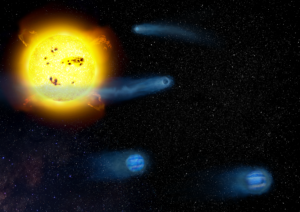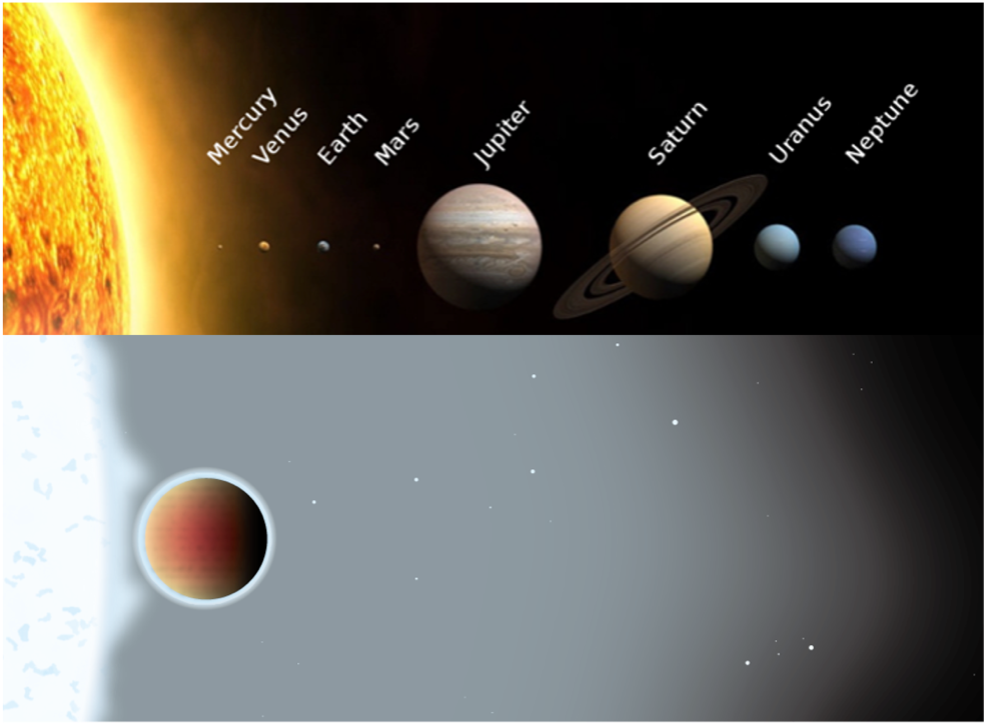
(Credit: Upper image – Wikimedia Commons, CC BY-SA 3.0; Lower image – Astrobiology Center)
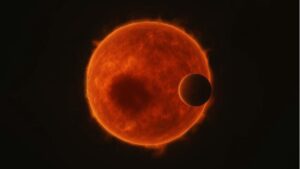
An international team led by researchers from the Astrobiology Center of the National Institutes of Natural Sciences has discovered hydroxyl radical (OH) molecules in the day side atmosphere of the exoplanet WASP-33b. This exoplanet is a giant gas giant called “Ultra Hot Jupiter” orbiting around its star (also called the main star) in an orbit much more inner than that of Mercury in the solar system (Figure 1). As a result, the planet’s atmosphere can reach temperatures of more than 2,500 degrees Celsius, hot enough to melt most metals. Dr. Nugroho of the Center for Astrobiology and lead author of the paper said, “This is the first detection of OH on a planet outside our solar system. This discovery not only marks the detection of molecules in exoplanetary atmospheres, but also the beginning of a detailed understanding of the chemistry of planetary atmospheres,” he said.
In the Earth’s atmosphere, OH results primarily from reactions between water vapor and oxygen atoms. This is also known as “atmospheric detergent” and plays an important role in removing potentially harmful substances to life, such as methane and carbon monoxide, from the atmosphere. OH plays an important role in determining atmospheric composition through its interaction with water vapor and carbon monoxide in the planetary atmosphere. is thought to result mostly from the breakdown of water vapor due to the high temperatures of planetary atmospheres. Dr. Ernst of Queen’s University said, “Our data support the idea that the extremely high temperatures of the planetary atmosphere dissociate water, since water vapor is thought to be scarce.”
This discovery was achieved by using the IRD, a high-dispersion spectrograph in the near-infrared light, newly installed on the Subaru Telescope in the summit region of Mauna Kea, Hawaii, at an altitude of 4200 meters. This instrument can detect atoms and molecules in stars and planets as absorption lines in the spectrum. As an exoplanet orbits its host star, the velocity of the exoplanet relative to Earth varies with time. This is the same principle as the “Doppler effect” that causes the pitch of sirens to change when an ambulance or other vehicle passes by us; instead of pitch, the color changes slightly. This allows us to distinguish whether the atomic and molecular features in the spectrum are due to the main star or the planet. Because the light from the planets is so weak, it is not possible to directly separate the light from the main star and the light from the planets in normal observations, but this special method has allowed us to separate the signals due to OH molecules from Ultra Hot Jupiters for the first time.
By taking advantage of the unique capabilities of Subaru Telescope’s IRD, the team was able to detect a small amount of hydroxy molecules in the atmospheres of exoplanets. The IRD is an ideal instrument for studying the atmospheres of exoplanets in the infrared,” says Professor Tamura, Director of the Astrobiology Center and one of the people responsible for the development of the IRD. One of the goals of modern astronomy is to search for ‘Earth-like’ planets. The new atmospheric components that will be discovered will lead us toward this goal by deepening our understanding of exoplanets and techniques for studying their atmospheres,” says Gibson, assistant professor at Trinity University. This time, the target was an extremely hot planet, but with further development, we hope to be able to study the atmospheres of cooler planets and eventually a second Earth,” says Kawahara, who is an assistant professor at the University of Tokyo.
Professor Watson of Queen’s University said “These observations will provide a test bed for the next generation of Very Large Telescopes, such as the TMT (Thirty Meter Telescope) and ELT (European Very Large Telescope), which will look for signs of life on small rocky planets. And by developing this technique, we may get a hint at the oldest question of all: ‘Are we alone in the universe?’”
This result was published in The Astrophysical Journal Letters with a reputation for publishing groundbreaking discoveries, on March 23, 2021.
論文情報:
Nugroho et al. 2021, “First Detection of Hydroxyl Radical Emission from an Exoplanet Atmosphere: High-dispersion Characterization of WASP-33b Using Subaru/IRD”, Astrophysical Journal Letters