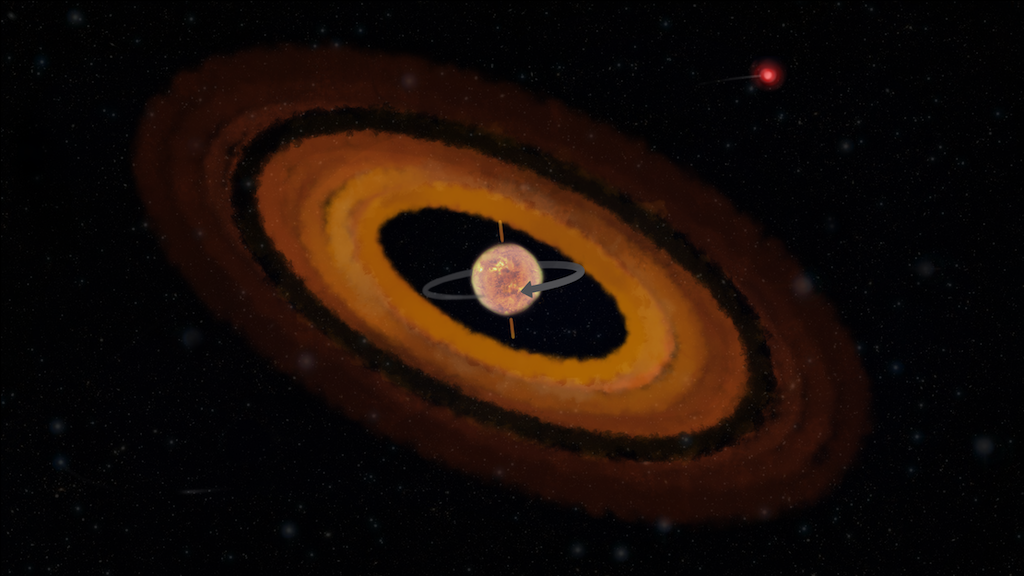
(Credit: Christoffer Gronne/Aarhus University)
Summary
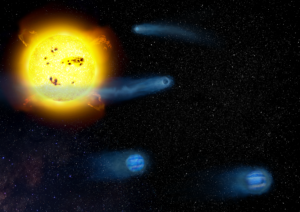
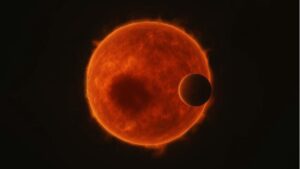
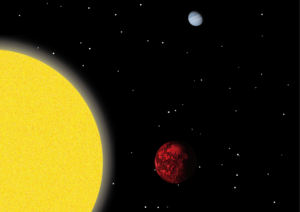
An international research team including researchers from the Astrobiology Center, National Astronomical Observatory of Japan, and Tokyo Institute of Technology observed the extra-solar system K2-290 with two planets and a companion star using Subaru Telescope and other instruments, revealing that the planet has a retrograde orbit to K2-290’s rotation.
In planetary systems outside the solar system, it is observationally known that the orbital direction (or axis of revolution) of planets often significantly differs from the rotation direction (axis of rotation) of the central star. Various mechanisms, such as gravitational scattering between planets or the influence of nearby stars’ gravity, have been proposed to induce such offsets, but the exact causes were previously unclear.

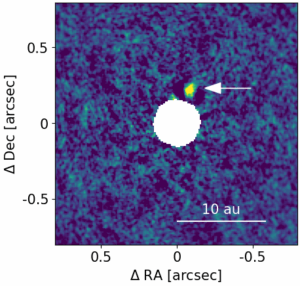
The observed K2-290 is a star with two well-aligned exoplanets, and observations including Subaru Telescope revealed that the orbital directions of these two planets are retrograde relative to the rotation direction of the central star. On the other hand, previous high-resolution imaging observations with Subaru Telescope confirmed the presence of a companion star (a low-mass star outside the planetary system) orbiting K2-290. Based on these facts, numerical simulations indicate that the original protoplanetary disk at which the planets formed was tilted by the gravity of the companion star, leading ultimately to the formation of retrograde planets. This is the first confirmation of evidence of significant changes in the disk plane by a companion star during the planet formation phase.
For more details:
Subaru Telescope Press Release
Aarhus University Press Release