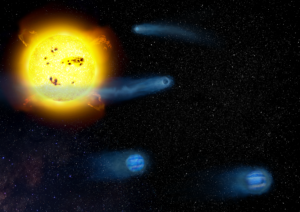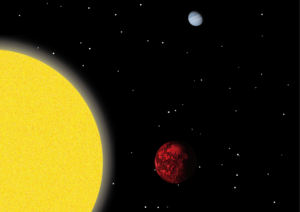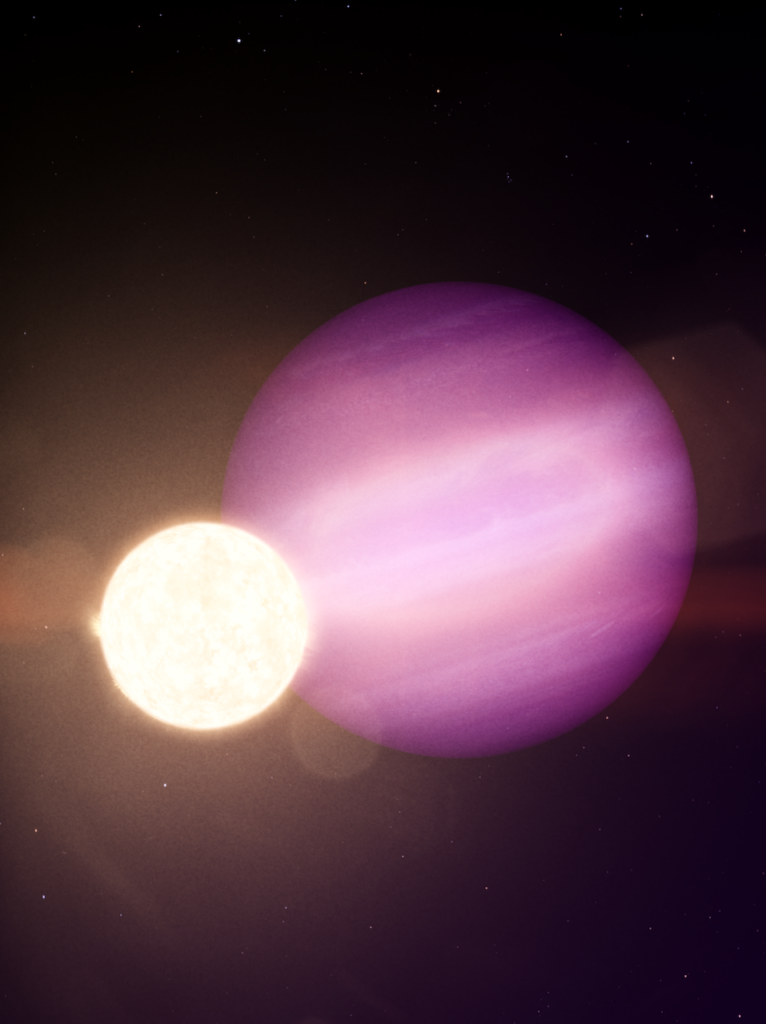
Image Credit: NASA’s Goddard Space Flight Center
Key Points of the Announcement:
- By multi-color transit observations with space and ground-based telescopes (Note 1), they discovered the first giant planet candidate orbiting a “white dwarf” (Note 2), which is a remnant after burnout of stellar death, with a period of 1.4 days.
- This discovery demonstrates that planets can exist near white dwarfs without being destroyed.
- The discovery of this unharmed planet sheds light on the potential existence of habitable planets around white dwarfs.
Abstract:
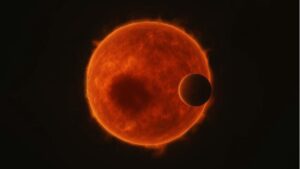
An international research team, including Project Professor Norio Narita from the Astrobiology Center (Professor at the Komaba Institute for Science, Graduate School of Arts and Sciences at the University of Tokyo), discovered the first candidate giant planet orbiting a white dwarf by multi-color transit observations with NASA’s Transiting Exoplanet Survey Satellite (TESS) launched in April 2018 (Note 3), NASA’s Spitzer Space Telescope retired in January 2020, and the multi-color simultaneous imaging camera MuSCAT2 developed by Project Professor Narita (Note 4).
This object, WD 1856 b, orbiting the white dwarf WD 1856+534 (hereinafter WD 1856: Note 5) located approximately 80 light-years away from the Solar system, is revolving with a period of 1.4 days, has a radius similar to that of Jupiter, and a mass estimated to be less than 14 times that of Jupiter. While examples of orbiting debris believed to be “asteroids” that are remnants after planet destruction have been previously discovered around white dwarfs, this finding marks the first discovery of an unharmed giant planet candidate near a white dwarf. This discovery provides the first evidence that exoplanets can exist near white dwarfs without being destroyed.
The research findings were published online in the international scientific journal “Nature” on September 17, 2020 (at 0:00 am Japan Standard Time).
*Normally, objects with masses less than 13 times that of Jupiter are called planets, and objects with masses greater than 13 times that of Jupiter are called brown dwarfs, so this presentation describes them as giant planet candidates in the sense that the possibility of brown dwarfs still remains.
Research Background:
When a star with a mass smaller than about eight times that of the sun ages and finishes nuclear fusion of hydrogen in its core, it becomes a “red giant” with an outer layer of hydrogen that expands to the level of the earth’s orbit. Finally, the outer layer is ejected, leaving behind “stellar cinders,” which are white dwarfs. Although more than 4,000 exoplanets orbiting stars other than the Sun have been discovered to date, no intact planets have yet been found around the white dwarfs that remain after the stars have reached the end of their lives, although some microplanets have been discovered that are thought to be the remnants of destroyed planets. However, no intact, undestroyed planets have yet been discovered.
Research Description:
Currently, in the field of exoplanet research, exoplanet searches are being conducted by NASA’s Transiting Exoplanet Survey Satellite (TESS), which uses the phenomenon of “transit” to search for exoplanets in almost the entire sky, mainly aiming to discover planets around nearby stars in the solar system. TESS (Transiting Exoplanet Survey Satellite) uses four ultra-wide-field cameras to observe a 24° x 96° region (called a sector) for 27.4 days at a time, looking for periodic dimming that occurs when a planet passes in front of its host star.
In the second year of TESS’ Sector 19 observations, the team discovered that the brightness of the region containing the white dwarf WD1856 (Note 6), located about 80 light years from the solar system, is dimming at a period of about 1.4 days. Initially, the automatic identification program used by the TESS team to detect exoplanets determined that the dimming signal was not due to a planet. This was because the auto-discrimination program only assumed planets around stars and did not assume planets around white dwarfs. Specifically, if it were a transit planet around a star, the dimming due to transit would have lasted at least 30 minutes, but this dimming lasted only about 8 minutes, so it was determined not to be a planet. However, in the process of visually confirming all the dimming signals, researchers realized that it might be a planet around a white dwarf, and it was selected as a candidate for a transit planet.
For each transit planet candidate discovered by TESS, additional observations are made to confirm whether or not it is a real planet. These confirmatory observations include “multicolor transit observations” to determine if WD1856 is indeed the one that is emitting light and if WD1856’s emission is the same at all wavelengths from visible light to infrared. The reason for this is that the planet does not emit light itself, so at any wavelength it will only attenuate a fraction of the area of the white dwarf hidden by the planet. The confirmatory observations were made with the Spitzer Space Telescope (which will be retired after this observation in January 2020) and ground-based telescopes. The Japanese team performed the multicolor transit observations using the MuSCAT2 simultaneous multicolor imaging camera, which was developed with the support of the National Astrobiology Center of the National Institutes of Natural Sciences (see Figure 1).
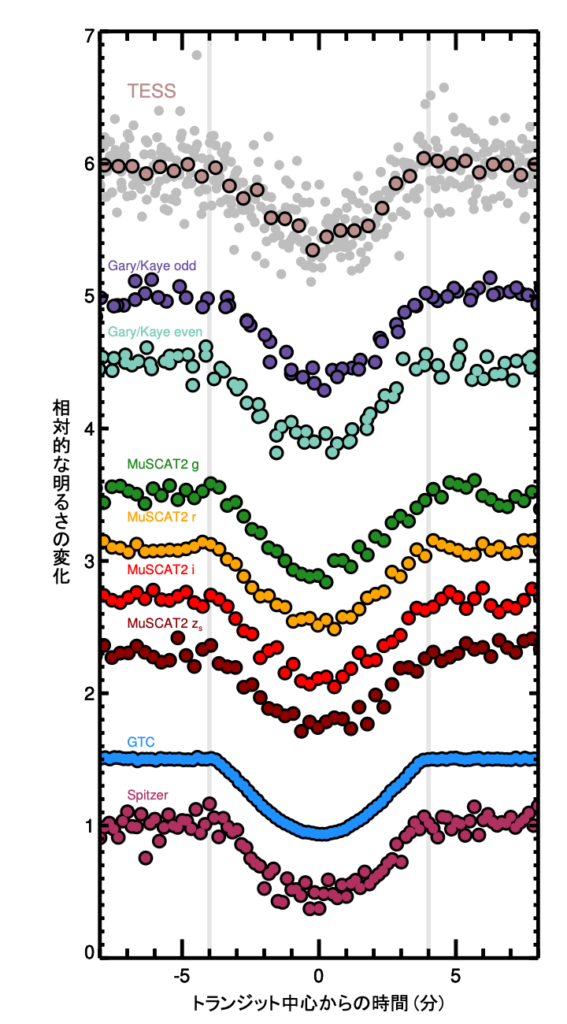
This additional multicolor transit observation confirmed that it is indeed WD1856 that is dimming, and that the rate of dimming is nearly identical at all observed wavelengths. It was concluded that WD1856 b is a giant planet candidate with a mass about the same size as Jupiter and smaller than Jupiter by a factor of 13.8 (although the possibility that it is a brown dwarf cannot be completely ruled out, it is highly likely to be a giant planet).
Until now, examples of “microplanets,” which are thought to be remnants of destroyed planets, have been found orbiting around white dwarfs. However, this is the first time that an intact, undestroyed giant planet candidate has been discovered. This discovery is the first demonstration that exoplanets may exist undestroyed even near white dwarfs.
The discovery of WD1856 b suggests one interesting possibility. The discovery of WD1856 b suggests an interesting possibility: that intact life-supporting planets (rocky planets that can retain liquid water on their surfaces) can also exist around white dwarfs. If a rocky planet could form in the “right” orbit near a white dwarf without being destroyed, as WD1856 b was, it could provide a suitable environment for life for billions of years (see Note 2).
Moreover, in fact, life habitable planets around white dwarfs are known to be good targets for studying the presence of signs of life by observing the light transmitted through the planet’s atmosphere during transit. In a specific estimate, if there were a life-habitable planet around a white dwarf like WD 1856, five transits with NASA’s James Webb Space Telescope (JWST), scheduled to launch in 2021, would detect water vapor and carbon dioxide molecules in the planet’s atmosphere, It is estimated that 25 transits will detect oxygen, ozone, and other molecules that could be called signs of life.
Although the actual discovery of a life-supporting planet around a white dwarf will depend on future exploration, the discovery of WD1856 b may shed light on the possibility of such a planet.
This research was supported by the Japan Science and Technology Agency (JST) Strategic Creative Research Promotion Program “PRESTO: Development and Application of Intelligent Measurement and Analysis Methods by Integrating Measurement Technology and Advanced Information Processing” under the research theme “Search for a Second Earth by Simultaneous Multi-color Imaging Observation and High Precision Analysis” (Researcher: Kenpo Narita, Subject No.: JPMJPR1775): JPMJPR1775).
Publication:
Journal:Nature
Title:“A Giant Planet Candidate Transiting a White Dwarf ”
Authors(* is the responsible author):
Andrew Vanderburg*, Saul Rappaport, Siyi Xu, Ian Crossfield, Juliette Becker, Bruce Gary, Felipe Murgas, Simon Blouin, Thomas Kaye, Enric Palle, Carl Melis, Brett Morris, Laura Kreidberg, Varoujan Gorjian, Caroline Morley, Andrew Mann, Hannu Parviainen, Logan Pearce, Elisabeth Newton, Andreia Carrillo, Ben Zuckerman, Lorne Nelson, Greg Zeimann, Warren Brown, Rene Tronsgaard, Beth Klein, George Ricker, Roland Vanderspek, David Latham, Sara Seager, Joshua Winn, Jon Jenkins, Fred Adams, Björn Benneke, David Berardo, Lars Buchhave, Douglas Caldwell, Jessie Christiansen, Karen Collins, Knicole Colon, Tansu Daylan, John Doty, Alexandra Doyle, Diana Dragomir, Courtney Dressing, Patrick Dufour, Akihiko Fukui, Ana Glidden, Natalia Guerrero, Kevin Heng, Andreea Henriksen, Chelsea Huang, Lisa Kaltenegger, Stephen Kane, John Lewis, Jack Lissauer, Farisa Morales, Norio Narita, Joshua Pepper, Mark Rose, Jeffrey Smith, Keivan Stassun, Liang Yu
DOI:10.1038/s41586-020-2713-y
Abstract URL:https://www.nature.com/articles/s41586-020-2713-y
Terminology:
Note 1: Multicolor Transit Observations
The eclipse phenomenon where a planet passes in front of a star is called “transit”. It occurs when the orbit of an exoplanet happens to cross in front of its host star. Planets that transit are called “transiting planets”. Observing the transit by multiple wavelengths is called multi-color transit observations. The multi-color observations are known for distinguishing whether transiting planet candidates are genuine planets, and Professor Norio Narita, supported by JST SAKIGAKE, conducts searches for extra-solar terrestrial planets by multi-color transit observations.
Note 2: White Dwarf
A star with a mass smaller than about eight times that of the Sun, after hydrogen nuclear fusion in its core ceases, expands into an object called a “red giant,” where the outer layers composed of hydrogen extend to about the orbit of Earth that are eventually ejected outward. A white dwarf is the remnant left behind in the core after this process. White dwarfs are very dense objects, with masses similar to the Sun but size comparable to that of Earth.
White dwarfs are initially very hot objects with surface temperatures reaching 100,000 degrees, but they gradually cool over about 2 billion years to temperatures similar to around 6,000 K (or 5,700 degrees Celsius), similar to a main-sequence star like the Sun. Subsequently, over approximately 8 billion years, their temperature slowly drops further to about 4,000 K.
Due to their small size comparable to Earth, the radiation energy of a white dwarf is much lower compared to a star even if the surface temperature is comparable to a star, making rotation periods of habitable planets around white dwarfs shorter periods than about 10 hours. Consequently, if a rocky planet exists in an orbit closer than about 10 hours around a white dwarf, that planet could remain a potentially habitable planet for several billion years.
Note 3: Transiting Exoplanet Survey Satellite (TESS)
TESS is NASA’s satellite project led by the Massachusetts Institute of Technology. Launched on April 18, 2018, TESS has conducted a plan to survey almost the entire sky for transiting exoplanets for two years. During its initial two-year mission, TESS discovered over 2,000 candidate transiting exoplanets. The project has since been granted an extended mission, currently in its third year of observations.
Note 4: MuSCAT2
MuSCAT2 is a multicolor simultaneous imaging camera developed by Professor Narita and Project Assistant Professor Fukui under the support of the Astrobiology Center, National Institutes of Natural Sciences. It is installed on the 1.52-meter Carlos Sánchez Telescope at the Teide Observatory on the island of Tenerife, Spain. MuSCAT2 enables simultaneous observations of celestial objects in four colors: blue light (400nm-550nm), red light (550nm-700nm), and two near-infrared wavelengths (700nm-820nm, 820nm-920nm). It is used to verify whether candidate transiting exoplanets discovered by TESS are genuine planets.
Note 5: WD1856 (WD1856+534)
WD1856 is a white dwarf located approximately 80 light-years away in the constellation Draco, forming a triple star system with the two red dwarf stars G 229-20 A and G 229-20 B. Although the exact age of this triple system is unclear, WD1856 is estimated backward to have become a white dwarf approximately 6 billion years ago, based on its current age.
WD1856 has a surface temperature of around 4,400 degrees Celsius, with a mass about half that of the Sun and in contrast a size only approximately 1.4 times that of Earth (about 1/80th the size of the Sun). Due to the low radiation energy of a white dwarf, WD1856 b, with its 1.4-day orbital period, is estimated to have a surface temperature of around -110 degrees Celsius, similar to the cold temperature of Jupiter in the solar system.
Note 6: Area including WD1856
The reason I say “region” here is that because TESS has an ultra-wide field of view, the field of view covered by a single pixel of the detector is large, and other bright stars were mixed in the same pixel, so we could not determine that WD1856 was dimmed.
Related Links:
The University of Tokyo Press Release
Japan Science and Technology Agency (JST) Press Release