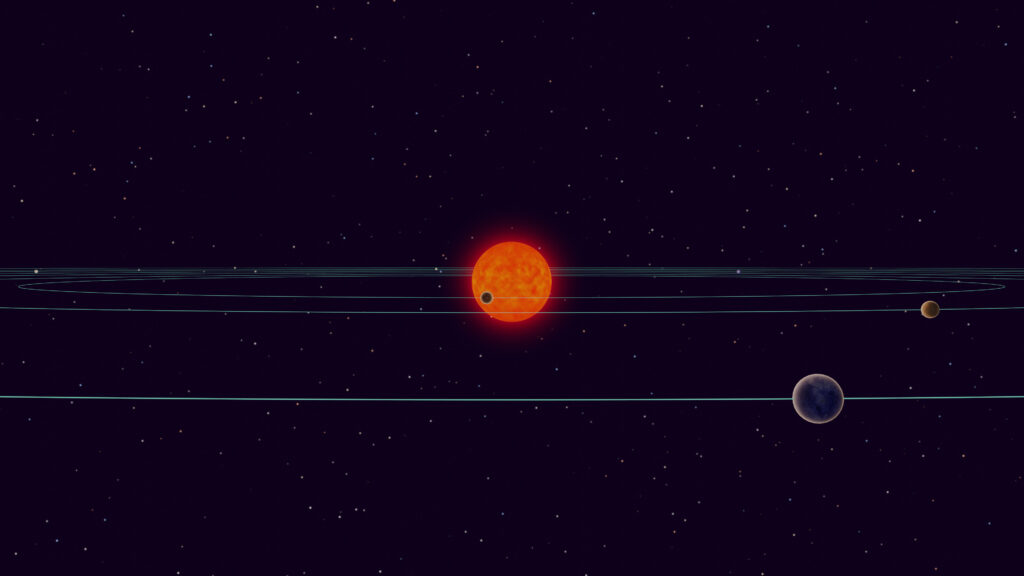
Key points of the announcement:
- The observations using the Subaru Telescope’s new spectrograph, IRD, revealed that the star’s rotation axis and the orbital axes of the planets in the TRAPPIST-1 system are nearly aligned.
- During these observations, the inclinations of the orbits of three planets (TRAPPIST-1b, e, f) out of seven were individually investigated, and two of them (TRAPPIST-1e, f) are terrestrial planets located within the habitable zone (the area where life can inhabit).
- This is the first time that the orbital inclinations of terrestrial planets within the habitable zone, like those in the TRAPPIST-1 system, have been investigated. This finding represents an important step not only in the discovery of terrestrial planets but also in pursuing their characteristics.
Research Description:
In recent years, the search for exoplanets has focused on stars with surface temperatures as low as half that of the Sun (M-type dwarfs), which, because of their low temperature and small radius, have surface temperatures that would allow liquid water to exist even in the case of planets with relatively short orbital periods (such planetary orbital regions are called habitable zones (Such planetary orbital regions are called habitable zones). In addition, small planets such as terrestrial planets are more easily detected around M dwarfs.
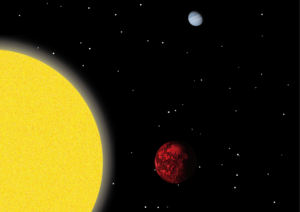
In particular, seven Earth-like planets have been discovered by the transit method (Note 1) around an M-type dwarf star called TRAPPIST-1, and three of them (TRAPPIST-1e, f, and g) are known to be located within the habitable zone. It is a hot topic in the field of exoplanet and astrobiology to investigate in detail what properties (mass, atmosphere, orbit, etc.) these planets have and whether they could really harbor life. However, because terrestrial planets are very small, the next step in their discovery, the study of their properties, is not easy.
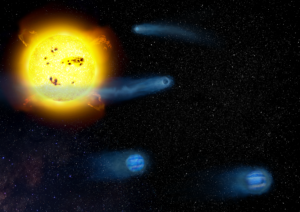
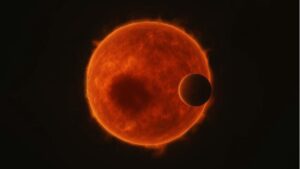
A group of researchers from the Tokyo Institute of Technology, the National Institutes of Natural Sciences, the Astrobiology Center of the National Institutes of Natural Sciences, and others have observed the transits of three planets (TRAPPIST-1b, e, and f) around TRAPPIST-1 using the new spectrograph IRD (mounted on the Subaru Telescope) developed primarily by the Astrobiology Center. By analyzing a phenomenon called the Rossiter effect (Figure 1), they found that the axes of TRAPPIST-1’s rotation and the orbits of the planets around TRAPPIST-1 are nearly aligned. Two of the three planets observed in transit (TRAPPIST-1e and f) are terrestrial planets in the habitable zone, and this observation has for the first time limited the inclination of the orbits of extrasolar planets in the habitable zone.
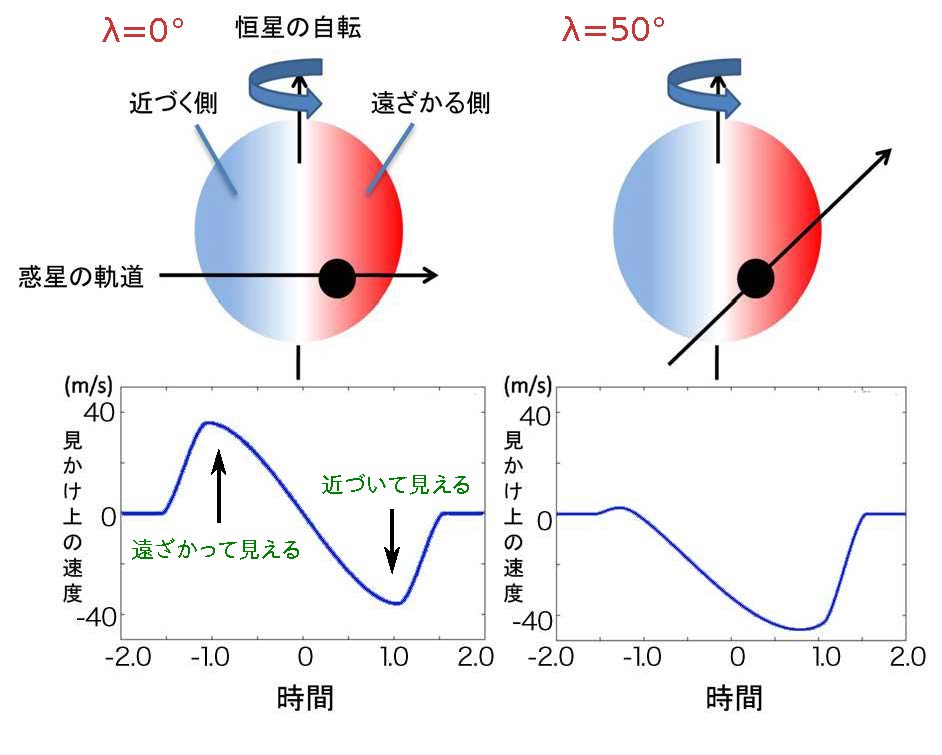
The inclination of a planet’s orbit relative to the stellar rotational axis is thought to reflect information about when the planet was formed and the subsequent time evolution of the planetary system. Previous observations using the same Rossiter effect have been limited to Jupiter-type and Neptune-type planets, which are heavier than Earth-type planets, but some planets are known to have greatly tilted orbital planes, some of which are completely retrograde. This is thought to be due to the fact that the orbits of planetary systems formed around their stars have been greatly disturbed by scattering and other factors.
The fact that the axes of stellar rotation and planetary orbits are well aligned in the TRAPPIST-1 system indicates that even around a low-temperature, low-mass star like TRAPPIST-1, multiple planets are formed in the same plane (orthogonal to the stellar rotation axis) and the orbits of the planets evolve over time without being significantly disturbed. The reason for this is that the orbits of the planets have evolved over time without being significantly disturbed by low temperature and low mass. This is essential information for discussing the origin of planetary systems around low-temperature, low-mass stars.
This discovery also reveals that the planets around TRAPPIST-1 in the habitable zone have similar characteristics to those of the Earth in the solar system in terms of the inclination of their orbits, despite the fact that they orbit densely in a position smaller than 1/10 of the Earth’s orbit, which is a very different appearance from that of the solar system. This is a novel and important result for discussing the possibility of life and its evolution on planets around low-temperature, low-mass stars, which account for the majority of stars in our Galaxy.
The research results were published in the Astrophysical Journal Letters, a U.S. astronomy journal, and were co-authored by researchers from the Tokyo Institute of Technology, the National Institutes of Natural Sciences Astrobiology Center, and others.
Publication:
Journal:The Astrophysical Journal Letters
Title:Evidence for Spin─Orbit Alignment in the TRAPPIST-1 System
Authors:Teruyuki Hirano, Eric Gaidos, Joshua N. Winn, Fei Dai, Akihiko Fukui, Masayuki Kuzuhara, Takayuki Kotani, Motohide Tamura, Maria Hjorth, Simon Albrecht, Daniel Huber, Emeline Bolmont, Hiroki Harakawa, Klaus Hodapp, Masato Ishizuka, Shane Jacobson, Mihoko Konishi, Tomoyuki Kudo, Takashi Kurokawa, Jun Nishikawa, Masashi Omiya, Takuma Serizawa, Akitoshi Ueda, Lauren M. Weiss
Paper Details:https://arxiv.org/abs/2002.05892
Publication Information:
Note 1) A transit is a phenomenon in which a planet passes in front of a star, partially obscuring the star’s surface (thus temporarily dimming the star). 0.06 au (1 au is the average Earth-Sun distance) from its star.
Related Links:
Subaru Telescope, National Astronomical Observatory of Japan Press Release