Background:
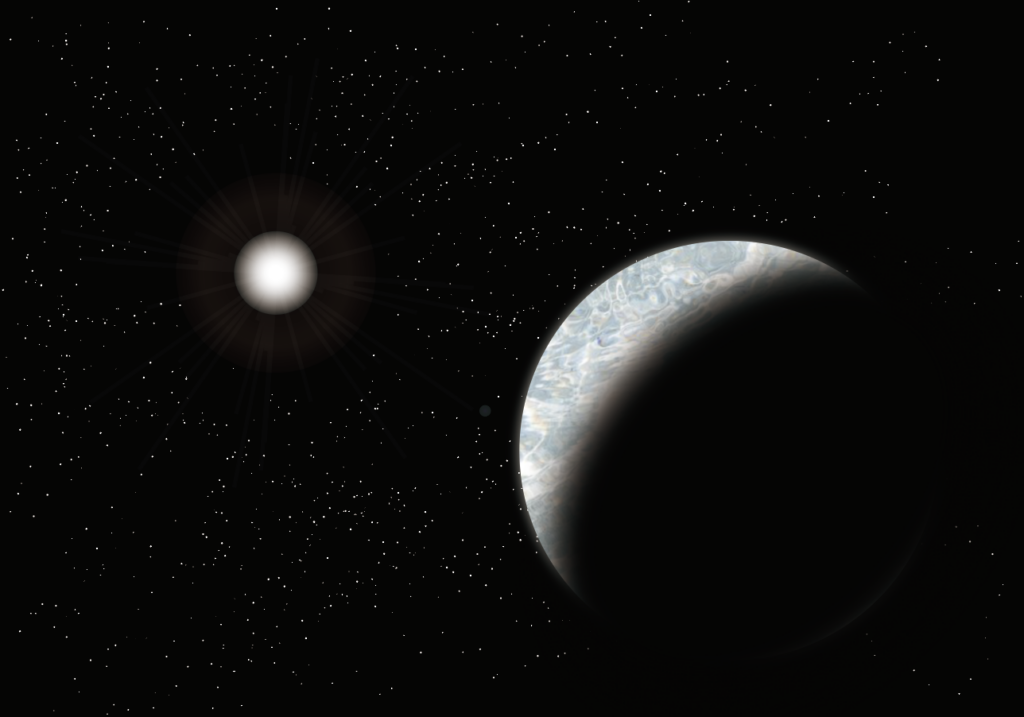
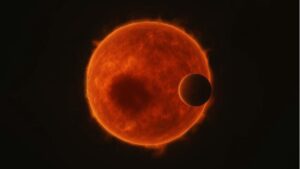
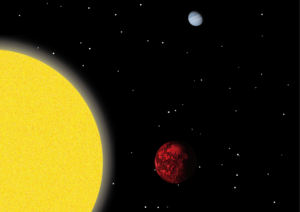
In 2018, seven Earth-sized planets were discovered around the nearby ultra-cool star TRAPPIST-1 (about 40.4 light-years away from the Sun). The TRAPPIST-1 planetary system has attracted attention as a candidate for potentially habitable Earth-sized planets (habitable planets: planets where liquid water could exist on the surface). To discuss the habitability of planets, the amount and composition of their atmospheres are important indicators. In practice, Earth’s current average temperature of about 15 degrees Celsius is maintained in part due to the contribution of greenhouse gases like water vapor and carbon dioxide. For six out of the seven planets around TRAPPIST-1, transmission spectroscopy during transits (phenomena where planets pass in front of their stars) suggests a possibility of retaining some form of atmosphere.
Planetary atmospheres can be divided into two types: hydrogen- and helium-rich atmospheres derived from the surrounding protoplanetary disk gas (primary atmospheres) and atmospheres such as carbon dioxide and water vapor (secondary atmospheres) obtained from geological activities (e.g., volcanic activity) and astronomical impacts (secondary atmospheres). The former is the atmosphere gravitationally acquired by a planet at the time of planet formation, while the latter is the atmosphere generated inside the planet or by external factors after the planet’s birth. It is known that light absorption by collisions of hydrogen molecules (collision-induced shock absorption) also acts as a greenhouse effect and leads to an increase in the temperature of a planet’s surface.
Research Description:
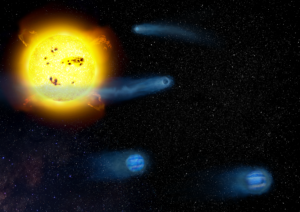
In this study, we focused on hydrogen-rich atmospheres and examined whether the seven Earth-size planets around TRAPPIST-1 acquired primary atmospheres in the past and whether they can retain them to the present from the viewpoint of planetary formation theory. We found that the seven Earth-size planets may have acquired primary atmospheres ranging from 0.01% to a few percent of their masses during the planet formation stage. However, we found that the acquired primary atmosphere would be entirely dissipated into space by exposure to X-rays and ultraviolet radiation from stars for hundreds of millions of years. Thus, if the seven Earth-size planets around TRAPPIST-1 still have atmospheres, they are likely to have secondary atmospheres. Earth-size planets around TRAPPIST-1 that are likely to have secondary atmospheres will be important targets for atmospheric composition observations with the James Webb Space Telescope (JWST), scheduled for launch in the 2020s.
Paper Information:
Journal:The Astrophysical Journal
Title:Do the TRAPPSIT-1 Planets Have Hydrogen-rich Atmospheres?
Authors::Yasunori Hori 1,2 & Masahiro Ogihara 2
Affiliations::
1) Astrobiology Center, 2) National Astronomical Observatory of Japan
DOI:https://doi.org/10.3847/1538-4357/ab6168
Published Paper:https://iopscience.iop.org/article/10.3847/1538-4357/ab6168