Abstract:
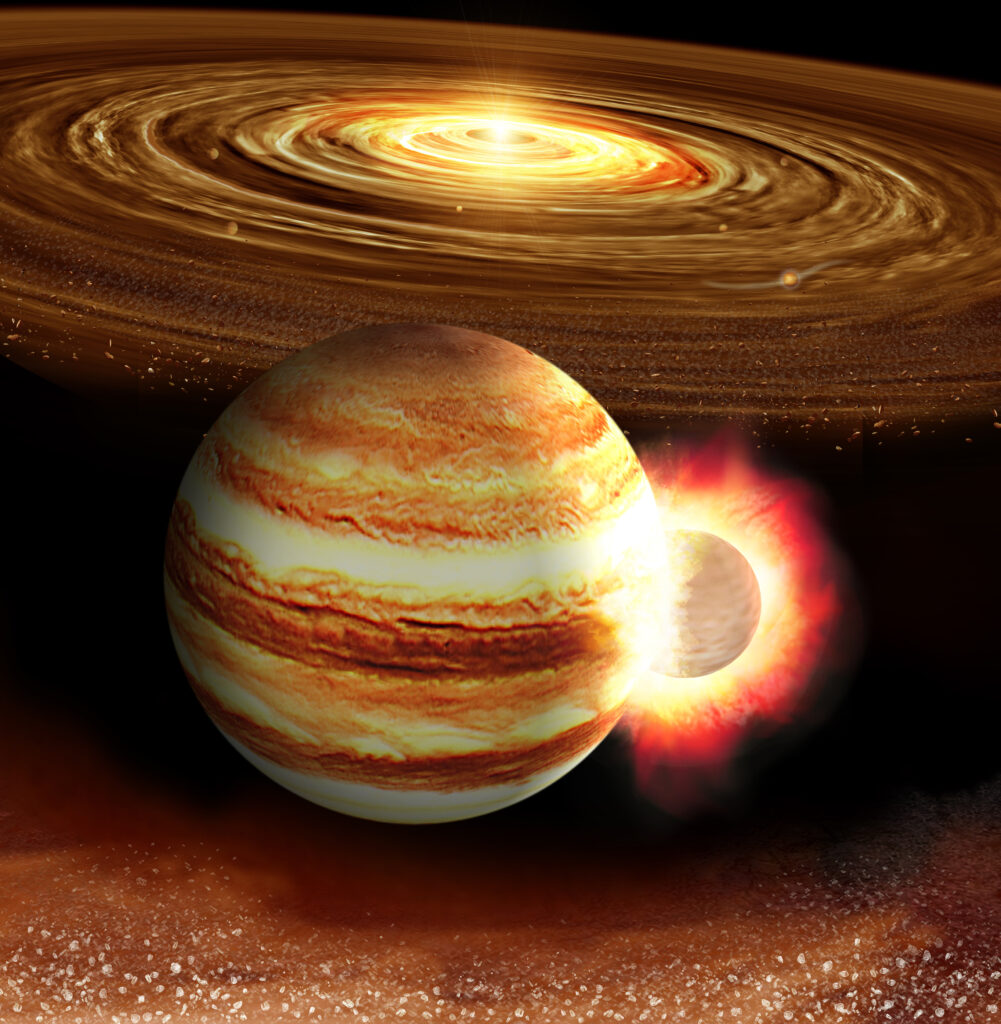
A research team led by Associate Professor Shang-Fei Liu at Sun Yat-sen University/Rice University Department of Physics and Astronomy and Project Assistant Professor Yasunori Hori at the Astrobiology Center, announced the possibility of a large-scale celestial impact occurring during the final stages of Jupiter’s formation. This research result was published in the British scientific journal Nature on August 15, 2019.
Background:
Jupiter, the largest planet in our solar system, is a gas giant with more than 90% of its mass composed of hydrogen and helium. Jupiter’s deep interior is thought to have a central core1 composed of rock and ice, but the details of this core remain a mystery. The existence and size of Jupiter’s core is considered to be an important key to understanding the birth of Jupiter. On July 5, 2016, the Juno spacecraft was launched from the Kennedy Space Center, Jupiter’s polar orbit and began precise measurements of Jupiter’s gravitational field. Observations of the gravity field revealed the possibility that Jupiter’s interior contains a much more massive central core (up to about half the size of Jupiter) than previously expected. Furthermore, it has been suggested that the giant core is a “low-density giant core” composed of a mixture of rocky and icy components, hydrogen (metallic hydrogen2), and helium. If Jupiter hides a low-density giant core, the question has been raised as to how the giant core was formed.
Research Findings:
The research team focused on the possibility of a large-scale celestial impact during the final stage of Jupiter’s formation as the origin of the low-density giant central core, and conducted a 3D fluid numerical simulation of a celestial impact. Figure 1 shows the situation (density distribution) before and after the almost head-on impact of a massive object, which is about 10 times the mass of the Earth, on Jupiter. It can be seen that the impacting object reaches deep into Jupiter and collides and merges with Jupiter’s central core. Under the influence of the disturbance caused by the impact shock wave and driven turbulence, the material in Jupiter’s central core is transported to the upper layers, where it mixes violently with the surrounding hydrogen and helium. The result is the formation of a large, extended, low-density, massive central core. However, in order for the giant core formed by a large astronomical impact to maintain its chemical composition and mechanical structure for the next 4.56 billion years, the temperature of the core after the impact must be about 30,000 degrees Celsius hotter than the core after the impact.
On the other hand, in the case of collisions of small objects with Jupiter or objects colliding with Jupiter at an oblique 45° angle, a low-density giant central core was not formed. Analysis of celestial impact events during Jupiter’s formation phase reveals that approximately 50% of impact events are oblique collisions with an impact angle of less than 30° from the frontal collision. This suggests that a large-scale head-on collision between Jupiter and a celestial body, as assumed in this study, is a sufficiently probable event.
From the above, we conclude that Jupiter may have experienced a large-scale celestial collision during the final stage of its formation.
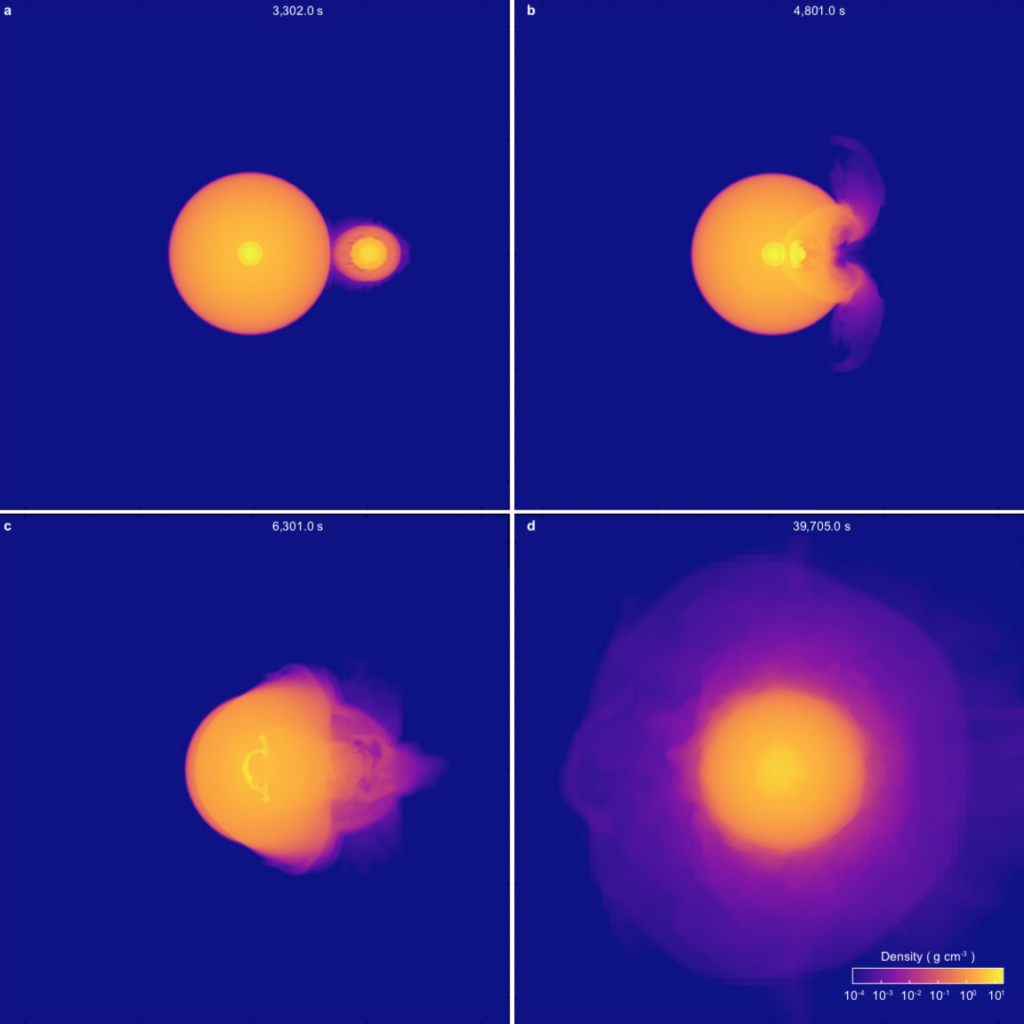
Top left: before collision; top right: just before collision with Jupiter’s central core
Bottom left: after the destruction of Jupiter’s central core; bottom right: 10 hours after the collision
*1 The size of Jupiter’s central core depends on the accuracy of spacecraft measurements of Jupiter’s gravity field and the behavior of hydrogen and helium (equation of state) under very high pressure and temperature conditions. According to the internal structure model based on Jupiter’s gravity field measurements before the Juno spacecraft, the central core was estimated to be approximately 8 times less than the mass of the Earth.
*2 Under very high pressure (> several hundred GPa), hydrogen becomes pressure ionized and metallic.
Publication:
Journal:Nature
Title:The formation of Jupiter’s diluted core by a giant impact
Annotation:
Shangfei Liu1,2, 堀 安範3,4, Simon Müller5, Xiaochen Zhen6, Ravit Helled5, Doug Lin7,8, Andrea Isella8
1) 中山大学 物理・天文学科, 2) ライス大学 物理・天文学専攻, 3) アストロバイオロジーセンター4) 国立天文台, 5) チューリッヒ大学 理論宇宙物理学・宇宙論センター, 6) 清華大学 物理学専攻 宇宙物理学センター7) カリフォルニア大学サンタクルーズ校 天文・宇宙物理学専攻, 8) 清華大学 先端研究所
DOI:10.1038/s41586-019-1470-2
Related Links:
Rice University Press Release