Credit: ALMA (ESO/NAOJ/NRAO), Tsukagoshi et al.
Abstract:
A research group, including researchers at the Astrobiology Center, led by Project Assistant Professor Takashi Tsukagoshi at the National Astronomical Observatory of Japan, observed a circumstellar disk of dust and gas (protoplanetary disk) around a young star TW Hydrae, and discovered compelling evidence within the disk suggesting planet formation. Specifically, they identified a small radio source within the disk that had not ever been detected. The research group speculate that this radio source could be either 1) a “circumplanetary disk” surrounding a Neptune-sized planet with ongoing formation or 2) a dusty structure formed by gas accumulations within vortices in the disk that could turn into planets in the future. In either scenario, this observation represents a crucial step in witnessing the vital processes of planet formation within the disk, enhancing our understanding of planet formation processes.
Research Background
In recent years, many planets of great diversity have been discovered around non-solar stars. Planets are thought to be born in a disk of dust and gas (protoplanetary disk) surrounding a young star. However, many details of the birth and growth process of a planet, such as how exactly the planet grows by incorporating the surrounding material, remain unresolved. Astronomers are trying to understand how planets are born by observing protoplanetary disks in detail.
How are planets formed in protoplanetary disks? Initially, protoplanetary disks are composed of microscopic dust particles ranging from a few micrometers to a few millimeters in diameter. Over time, this dust coalesces and grows into a rocky mass called a microplanet. This is the seed of a planet. The rocky mass thus created grows and eventually becomes a planet, taking in dust and gas from its surroundings due to its own gravity. Theoretical calculations predict that the material being incorporated will form a disk-like structure that rotates around the planet. This disk-like structure is called a periplanetary disk. The size of the disk is thought to be very small, about 1% of the total size of the protoplanetary disk.
Finding “periplanetary disks formed in protoplanetary disks” is one of the most important themes in the study of the formation process of planetary systems. However, we have not been able to find a periplanetary disk in our previous observations. Recent observations with the ALMA telescope have revealed dust collecting in protoplanetary disks (Note 1), but these disks are too large to be considered periplanetary disks.
High-Resolution, High-Sensitivity Observations with ALMA Telescope
Takashi Tsukagoshi, Project Assistant Professor at the National Astronomical Observatory of Japan, and his research team observed the young star TW Hydrae using the ALMA telescope in order to study the detailed process of planet formation. The star TW Hydrae is estimated to be approximately 10 million years old. Located 194 light years from Earth, it is the closest of these young stars to our solar system. Since TW is as massive as the Sun, it has been the subject of numerous observations as a possible clue to the origin of our solar system.
It is well known from previous observations that a protoplanetary disk exists around TW Hydrae. Dust and gas in protoplanetary disks do not emit visible light because of their extremely low temperature of about -250°C. On the other hand, radio waves are emitted from low-temperature materials. On the other hand, radio waves are emitted from low-temperature materials, so they have been actively observed with the ALMA telescope, which is capable of capturing radio waves. As a result, it is known that the disk has a structure with multiple gaps (Note 2). Disks have a symmetrical structure around the center, and small structures such as periplanetary disks associated with forming planets have not been found until now.
Observation Results
The sensitivity of this observation is about three times higher than that of previous observations with the ALMA telescope, and succeeded in obtaining a more detailed distribution of radio wave intensity within the disk.
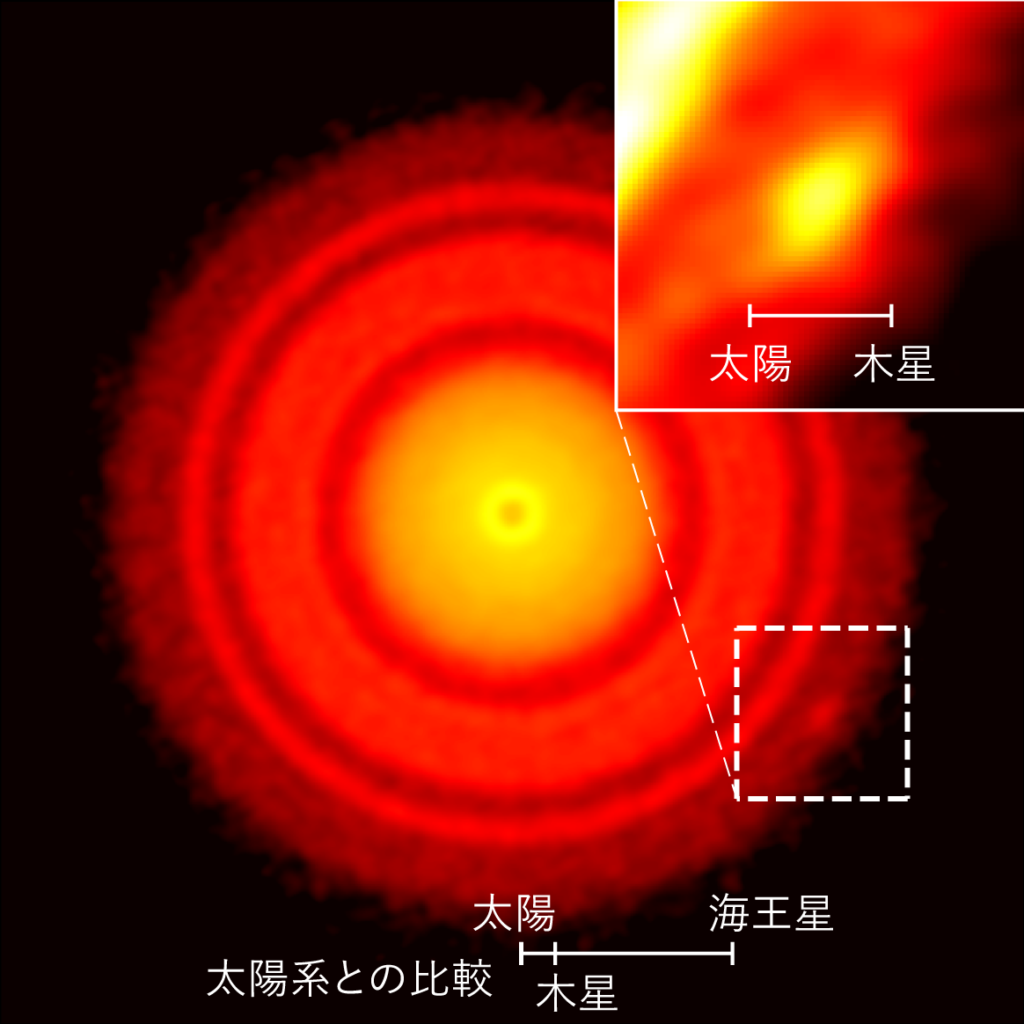
As a result, only one small radio source was discovered in the protoplanetary disk, which had not been found before. The source was located on the southwest side of the disk, 52 AU(*3) from the center of the protoplanetary disk, where the radio waves were 1.5 times stronger than those in the surrounding area. The radio source extends slightly in the direction of disk rotation and is about 4 AU long and 1 AU wide. This is the first time such a small radio source has been found in a protoplanetary disk.
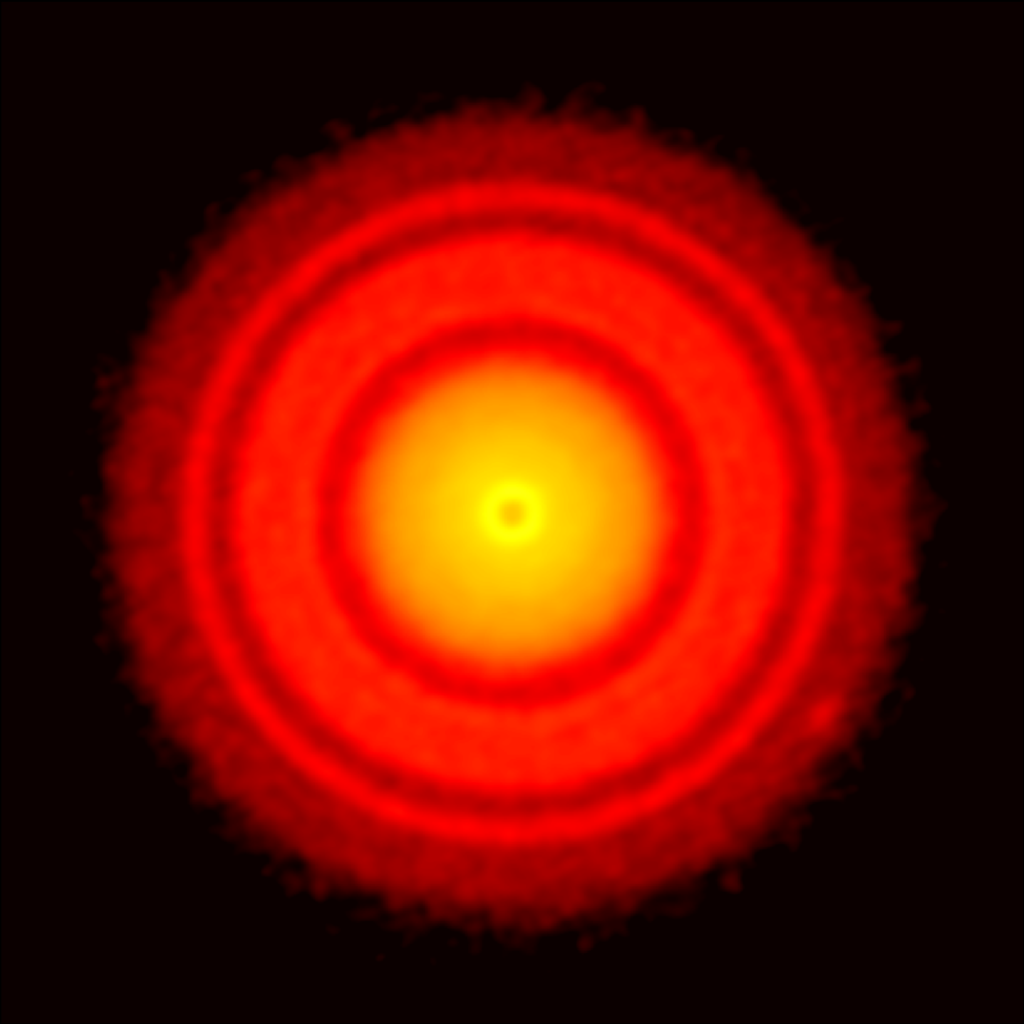
Credit: ALMA (ESO/NAOJ/NRAO), Tsukagoshi et al.
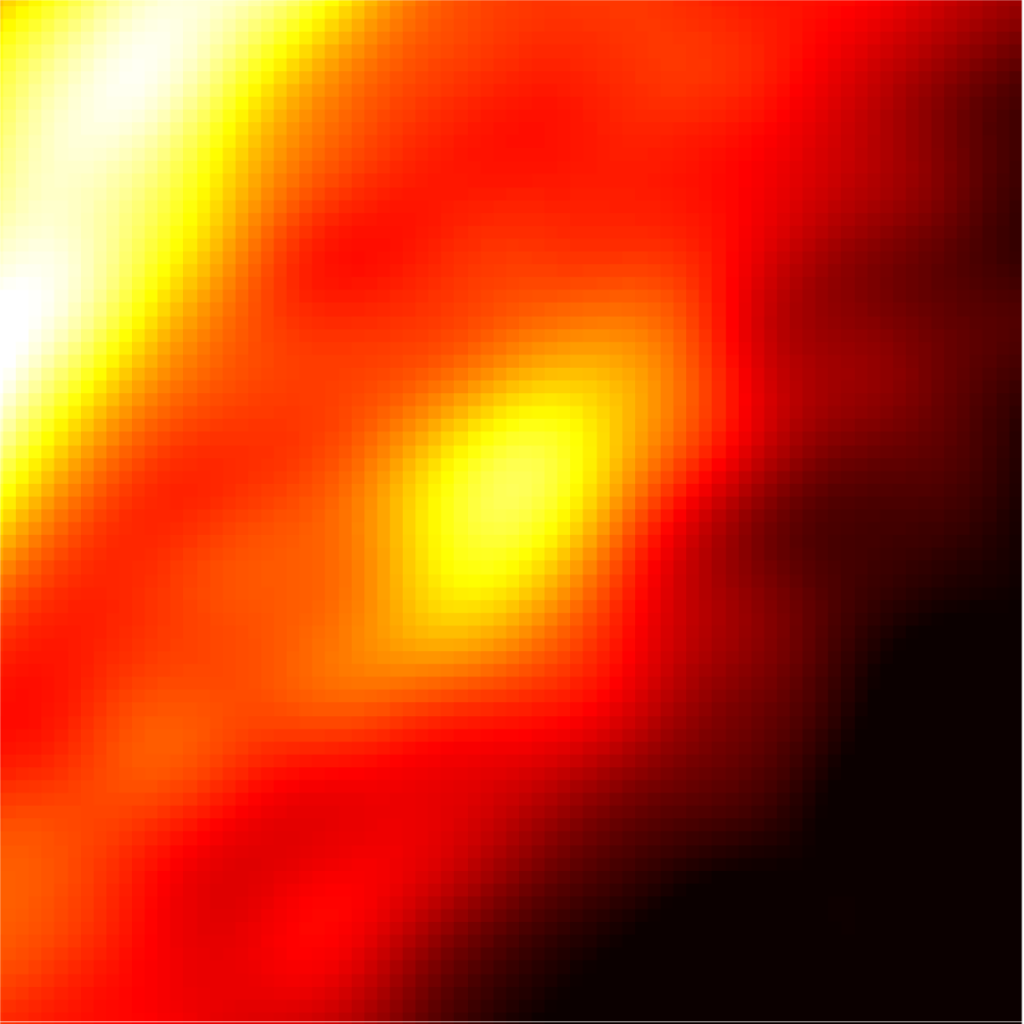
Credit: ALMA (ESO/NAOJ/NRAO), Tsukagoshi et al.
What is the identity of this small radio source? There are two main possibilities.
One possibility is that it is a circumstellar disk. The size of the structure discovered suggests that if it is a periplanetary disk, a Neptune-mass planet has already formed at its center.
In fact, previous observations have shown that a Jupiter-mass planet would not exist at a distance of 52 AU from TW Hydrae. One of the reasons for this is infrared observations. Heavy planets in protoplanetary disks glow brightly in the infrared because they collect gas from the surrounding protoplanetary disks. However, no such infrared point source has been confirmed by previous observations. Another reason is the absence of a gap in the disk 52 AU from the central star. It is thought that a heavy planet would create a gap by exerting gravity on the surrounding protoplanetary disk, but no such structure has been found in previous observations.
Based on the above facts, it is thought that there are no Jupiter-mass heavy planets in this disk, but due to the sensitivity limitations of the observations, nothing could be said yet about whether there are Neptune-mass light planets in the disk. This time, by taking advantage of the high sensitivity and resolution of ALMA, we were able to detect weak radio emissions, and thus clarify the possibility of the existence of a lighter planet.
On the other hand, the observed radio wave strength is a little too strong to be considered a periplanetary disk surrounding a Neptune-sized planet. In addition, the observed radio source was elliptical in shape, whereas a circumplanetary disk would be assumed to be circular with the planet at its center. Therefore, there is a possibility that the radio source is dust accumulated in a small gas vortex. Just as high and low pressure systems occur on Earth, there are thought to be many localized swirling currents in protoplanetary disks, where dust is swept up and collected. This is an important structure for the first stage of dust coalescence into a planet. Theory predicts that the dust trapped in the vortex will spread out in an elliptical shape, which is consistent with the structure of the radio source found by this observation. On the other hand, the presence of only one such small-scale anticyclone in a protoplanetary disk is a bit unnatural.
Thus, there are parts that are consistent with observations and parts that are unnatural in both the “periplanetary disk theory” and the “gas vortex theory,” and we were unable to determine the identity of the source in this research. However, whether it is a circumstellar disk or dust trapped in a vortex, this research is very significant in that it is the first time that we have pinpointed an important part of the planet formation process.
Developments for Future Research
In order to determine the identity of the small radio source discovered in this study, the research group aims to more directly capture signs of a planet in formation. Tsukagoshi explains, “The inner edges of periplanetary disks are particularly warm, as the temperature of forming planets increases as they take in material from their surroundings. We hope to use ALMA to obtain higher resolution observations to determine the temperature distribution inside the radio source discovered this time and to confirm whether there is a planet at the center of the source. We are also preparing to use the Subaru Telescope to observe the light emitted when the hydrogen around the planet becomes hot. He added.
Publication Information:
Note 1: For example, crescent and spiral clusters of dust have been found around the young star MWC 758. (Reference: Research result published on June 21, 2018, “Planet birth site with diverse structures – high-resolution observations of the young star MWC 758”)
Note 2: See the research results published March 31, 2016, “First Observation of the Birth Site of a Planet with an Earth-like Orbit Around a Young Star” and the press release published September 14, 2016, “Captured the Formation Site of a Giant Ice Planet – Evidence of Neptune-sized Planet Formation Found with ALMA Telescope –” and others.
Note 3: 1 AU corresponds to the average distance between the Earth and the Sun, which is about 150 million kilometers. 52 AU corresponds to about 1.7 times the orbital radius of Neptune in the solar system.
Paper and Research Team:
The observational achievements were published in the astronomical journal “The Astrophysical Journal Letters” on June 10, 2019, with the title “Discovery of an au-scale excess in millimeter emission from the protoplanetary disk around TW Hya.”
The research team member involved in this study are as follows:
Takashi Tsukagoshi (National Astronomical Observatory of Japan)
Takayuki Muto (Kogakuin University)
Hideko Nomura (National Astronomical Observatory of Japan / Tokyo Institute of Technology)
Ryohei Kawabe (National Astronomical Observatory of Japan / SOKENDAI / the University of Tokyo)
Kazuhiro Kanagawa (the University of Tokyo)
Satoshi Okuzumi (Tokyo Institute of Technology)
Shigeru Ida (Tokyo Institute of Technology)
Catherine Walsh (University of Leeds)
Tom J. Millar (Queen’s University Belfast)
Sanemichi Takahashi (National Astronomical Observatory of Japan / Kogakuin University)
Jun Hashimoto (Astrobiology Center)
Taichi Uyama (California Institute of Technology / the University of Tokyo / National Astronomical Observatory of Japan)
Motohide Tamura (the University of Tokyo / Astrobiology Center)
This research was supported by the Japan Society for the Promotion of Science Grants-in-Aid for Scientific Research (No. 17K14244, 17H01103, 18H05441, 19K03932) and STFC (ST/P000321/1, ST/R000549/1).
Related Links:
National Astronomical Observatory of Japan Press Release