Abstract:
An international research team led by Livingston, a graduate student at the University of Tokyo, Professor Tamura (the University of Tokyo, Astrobiology Center of National Institutes of Natural Sciences), extremely carefully analyzed raw data (extremely precise measurements of stellar brightness) from the K2 mission (Note 1) by NASA’s Kepler Space Telescope and ESA’s Gaia Space Telescope to select promising exoplanet candidates. They further conducted follow-up imaging and spectroscopic observations of these candidates from ground-based telescopes and newly verified 60 exoplanets. Combined with a previous announcement in August, this team has discovered a total of 104 exoplanets, breaking a new record for the most exoplanet discoveries in Japan. By this report the number of the verified exoplanets by the K2 mission greatly exceeded 300 in total.
This discovery has notable significance, in addition to reporting a large number of exoplanets within a short period of three months, for the bright host stars making detailed follow-up observations of these exoplanets feasibl, for successful discovery of three new “ultra-short period planets” (in total sevel combined with the previous discoveries) with orbital periods less than 24 hours that had been tough to discover, and for increasing the number of multiple planetary systems by 20. Understanding the formation and evolution of these attracting ultra-short period planets is crucial and this discovery of many of nearby, detailed-observable planets is an extremely powerful strength for future expansion of astrobiology in exoplanetary fields.
The research findings, first-authored by Livingston, a graduate student at the University of Tokyo, were published in the Astronomical Journal, a designated astronomy journal in the United States.
Key Points of the Announcement:
- 60 new exoplanets were discovered, totaling 104 exoplanets combined with the previous discoveries, breaking a new record for exoplanet discoveries in Japan.
- Among the discovered exoplanets are ultra-short period planets with orbital periods less than 24 hours and over 20 multiple planetary systems.
- 18 out of the 60 discovered exoplanets are rocky planets smaller than twice the size of Earth.
An international research team including the University of Tokyo and the Astrobiology Center has discovered 60 exoplanets based on observations from NASA’s K2 mission and ESA’s Gaia space telescope. From the K2 data, the team determined the properties and planetary system parameters of these candidate objects by analyzing 155 of them in detail (Figure 1). Due to the brightness of their primary stars, many of these planets are ideal for detailed studies of their compositions and atmospheres. This finding was obtained through precise time-series photometric observations with K2 and precise positional measurements with Gaia, which allowed a much better characterization of the planets and their main stars than previously possible.
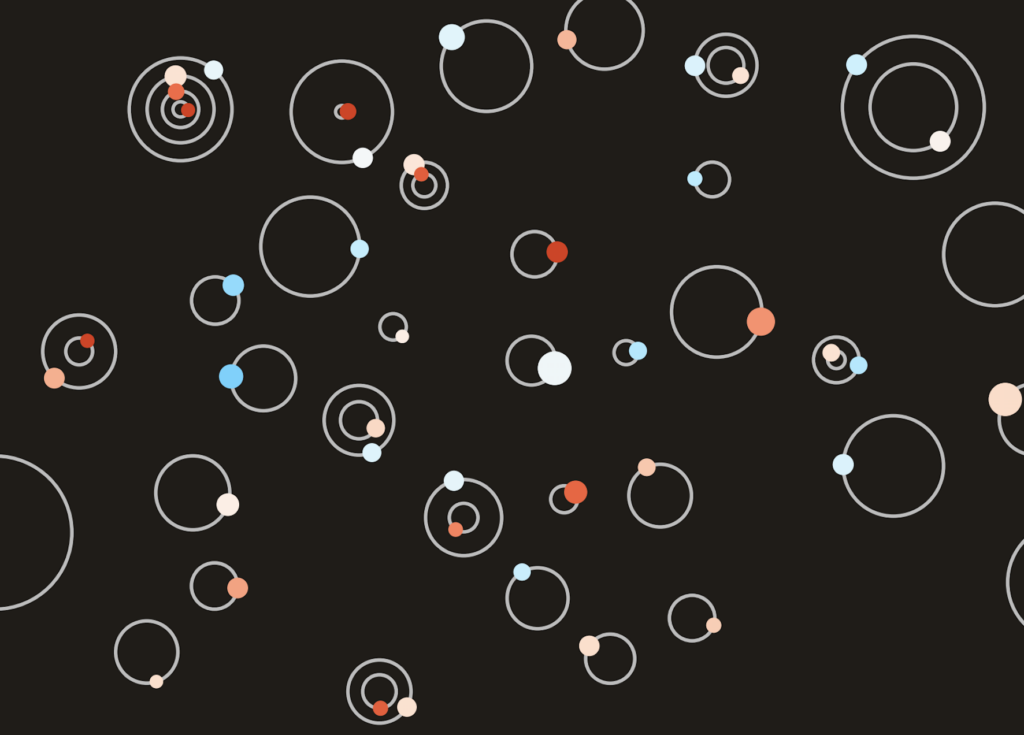
This announcement was made by John Livingston, a graduate student at the University of Tokyo, who reported the discovery of 44 exoplanets in August of this year, and together with the 60 exoplanets reported this time, 104 exoplanets were reported in just two consecutive months. 44 was the most at the time, but 104 significantly broke the record for the most exoplanet discoveries in Japan. This was the largest number of exoplanet discoveries in Japan at the time, and the 104 discoveries significantly broke the record for the most exoplanets discovered in Japan.
The first Kepler space telescope (launched in 2009) was terminated in 2013 when the reaction wheel failed. The K2 mission was then launched, reusing the same space telescope and using a different observation strategy to search for exoplanets. The K2 mission also came to an end on October 30, 2018 due to fuel depletion, but it has discovered numerous exoplanets. Livingston said, “With the additional analysis of 227 candidate objects, we estimate that hundreds of exoplanets are still hidden in the K2 data.”
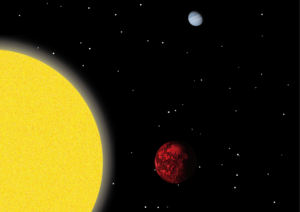
The newly discovered planets include more than 20 multi-planet systems and Ultra-Short Period (USP) planets with a year of less than 24 hours. These ultrashort-period planets have recently begun to attract attention because their formation is shrouded in mystery. Livingston says, “This planetary system provides important clues as to how these ultrashort-period planets formed.” He says. Also of particular importance are the nearby Earth-like small planets that have recently become available for closer examination, “18 of the 60 are less than twice the size of Earth and are likely to be rocky planets with little or no atmosphere,” Livingston says.
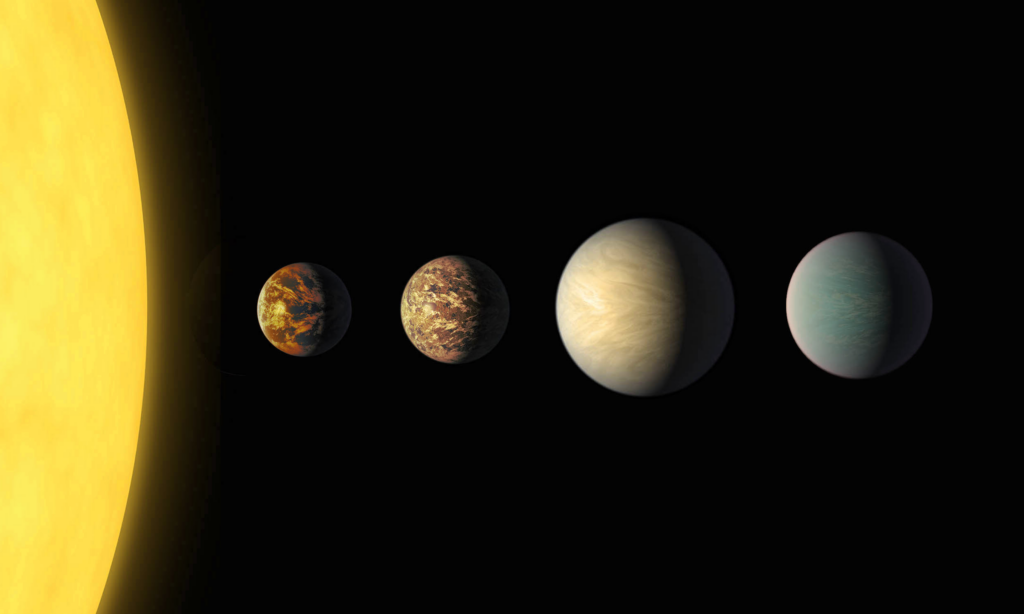
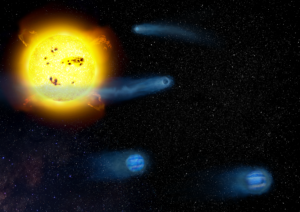
(Credits: NASA/JPL-Caltech/R. Hurt, T. Pyle (IPAC), UTokyo/J. Livingston)
The team further confirmed that 18 of the 227 candidates were false detections due to eclipsing binary stars in transit (Note 3). To confirm this, in addition to the K2 and Gaia data, the team used high-resolution imaging observations using “adaptive optics” (Note 4) to cancel out atmospheric fluctuations and “speckle observations” (Note 5) to superimpose many short-exposure images, and high-dispersion spectroscopic observations (Note 6) to characterize the main stars in detail. Our sharp imaging observations can locate a companion star that is extremely close to the main star, and our high-dispersion spectroscopic observations can find the companion star even if it is hidden by the main star,” said Livingston. Livingston said. Such techniques will play an important role in characterizing new planets, and ongoing research will lead to the discovery of many more planets in the future.
Although the K2 mission has come to an end, its role has been taken over by the TESS mission, launched in April 2018, which has begun reporting on exoplanet discoveries based on TESS data. ‘The future is bright for transit planets,’ Livingston said. ‘We already have TESS, and we have JWST coming up soon. We look forward to many exciting planetary discoveries over the next few years.”
This study was published in the November 26, 2018 issue of The Astronomical Journal.
*December 3: The number of exoplanet candidates and the number of planets with short orbital periods have been revised.
用語解説:
Note 1: the K2 mission of the Kepler Space Telescope
NASA’s Kepler Space Telescope, launched in 2009, has discovered over 5000 exoplanets and candidates within a part of the Cygnus constellation. Due to a malfunction in 2013, however, it was repurposed as the “K2” mission. The objects reported by this telescope are merely planet candidates and confirmation and validation through ground-based observations or other methods are necessary. The K2 mission has verified nearly 300 exoplanets to date, but there is a demand for validating more diverse planets.
Note 2: Gaia Space Telescope
EA space telescope launched by the European Space Agency (ESA) in 2013. The objective is to precisely measure the positions of stars and create a detailed three-dimensional map of our Milky Way.
Note 3 Transit method
When a planet passes in front of a star, the light of the star periodically dims. This method is used to find a planet by observing this change in brightness over a long period of time. It is unlikely that a planet will pass “just in front” of a star, so it is necessary to observe a large number of stars. On the other hand, the larger the planet, the greater the change in brightness. By observing many stars, Kepler was able to find thousands of planets.
Note 4 Compensating Optics
This is a technique to obtain sharp images of stars by canceling atmospheric fluctuations in the instrument.
Note 5 Speckle Observation
This is an observation method to obtain sharp images of stars by acquiring a large number of images with a short exposure time and precisely aligning them during data processing. Together with adaptive optics, it is one of the methods to compensate for atmospheric turbulence.
Note 6: Spectroscopic observation
A method of observing celestial objects by using optical elements such as prisms and diffraction gratings to separate light into various wavelengths in order to precisely study the “color (= wavelength)” of celestial light. It can be used to detect close binary stars that cannot be resolved by imaging observations, and in high-precision observations, it can also be used to detect exoplanets (Doppler method).
Research Group:
University of Tokyo, Center for Astrobiology, National Astronomical Observatory of Japan, etc.
Research Support:
This work was supported by Grant-in-Aid for Scientific Research (18H05442) and Grant-in-Aid for Specially Promoted Research (No. 22000005).
Related Links:
NAOJ Press Release